 Xem Studiomeasured geometry
Library › Stirling engines › Guide ·
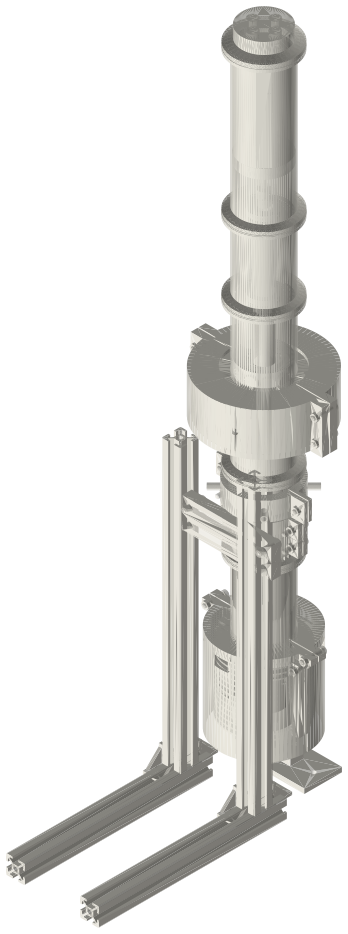
Free-piston Stirling generator, 2 in tri-clamp: performance, dynamics and losses (air and helium, 1 and 10 bar)
How much power does a small free-piston Stirling make at 1 bar and pressurised, in air and helium? · Standard part · basis: My analysis of the 2 in tri-clamp free-piston generator (tools/gen_fpse_gen.py): Urieli & Berchowitz adiabatic + simple analysis, Redlich & Berchowitz linear dynamics, at the drawn geometry and the computed masses
Long Earth Society build part. My numbers for the free-piston generator. The engines
Exact dimensions. True size, with no printing tolerance added.
- sizes
- 4 in table
Notes
- Method. Cycle: the Urieli & Berchowitz ideal-adiabatic model with their simple analysis (gas-to-wall temperature drops in the heater and cooler, regenerator enthalpy loss from its NTU, pumping loss from the friction of the slots and screens; screen correlations of Gedeon & Wood). Motion: Redlich & Berchowitz linear dynamics of the piston and displacer (masses, leaf and gas springs, the working-space pressure coefficients taken from small-amplitude adiabatic runs, the bounce space, the flow damping), solved for the frequency, the displacer's amplitude and phase and the start condition. The stroke is set where the net cycle power equals what the alternator absorbs.
- Assumptions: inside of the heater wall 800 K, cooler wall 300 K; running clearances 15 µm radial (piston land, rod, stinger gland) and 10 µm (gas-spring piston) for the leakage estimates only; wall conductivity 16 W/m·K for conduction; metal parts 7.9 g/cm³, magnets 7.5 g/cm³ for the masses; flexure modulus 200 GPa.
- Design point: helium at 10 bar mean (fill about 9.2 bar at 20 °C, cold), ±5.0 mm piston: 45.1 Hz, displacer ±4.47 mm leading by 68°, pressure swing ±1.60 bar (8.59–11.79 bar).
- Power at the design point: PV 70.3 W, pumping loss 11.3 W, seal and gas-spring leakage 3.06 W, net 55.9 W to the alternator; 43.2 W electrical into 11.5 Ω (31.5 V peak, 2.74 A peak), 12.7 W in the coil.
- Heat: 123 W through the heater, plus 5.4 W regenerator loss, 4.4 W shuttle conduction (Martini), 47.4 W wall conduction: 180 W into the head, 24.0 % to electricity; 53 W to the cooler. With 30–50 % of a burner's heat reaching the head that is 28–47 g of propane per hour.
- Stroke against load (helium 10 bar): ±3.0 mm at 9.2 Ω → 17.3 W; ±4.0 mm at 10.3 Ω → 29.1 W; ±5.0 mm at 11.5 Ω → 43.2 W; ±5.5 mm at 12.1 Ω → 50.9 W. The stroke rises steeply as the load resistance rises: the load is the stroke control.
- Start (helium 10 bar, design load connected, from rest): growth rate -0.1 s⁻¹ at 500 K, +3.3 s⁻¹ at 600 K, +5.4 s⁻¹ at 700 K, +6.8 s⁻¹ at 800 K (positive: the oscillation grows by itself). Air at 1 bar: +0.2 s⁻¹.
- Without the optional heater and cooler inserts (helium 10 bar, ±5 mm): 6.6 W.
- Sensitivity: displacer mass −10 % / +10 %: lead 82° / 54°, 41.4 / 40.7 W: re-tune with the gas-spring column if the built displacer differs.
- Vibration: the piston and displacer are not balanced; the vessel feels about 436 N peak at the running frequency. Bolt the stand to a heavy bench or add a tuned absorber.
- Vessel: relief 15 bar gauge; hoop stress at relief 23.0 MPa (hot spool), 27.5 MPa (bored spool); end load on each joint 4.0 kN.
Sizes
| case | f_Hz | Xp_mm | Xd_mm | lead_deg | swing_bar | PV_W | pumping_W | leak_W | net_W | R_L_ohm | EMF_V_pk | P_e_W | Q_in_W | eff_pct |
|---|---|---|---|---|---|---|---|---|---|---|---|---|---|---|
| helium 10 bar | 45.1 | 5.0 | 4.47 | 68.0 | 1.6 | 70.33 | 11.35 | 3.06 | 55.92 | 11.5 | 40.8 | 43.17 | 180.0 | 24.0 |
| air 10 bar | 42.8 | 5.0 | 3.45 | 57.0 | 1.411 | 42.88 | 7.44 | 1.95 | 33.5 | 19.0 | 38.7 | 28.41 | 132.0 | 21.4 |
| helium 1 bar | 20.5 | 5.0 | 0.43 | 63.0 | 0.174 | 0.23 | 0.07 | 0.02 | 0.14 | 1213.2 | 18.5 | 0.14 | 48.0 | 0.3 |
| air 1 bar | 20.0 | 5.0 | 0.34 | 65.0 | 0.161 | 0.18 | 0.05 | 0.02 | 0.11 | 1436.4 | 18.1 | 0.11 | 48.0 | 0.2 |
Where the files are
Other publishers' files are linked, not hosted. "verify" = check the license at the link before commercial use.
Xem scan
Not needed Published standard; the sheet is the geometry.
Plain text: sheet.txt · JSON: /api/geometry?object=fpse-generator-2in-performance
Fits with
Questions
Does a free-piston Stirling work at this small size?
Yes, if it is pressurised. Power goes with mean pressure × swept volume × frequency; at 1 bar this 48 mm piston gives 0.1 W in air and 0.1 W in helium at ±5 mm, at 10 bar helium 43 W. NASA's Sunpower ASC is the proof of scale: about 80 W from a 1.3 kg convertor on helium.
What charge pressure is needed for useful power?
10 bar helium running (about 9 bar filled cold) gives 43 W at ±5 mm; 1 bar gives a fraction of a watt to a few watts.
What must the clamps and gaskets be rated for?
Above the 15 bar gauge relief setting at their temperature. The high-pressure bolted 2 in clamps are published at 1000 psi (69 bar) at 70–75 °F and 800 psi (55 bar) at 250 °F; the gasket's own rating is the other half.