 Xem Studiomeasured geometry
Library › Stirling engines › Guide ·
NASA and Sunpower free-piston Stirling references (public domain) and design numbers
Where are the NASA free-piston Stirling engine design reports and what are the key numbers? · Hardware · basis: NASA Technical Reports Server (NTRS): US Government works are public domain. Headline numbers from the published convertor papers (ASRG, GPHS-ESP, TDC, RE-1000, Sunpower EE-35 / Microgen); hobby-scale rules from Urieli / Berchowitz
Long Earth Society build part. The reading list behind the LES free-piston test bed. The engines · all LES parts
- sizes
- 5 in table
Notes
- Where the real designs are: NTRS (ntrs.nasa.gov) hosts decades of free-piston Stirling work: the Sunpower RE-1000 test engine (1 kW, 1980s, the best-documented FPSE: dimensions, pressures, strokes, phase angles all published), the Stirling Technology Co. 55 W TDC, the Sunpower ASC/ASRG convertors (80 We class, 102 Hz, helium at 3.5 MPa, 850 °C hot end, flexure suspended, 14+ years on test), Glenn's flexure fatigue and life-test reports, and the thermoacoustic (TASHE) work. Search NTRS for 'free-piston Stirling', 'ASRG', 'RE-1000', 'flexure bearing', 'linear alternator'.
- Representative numbers: RE-1000: 57 mm bore, 1 kW, 30 Hz, 7 MPa helium, displacer on a gas spring, piston on a gas spring + dashpot load. ASC-E2: ~80 We, 102 Hz, 3.5 MPa He, piston stroke ~5 mm, hot end 850 °C, cold 90 °C, 38% convertor efficiency, flexure-suspended displacer and piston. GPHS-ESP / SRG110: 55 We, 80 Hz. Microgen (Sunpower-derived) domestic CHP: 1 kWe, 50 Hz, helium.
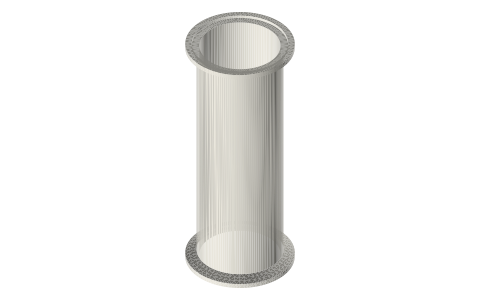
- Why it matters at hobby scale: the same physics scales down (resonance, clearance seals, flexures, linear alternator), only the pressure and frequency drop: air at 1 bar, 10–20 Hz, 0.1–2 W. The parts on this shelf (flexures, alternator kit, free-piston core, regenerator media, tri-clamp vessel) are the hobby-scale translation of the ASRG parts list.
- Open design tools: Urieli's Stirling cycle machine analysis (ideal adiabatic + simple models, free online); Sage (commercial, used by NASA); Berchowitz & Urieli 'Stirling Cycle Engine Analysis' (1984) is the standard text; Walker 'Stirling Engines' (1980); Senft 'An Introduction to Low Temperature Differential Stirling Engines' for the can-engine end.
- Nothing here is NASA's CAD (none is public); the dimensions quoted are from the papers.
Sizes
| machine | power | freq_hz | pressure | hot_c | suspension | ntrs_search |
|---|---|---|---|---|---|---|
| Sunpower RE-1000 | 1 kW | 30 | 7 MPa He | 600 | gas springs | RE-1000 free-piston |
| STC 55 W TDC | 55 We | 80 | 2.5 MPa He | 650 | flexures | Technology Demonstration Convertor |
| Sunpower ASC-E2 (ASRG) | 80 We | 102 | 3.5 MPa He | 850 | flexures | Advanced Stirling Convertor |
| Microgen (Sunpower) | 1 kWe | 50 | He | 500 | flexures | Microgen Stirling |
| LES hobby free-piston | 0.1–2 W | 10–20 | 1 bar air | 150 | printed/steel flexures | — |
Where the files are
Other publishers' files are linked, not hosted. "verify" = check the license at the link before commercial use.
| NASA (NTRS, public domain) | Advanced Stirling Convertor (ASC) development (2010) | US Government work, public domain | |
| NASA (NTRS, public domain) | RE-1000 free-piston Stirling engine sensitivity test results (1986) | US Government work, public domain | |
| NASA (NTRS, public domain) | Stirling convertor flexure fatigue testing (2008) | US Government work, public domain | |
| NASA (NTRS, public domain) | Thermoacoustic Stirling heat engine (TASHE) for space power (2004) | US Government work, public domain | |
| Wikipedia | Advanced Stirling radioisotope generator | web | CC BY-SA 4.0 (text) |
| Wikipedia | Stirling radioisotope generator | web | CC BY-SA 4.0 (text) |
| Long Earth Society | Engine builds | web, video | LES site |
Xem scan
Not needed Published standard; the sheet is the geometry.
Plain text: sheet.txt · JSON: /api/geometry?object=nasa-fpse-references
Fits with
Questions
Are NASA's Stirling engine designs public?
The reports are (US Government work, public domain, on NTRS): dimensions, operating points, test data and analysis for RE-1000, TDC, ASC/ASRG. The CAD and the Sunpower-proprietary details are not.
What frequency and pressure do NASA Stirling convertors run at?
ASC/ASRG: about 102 Hz on helium at 3.5 MPa with an 850 °C hot end; RE-1000: 30 Hz at 7 MPa; the 55 W TDC: 80 Hz at 2.5 MPa.
Can I build a free-piston Stirling engine at home?
Yes at air pressure and 10–20 Hz: the physics is the same, the output is 0.1–2 W. The hard parts are the clearance seal (lap or use glass/graphite) and tuning the two resonances; everything else is on this shelf.