 Xem Studiomeasured geometry
Library › Stirling engines › Free-piston ·
Tri-clamp piston plug: tube-rod socket for the -rod piston, 1.5, 2 and 3 in
How do I connect a tri-clamp piston to a flexure bearing? · Hardware · basis: Disc Ø = piston skirt bore (bore − 3.2: 31.6 / 44.3 / 69.7); legs pinned at the wrist-pin height 17.6 / 23.5 / 37.0; Ø5 × 15 tube socket; Ø3.4 rod passage
Long Earth Society build part. The connecting parts of the tri-clamp free-piston engine. The engines
Exact dimensions. Every file is drawn at true size with no printing tolerance. The holes and pins that meet another part are listed below under Mating features, with the fit each joint needs; open those by your printer's or process's clearance before making the part. Mating features
- sizes
- 3 in table
Notes
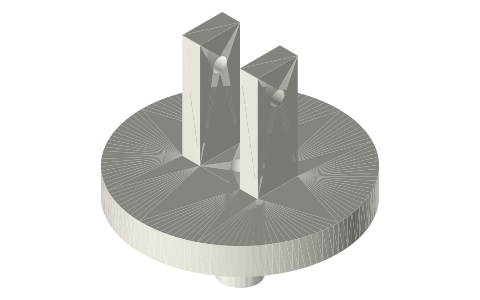
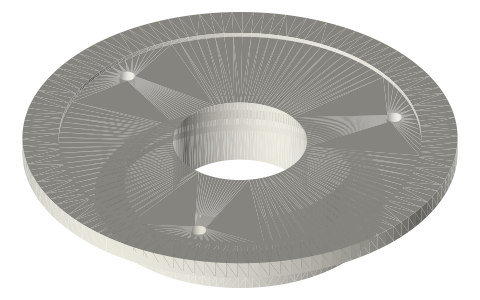
- The plug that turns a -rod power piston into a free piston on a tube rod: it drops into the open skirt and is held by the two Ø3 wrist dowels through its legs.
- Disc Ø31.6 / Ø44.3 / Ø69.7 × 6 mm (the piston skirt bore, exact), two 4 × 9 legs up to the wrist-pin height with Ø3 pin holes at 17.6 / 23.5 / 37.0 mm.
- Below the disc: an Ø8 × 15 stub with a Ø5 × 15 socket for the 5 mm tube piston rod. A Ø3.4 passage runs through on centre so the Ø3 displacer rod clears it (the rod runs in the piston crown, not here).
- Overall height 38.6 / 44.5 / 58.0 mm.
Sizes
| spool_in | disc_od_mm | pin_z_mm | tube_socket_mm | rod_passage_mm | overall_h_mm |
|---|---|---|---|---|---|
| 1.5 | 31.6 | 17.6 | Ø5 × 15 | 3.4 | 38.6 |
| 2 | 44.3 | 23.5 | Ø5 × 15 | 3.4 | 44.5 |
| 3 | 69.7 | 37.0 | Ø5 × 15 | 3.4 | 58.0 |
Mating features
Drawn at the exact size. Open press, slide, run and socket features by your process's clearance; leave designed gaps and clamp fits as drawn.
| feature | exact | mates with | fit | files |
|---|---|---|---|---|
| piston plug disc in the skirt | piston skirt bore (bore − 3.4) | piston skirt | slide | fp-piston-plug-* |
| plug wrist-pin holes | Ø3 | Ø3 pins | press | fp-piston-plug-* |
| plug tube socket | Ø5 × 15 | 5 mm tube | press | fp-piston-plug-* |
| plug rod passage | Ø3.4 | Ø3 rod (no contact) | designed | fp-piston-plug-* |
Where the files are
Other publishers' files are linked, not hosted. "verify" = check the license at the link before commercial use.
| NASA NTRS | Free-piston Stirling convertor flexure bearing development and life testing | US Government work | |
| Long Earth Society | Tri-clamp Stirling engine builds | web, video | LES site |
| Wikipedia | Free-piston engine | web | CC BY-SA 4.0 (text) |
Free files
★ Free files 3 parts. Generated by Xem Studio from the standard; threads are plain cylinders at major diameter. CC BY 4.0. index.json
| fp-piston-plug-1.5in | 1.5 in piston plug: drops into the open skirt, two Ø3 × 16 wrist dowels through its legs at 17.6 mm retain it, Ø5 tube socket 15 deep, Ø3.4 clearance for the displacer rod (it runs in the piston's Ø3 crown bore, not here) | STEP · STL |
| fp-piston-plug-2in | 2 in piston plug: drops into the open skirt, two Ø3 × 16 wrist dowels through its legs at 23.5 mm retain it, Ø5 tube socket 15 deep, Ø3.4 clearance for the displacer rod (it runs in the piston's Ø3 crown bore, not here) | STEP · STL |
| fp-piston-plug-3in | 3 in piston plug: drops into the open skirt, two Ø3 × 16 wrist dowels through its legs at 37.0 mm retain it, Ø5 tube socket 15 deep, Ø3.4 clearance for the displacer rod (it runs in the piston's Ø3 crown bore, not here) | STEP · STL |
Plain text: sheet.txt · JSON: /api/geometry?object=tri-clamp-piston-plug
How it fits
Goes in or on
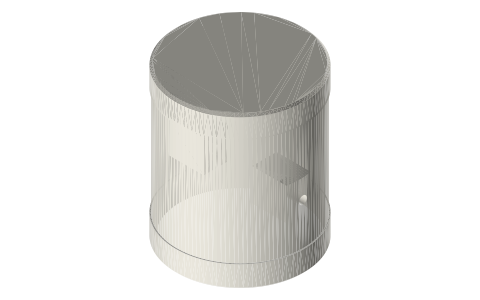 Tri-clamp power pistondisc in the -rod piston's skirt, on the Ø3 wrist dowels
Connects to
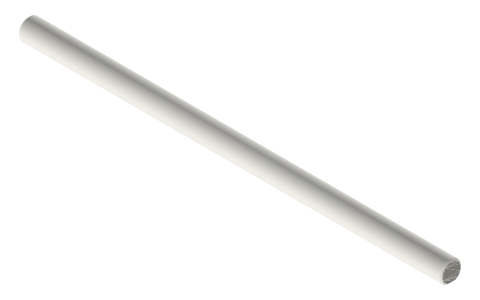 Crankshafts Ø3, Ø5 and Ø8 with full-length D-flat5 mm tube rod in the Ø5 × 15 socket
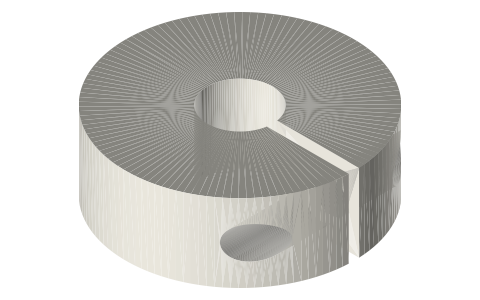 Flexure hub collarsb5 collars on the same tube
Also needed
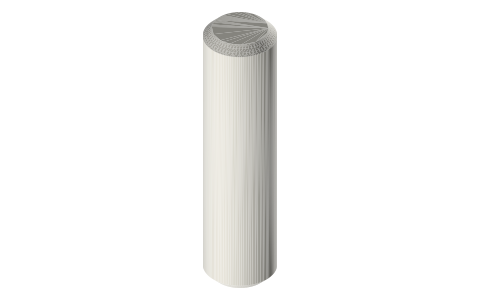 Dowel pins, 2–6 mmtwo Ø3 × 16 wrist dowels
In these build lists
Beta Stirling, rhombic drive, 2 in tri-clampDisplacer and piston in one bore, driven by two counter-rotating gears on a rhom…Free-piston Stirling, 2 in tri-clampNo crank: piston and displacer each hang on a stack of spiral flexures, with a t…You might also need
Questions
How does the piston connect to a flexure bearing?
Through the piston plug: it sits in the skirt on the wrist dowels and its Ø5 socket takes the 5 mm tube; the flexure hubs clamp on that tube.
How does the displacer rod get past the piston plug?
Through a Ø3.4 passage on centre: the Ø3 rod clears the plug and runs on up inside the tube rod.