 Xem Studiomeasured geometry
Library › Hardware › Sanitary clamp fittings ·
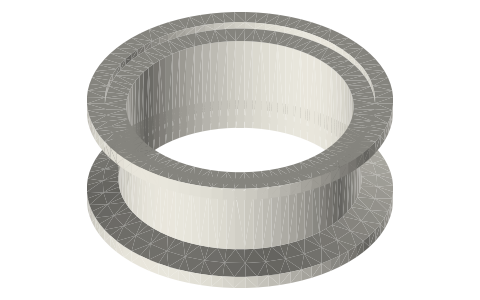
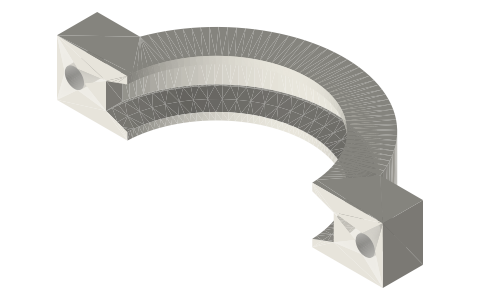
Tri-clamp thermal-break spacer, 2 in × 25.4 mm: an insulating section with its own two clamp faces
How do I put a thermal break between two tri-clamp sections? · Hardware · basis: Design values; faces from the shared ISO 2852 ferrule profile (gen_hardware.tc_spool); conduction estimates are mine (assumptions stated)
Long Earth Society build part. The optional thermal break of my modular thermoacoustic engine. The engines
Exact dimensions. Every file is drawn at true size with no printing tolerance. The holes and pins that meet another part are listed below under Mating features, with the fit each joint needs; open those by your printer's or process's clearance before making the part. Mating features
- sizes
- 1 in table
Notes
- Two clamp faces on one short insulating body: clamp it between a warm section and a part that must stay cool (an alternator, a seal, magnets). Each face has its own gasket and clamp, so the heat path through it is only its own wall.
- Why not a ring in one joint: every tri-clamp joint already has a gasket between the faces, and the metal path across a joint is the clamp itself, which grips both rims on their 20° cones. A thin insulating ring in a joint adds little; the clamp still bridges it. With the spacer, the two clamps never touch each other.
- Where it goes: only where the temperature suits what it is made of. On my modular thermoacoustic engine it can only sit at the cold joint (above the ambient exchanger, at the cooling water's temperature); the hot joint runs at about 550 °C, which an insulating ring rated to about 260 °C cannot take.
- What it costs there: its bore adds 27.1 mm of cold gas between the stack and the piston, which lowers the pressure swing per stroke: 4.4 W against 10.2 W at the design point (model). So it is optional on that engine.
- Pressure: at a 15 bar gauge relief the hoop stress in a 1.65 wall would be 23 MPa; the builder checks that against what it is made of, at its temperature, and may leave it at 1 bar.
Sizes
| part | face_to_face_mm | bore_mm | outside between faces_mm | joints | clamps |
|---|---|---|---|---|---|
| break-spacer-2in-25.4 | 25.4 | 47.5 | 50.8 | 2 | 2 |
Mating features
Drawn at the exact size. Open press, slide, run and socket features by your process's clearance; leave designed gaps and clamp fits as drawn.
| feature | exact | mates with | fit | files |
|---|---|---|---|---|
| faces | ISO 2852 2 in, both ends (land Ø56.5–Ø64, rim 2.85, 1.6 recess, 20° back) | Type B gasket + clamp at each face (two clamps, not touching) | clamp | all |
| bore | Ø47.5 | gas passage (no contact) | designed | all |
| outside between the faces | Ø50.8 | clamp room (no contact) | designed | all |
Where the files are
Other publishers' files are linked, not hosted. "verify" = check the license at the link before commercial use.
| ISO (via iTeh sample) | ISO 2852 clamp liners: face profile and flange / groove diameters | standard excerpt; dimensions are facts | |
| ASME | BPE Bioprocessing Equipment (tube OD and wall, clamp fittings) | standard | ASME; dimensions are facts verify |
| Xem Studio | tools/gen_ta_modular.py: the section geometry, the network model and every number on these pages | code | CC BY 4.0 |
| Long Earth Society | Engine builds | web, video | LES site |
Free files
★ Free files 1 parts. Generated by Xem Studio from the standard; threads are plain cylinders at major diameter. CC BY 4.0. index.json
| break-spacer-2in-25.4 | 2 in × 25.4 mm thermal-break spacer: ISO 2852 faces both ends (the standard ferrule profile), Ø47.5 bore, Ø50.8 between the faces; two clamps, one on each face, so no clamp bridges it | STEP · STL |
Plain text: sheet.txt · JSON: /api/geometry?object=tri-clamp-thermal-break-spacer
How it fits
In these build lists
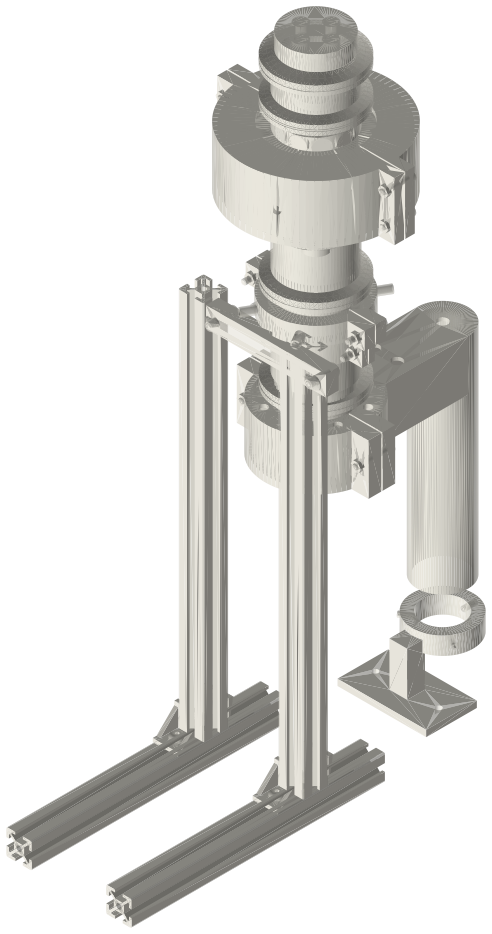
Modular free-piston thermoacoustic engine, 2 in…A standing-wave thermoacoustic engine built from 2 in sanitary sections like Leg…You might also need
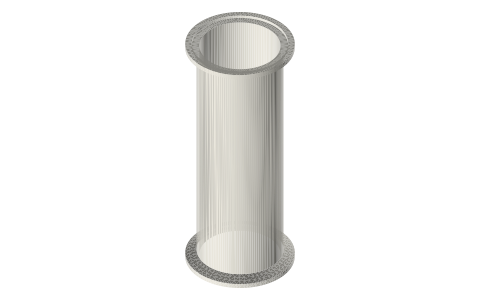
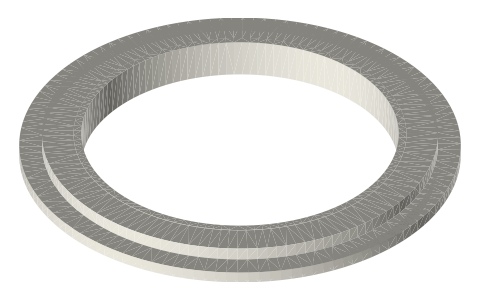
Questions
Can it be the hot joint's ring?
Not on the modular engine: the hot joint runs at about 550 °C; the break goes where its rating allows, the cold joint.
Does it seal like a spool?
Yes: the faces are the standard ISO 2852 profile, with a Type B gasket and a clamp at each.