 Xem Studiomeasured geometry
Library › Hardware › Found & household materials ·
Balloons, gloves, inner tubes and silicone sheet as diaphragms
What is the best diaphragm material for a Stirling engine? · Standard part · basis: Measured thicknesses of common latex and silicone sheet sources; stretch limits from material data
Long Earth Society build part. The power diaphragm on the classic can engine. The engines · all LES parts
- sizes
- 5 in table
Notes
- Party balloon (latex, 12 in): 0.15–0.25 mm wall, stretches 600%; cut the neck off and use the flat 'equator' zone. Nitrile glove: 0.10 mm (palm), low stretch, best for low-pressure diaphragms under Ø40. Bicycle inner tube (butyl): 0.9–1.1 mm, stiff, fine for Ø80+ with 5 mm travel. Silicone sheet: 0.25 / 0.5 / 1.0 mm, survives 230 °C, the only one for a hot-side diaphragm.
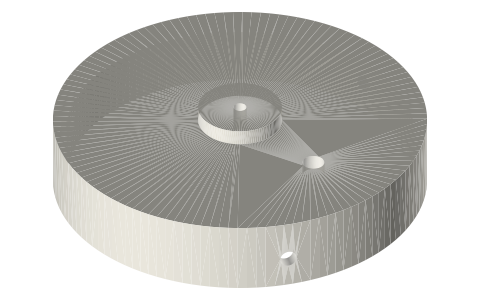
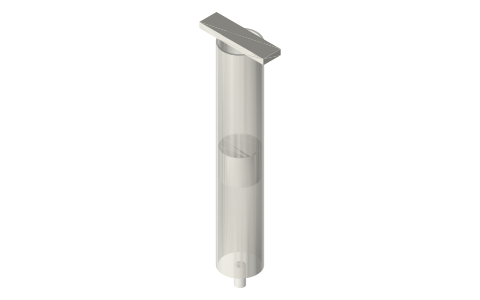
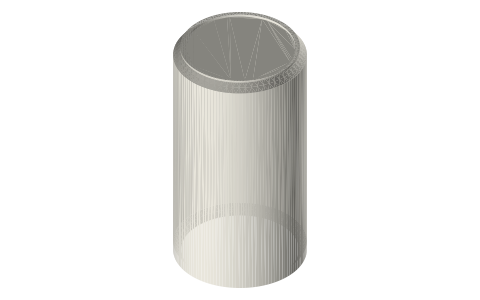
- Sizing: a diaphragm's effective area is about the mean of the clamp bore and the centre disc; for the 12 oz can engine (Ø66 can, 10 mL syringe swept 2 mL) a Ø50 clamp bore with a Ø25 centre disc and 3 mm of travel gives about 4.4 cm² × 0.3 cm = 1.3 mL per direction. The clamp rings in the can-engine kit are Ø40, Ø50 and Ø60 bore.
- Clamp the sheet flat and slack (not pre-stretched) between two printed rings on six M3 screws; a smear of silicone grease on the lower ring seals it. Balloon rubber dies in sunlight in a few weeks; silicone lasts years.
Sizes
| material | thickness_mm | max_temp_c | stretch | use |
|---|---|---|---|---|
| 12 in latex balloon | 0.15–0.25 | 60 | 600% | cold-side diaphragm, Ø30–60 |
| nitrile glove | 0.1 | 80 | 300% | small low-pressure diaphragm |
| bicycle inner tube (butyl) | 0.9–1.1 | 100 | 200% | large diaphragm, long travel |
| silicone sheet | 0.25 / 0.5 / 1.0 | 230 | 400% | hot-side or long-life diaphragm |
| PE film (freezer bag) | 0.05 | 70 | low | displacer-rod seal only |
Where the files are
Other publishers' files are linked, not hosted. "verify" = check the license at the link before commercial use.
| Wikipedia | Diaphragm (mechanical device) | web | CC BY-SA 4.0 (text) |
| Wikipedia | Toy balloon | web | CC BY-SA 4.0 (text) |
| Long Earth Society | Engine builds (videos and write-ups) | web, video | LES site |
Xem scan
Not needed Published standard; the sheet is the geometry.
Plain text: sheet.txt · JSON: /api/geometry?object=balloons-and-diaphragms
Fits with
Questions
What can I use as a Stirling engine diaphragm?
A latex balloon for the classic cold-side can engine, silicone sheet (0.5 mm) for anything hot or long-lived, nitrile glove for tiny engines, inner tube for big slow ones.
How thick is a balloon?
0.15–0.25 mm uninflated at the equator; it thins to under 0.1 mm inflated. Use it flat and slack.
What size diaphragm for a soda can Stirling?
Ø50 mm clamp bore with a Ø25 centre disc moves about 1.3 mL over 3 mm of travel, matched to a 12 oz can displacer.