 Xem Studiomeasured geometry
Library › Mechanisms › Gears ·
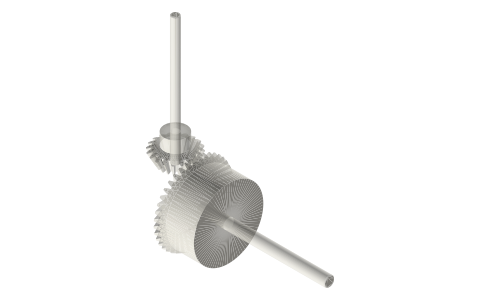
Bevel gears, module 1.5, 20 : 40, shafts at 90°
How do bevel gears turn motion through an angle? · Hardware · basis: Xem Studio design following Brown No. 25 (1868)
Also called: bevel gears, bevel gear pair, mitre gears, right angle gears, conical gears, engranajes cónicos, Kegelradgetriebe
Exact dimensions. True size, with no printing tolerance added.
- sizes
- 6 in table
Notes
- Two cone-shaped gears whose pitch cones share an apex roll on each other like friction cones: the shafts meet at the apex at any angle (90° here) and the ratio is the tooth ratio, 40 : 20 = 2 : 1. Equal gears at 90° are mitre gears.
- Pitch cone angles from tan δ₁ = sin Σ / (N₂/N₁ + cos Σ): 26.57° and 63.43°; cone distance 33.54 mm, face 11.2 mm. The teeth are exact spherical involutes, generated on a sphere about the apex, so the mesh is conjugate at every position; drawn turned 4°.
- Brown's No. 25 (bevel gears for shafts at an angle; mitre gears when the two are equal).
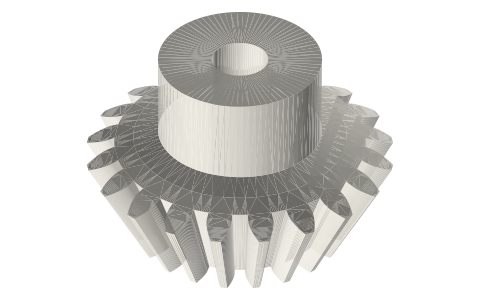
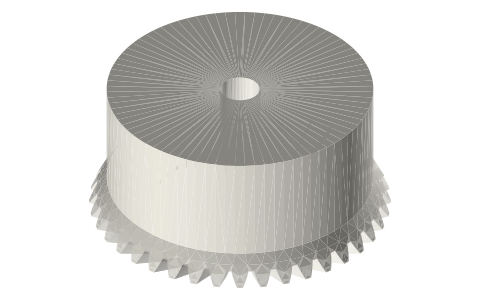
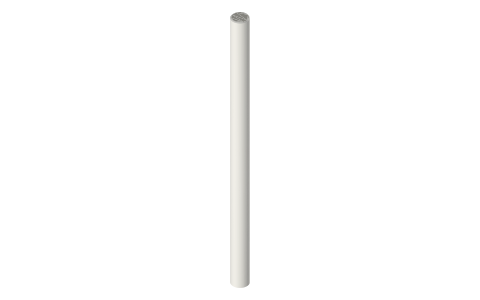
- Parts (each has its own page): bevel-gear-m1-5-20t-for-40t-90deg, bevel-gear-m1-5-40t-for-20t-90deg, linear-shafts-h6.
- Brown's movement No. 25 (1868) shows it; this model is a Xem Studio design following his figure, every part at true size.
Bevel gears, module 1.5, 20 : 40, shafts at 90° size chart
| parameter | value |
|---|---|
| module (large end) | 1.5 |
| teeth | 20 / 40 |
| ratio | 2 : 1 |
| shaft angle | 90° |
| pitch cones | 26.57° / 63.43° |
| cone distance | 33.54 mm |
Where the files are
Other publishers' files are linked, not hosted. "verify" = check the license at the link before commercial use.
| Henry T. Brown (1868, public domain) | Five Hundred and Seven Mechanical Movements — scan on archive.org | web | Publisher's page; dimensions are facts |
| 507movements.com | Brown's movement No. 25: figure, his text and an animation | web | Publisher's page; dimensions are facts |
Free files
★ Free files 1 parts. Xem Studio design: free to use, print and sell things from; not to be republished as files. Xem Studio Design License. index.json
| bevel-gears-mechanism-assembly | Assembled mechanism, all parts placed at one pose (STEP keeps each part separate) | STEP · STL |
https://xemstudio.com/mcp to Claude, ChatGPT, Cursor or any MCP client (free, no account, one minute) and it can look up exact sizes, mating fits and free STEP/STL from every chat.Plain text: sheet.txt · JSON: /api/geometry?object=bevel-gears-mechanism
Fits with
Questions
How do bevel gears turn motion through an angle?
Two cone-shaped gears whose pitch cones share an apex roll on each other like friction cones: the shafts meet at the apex at any angle (90° here) and the ratio is the tooth ratio, 40 : 20 = 2 : 1. Equal gears at 90° are mitre gears.
What is the pitch cone angle of a 20 and 40 tooth bevel pair at 90°?
tan δ = 20/40: 26.57° for the pinion and 63.43° for the wheel.
Why are bevel teeth spherical involutes?
Every point of a bevel gear moves on a sphere about the apex; the tooth shape that rolls conjugately on that sphere is the spherical involute (Tredgold's back-cone method approximates it).