 Xem Studiomeasured geometry
Library › Mechanisms › Gears ·
Fast and loose pulleys with bevel gears: start, stop or reverse an upright shaft
How do fast and loose pulleys reverse a shaft through bevel gears? · Hardware · basis: Xem Studio design following Brown No. 7 (1868)
Also called: reversing gear, bevel reversing gear, fast and loose pulleys, mitre gear reverse, inversor con engranajes cónicos y poleas, Wendegetriebe mit Kegelrädern und Riemen
Exact dimensions. True size, with no printing tolerance added.
- sizes
- 4 in table
Notes
- Resize: multiply every length by one factor k and the motion stays identical: angles, ratios, timing and the formulas below do not change, because a mechanism's motion depends only on the ratios of its lengths. Here, scales with k: pulleys, driving pulley; stays the same: gears; step to the nearest standard size (and redraw the hole or pocket it fits): upright shaft.
- Resize: Gears scale by the module m (pitch Ø = m·z, centre distance = m·(z₁ + z₂)/2): keep the tooth counts so the ratio stays, and choose a standard module (0.5, 0.8, 1, 1.25, 1.5, 2, 2.5, 3).
- Resize: fit clearances stay in mm (a slide fit is the same gap at any size); keep every printed wall and pin at least two nozzle widths; mass grows with k³ but part strength only with k², so at k = 2 parts are about 8× heavier and 4× stronger: check pins and thin links when scaling up.
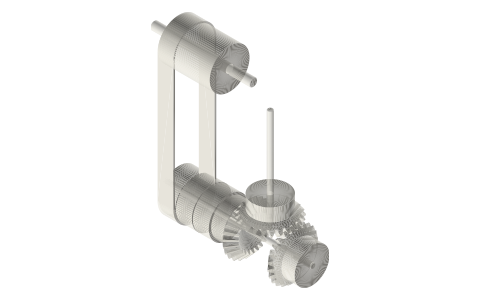
- Two mitre gears face each other on a cross shaft and both mesh with a third on the upright shaft. One (A) is keyed to the cross shaft, which carries the fast pulley; the other (B) runs loose with its own pulley; between them is a loose idler pulley.
- Belt on the fast pulley: the shaft turns gear A and the upright shaft turns one way. Belt on B's pulley: gear B, on the other side of the upright gear, turns it the other way. Belt on the idler: it stops. The belt is shifted sideways along the wide driving pulley. Brown draws the two bevels on a shaft and a hollow shaft one inside the other; here B simply runs loose on the one shaft.
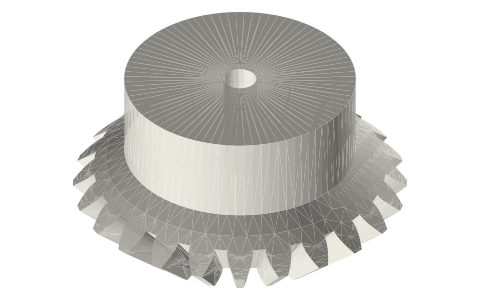
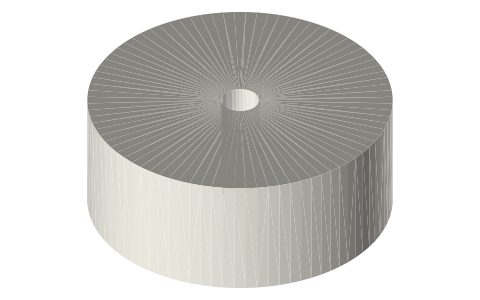
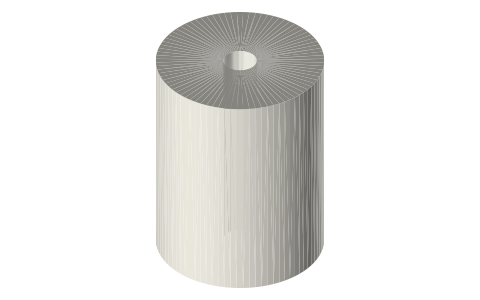
- Three module 2, 24-tooth spherical-involute mitre gears (cone distance 33.94 mm), Ø40 × 16 pulleys on a Ø5 shaft; the three gears were checked in mesh at six angles. Brown's No. 7.
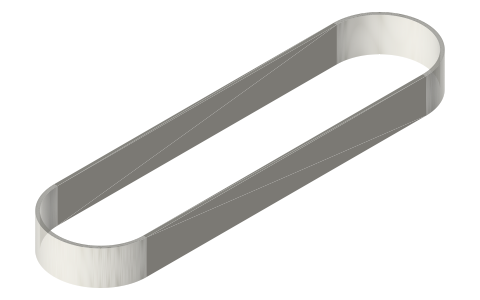
- Parts (each has its own page): mitre-gear-m2-24t-bore5, plain-flat-pulley-40x16-bore5, plain-flat-pulley-40x52, flat-belt-16x1-5-pulleys-40-40-c130, linear-shafts-h6.
- Brown's movement No. 7 (1868) shows it; this model is a Xem Studio design following his figure, every part at true size.
Fast and loose pulleys with bevel gears: start, stop or reverse an… size chart
| parameter | value |
|---|---|
| gears | 3 × mitre, module 2, 24 T |
| pulleys | 3 × Ø40 × 16 (fast, idle, loose) |
| driving pulley | Ø40 × 52, 130 mm above |
| upright shaft | same speed, either direction |
Where the files are
Other publishers' files are linked, not hosted. "verify" = check the license at the link before commercial use.
| Henry T. Brown (1868, public domain) | Five Hundred and Seven Mechanical Movements — scan on archive.org | web | Publisher's page; dimensions are facts |
| 507movements.com | Brown's movement No. 7: figure, his text and an animation | web | Publisher's page; dimensions are facts |
Free files
★ Free files 1 parts. Xem Studio design: free to use, print and sell things from; not to be republished as files. Xem Studio Design License. index.json
| bevel-reversing-gear-fast-loose-pulleys-mechanism-assembly | Assembled mechanism, all parts placed at one pose (STEP keeps each part separate) | STEP · STL |
https://xemstudio.com/mcp to Claude, ChatGPT, Cursor or any MCP client (free, no account, one minute) and it can look up exact sizes, mating fits and free STEP/STL from every chat.Plain text: sheet.txt · JSON: /api/geometry?object=bevel-reversing-gear-fast-loose-pulleys-mechanism
Fits with
Questions
How do fast and loose pulleys reverse a shaft through bevel gears?
Two mitre gears face each other on a cross shaft and both mesh with a third on the upright shaft. One (A) is keyed to the cross shaft, which carries the fast pulley; the other (B) runs loose with its own pulley; between them is a loose idler pulley.