 Xem Studiomeasured geometry
Library › Mechanisms › Intermittent motion ·
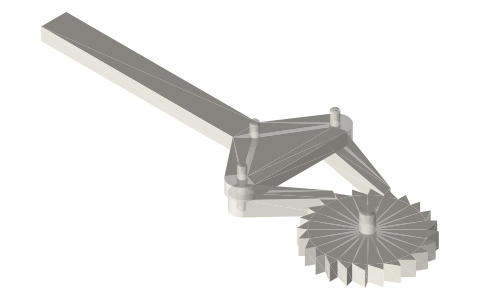
Lever with two pawls driving a ratchet on both strokes
How can a lever drive a ratchet on both its strokes? · Hardware · basis: Xem Studio design following Brown No. 206 (1868)
Also called: double pawl ratchet, two pawl lever, continuous ratchet drive, palanca de dos trinquetes, Doppelklinkenschaltwerk
Exact dimensions. True size, with no printing tolerance added.
- sizes
- 3 in table
Notes
- A lever rocks on a fulcrum beside the ratchet wheel and carries two pawls, pinned one above and one below the fulcrum. Swinging the handle one way, the upper pawl pivot moves toward the wheel and its pawl pushes a tooth; swinging it back, the lower pivot moves toward the wheel and the lower pawl pushes another tooth, while the first slides back over the teeth. The wheel is driven the same way on both strokes, so the motion is nearly continuous.
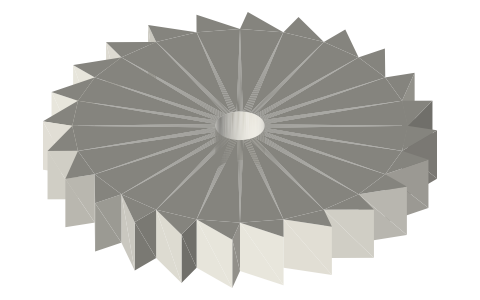
- Catalog Ø40, 24-tooth ratchet; both pawls drawn with their end faces lying on the steep faces of two teeth (face contact, no overlap) at the same instant.
- Brown's No. 206 (lever with rising and falling pawls giving a nearly continuous rotary motion to a ratchet wheel).
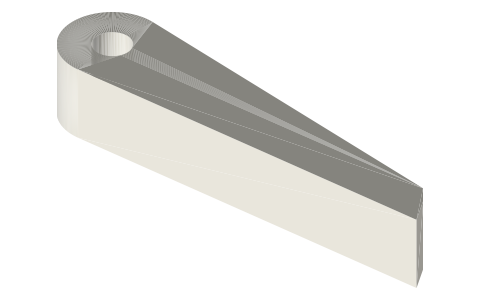
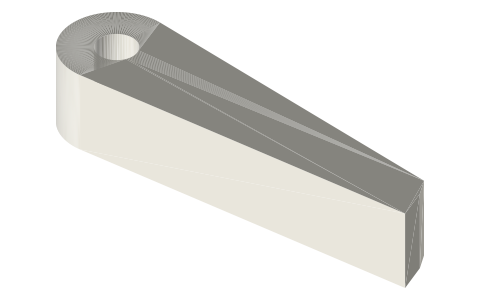
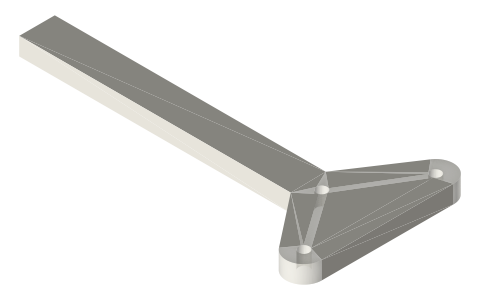
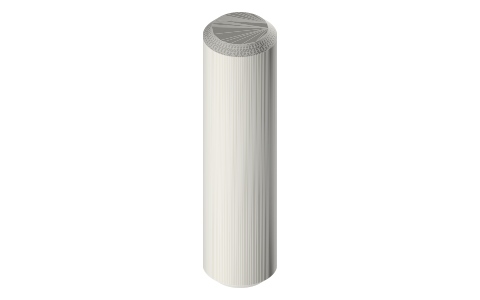
- Parts (each has its own page): ratchet-and-pawl, lever-pawl-24t-d40-upper, lever-pawl-24t-d40-lower, double-pawl-lever-fulcrum-handle-80, dowel-pins-metric.
- Brown's movement No. 206 (1868) shows it; this model is a Xem Studio design following his figure, every part at true size.
Lever with two pawls driving a ratchet on both strokes size chart
| parameter | value |
|---|---|
| ratchet | 24 T, Ø40 |
| pawls | 2, face contact |
| drive | both strokes, same direction |
Where the files are
Other publishers' files are linked, not hosted. "verify" = check the license at the link before commercial use.
| Henry T. Brown (1868, public domain) | Five Hundred and Seven Mechanical Movements — scan on archive.org | web | Publisher's page; dimensions are facts |
| 507movements.com | Brown's movement No. 206: figure, his text and an animation | web | Publisher's page; dimensions are facts |
Free files
★ Free files 1 parts. Xem Studio design: free to use, print and sell things from; not to be republished as files. Xem Studio Design License. index.json
| double-pawl-lever-ratchet-mechanism-assembly | Assembled mechanism, all parts placed at one pose (STEP keeps each part separate) | STEP · STL |
https://xemstudio.com/mcp to Claude, ChatGPT, Cursor or any MCP client (free, no account, one minute) and it can look up exact sizes, mating fits and free STEP/STL from every chat.Plain text: sheet.txt · JSON: /api/geometry?object=double-pawl-lever-ratchet-mechanism
Fits with
Questions
How can a lever drive a ratchet on both its strokes?
A lever rocks on a fulcrum beside the ratchet wheel and carries two pawls, pinned one above and one below the fulcrum. Swinging the handle one way, the upper pawl pivot moves toward the wheel and its pawl pushes a tooth; swinging it back, the lower pivot moves toward the wheel and the lower pawl pushes another tooth, while the first slides back over the teeth. The wheel is driven the same way on both strokes, so the motion is nearly continuous.