 Xem Studiomeasured geometry
Library › Airfoils › NACA 4-digit ·
NACA 0015 airfoil
What is the exact shape of the NACA 0015 airfoil, and what do the digits mean? · Standard part · basis: Computed from the NACA equations (Report 460 / Report 610, restated in NASA TM-4741)
Also called: NACA 0015, NACA 0015 coordinates, NACA 0015 dat, NACA 0015 profile, NACA 0015 DXF, NACA 0015 STEP, NACA 0015 STL, perfil NACA 0015, Profil NACA 0015, naca0015, NACA 0015 wing section, 15 percent symmetric airfoil, thick symmetric airfoil, 3d plane airfoil
Exact dimensions. True size, with no printing tolerance added.
- length
- 100.0 mm
- width
- 20.0 mm
- height
- 15.0 mm
Notes
- NACA 0015 is a 15% thick symmetric 4-digit section (NASA TM-4741 designation). Like all symmetric sections it has zero lift at zero angle and zero moment about the a.c. (Virginia Tech Appendix A).
- Thicker sections give a deeper spar and gentler stall; NACA data on the 2415 vs 2412 show thickening from 12% to 15% slightly increases drag and slightly lowers CLmax (Virginia Tech Appendix A).
- NACA 4-digit sections have good stall behaviour, small centre-of-pressure movement and low roughness sensitivity, but a low CLmax, relatively high drag and high pitching moment (Aerospaceweb summary).
- NACA 0015: symmetric, 15 % thick.
- NACA 4-digit: first digit = maximum camber in % of chord, second = its position in tenths of chord, last two = maximum thickness in % of chord (NACA Report 460).
- Ordinates are in % of chord from the leading edge, computed from the published equations with the closed-trailing-edge thickness coefficient (−0.1036, as in NASA TM-4741). The original reports use an open trailing edge (−0.1015); the difference is under 0.03 % of chord near the trailing edge.
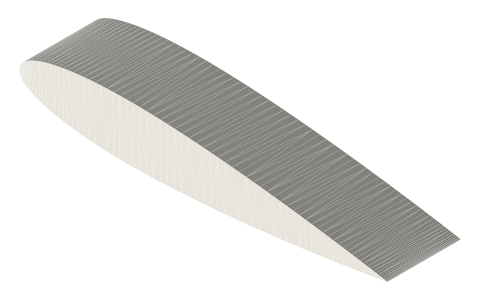
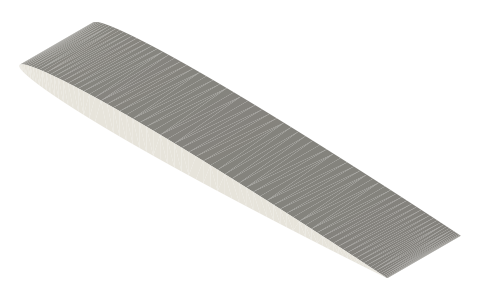
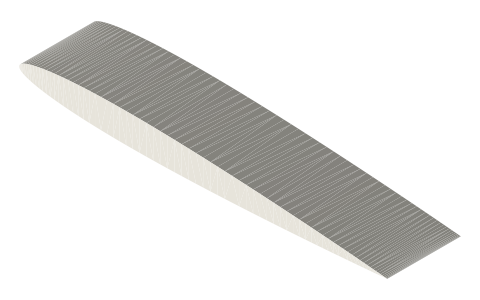
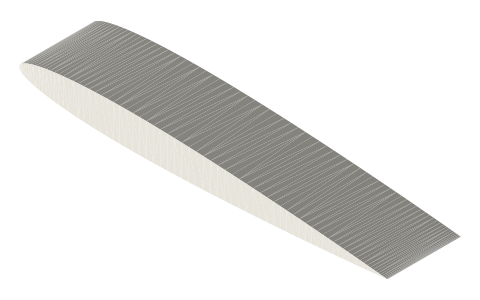
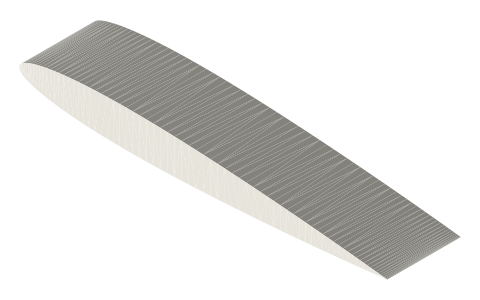
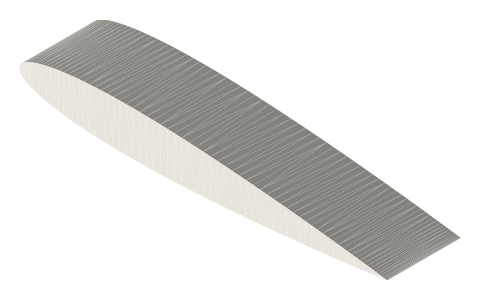
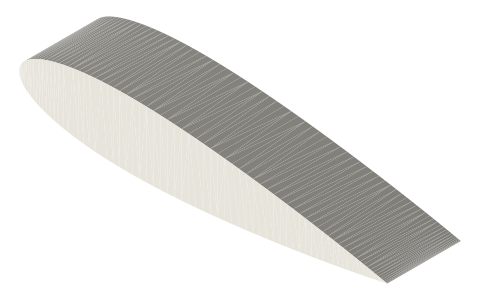
- The file is a 100 mm chord section, 20 mm deep: scale it uniformly to your chord, or import the STEP and sweep or loft it into a wing. Thickness scales with chord; the shape is the same at any size.
- Max thickness: 15% chord (from designation) (NASA TM-4741)
- Camber: 0 (symmetric) (NASA TM-4741)
- Zero-lift angle: 0 deg (symmetric section) (Virginia Tech Appendix A)
- Moment about a.c.: zero (symmetric; c.p. = a.c.) (Virginia Tech Appendix A)
- Effect of 12% -> 15% thickness (2412 vs 2415): drag slightly up, CLmax slightly down (Virginia Tech Appendix A)
- 4-digit code: 1st digit max camber %c; 2nd digit camber position in tenths c; last two thickness %c (NASA TM-4741; Aerospaceweb)
- Thickness equation (t/c = 0.20 basis): y/c = 0.2969 sqrt(x) - 0.1260 x - 0.3516 x^2 + 0.2843 x^3 - 0.1015 x^4, scaled by (t/c)/0.20 (NASA TM-4741)
NACA 0015 airfoil size chart
| x (% chord) | upper x | upper y | lower x | lower y |
|---|---|---|---|---|
| 0 | 0.000 | 0.000 | 0.000 | 0.000 |
| 1.25 | 1.250 | 2.367 | 1.250 | -2.367 |
| 2.5 | 2.500 | 3.268 | 2.500 | -3.268 |
| 5 | 5.000 | 4.443 | 5.000 | -4.443 |
| 7.5 | 7.500 | 5.250 | 7.500 | -5.250 |
| 10 | 10.000 | 5.853 | 10.000 | -5.853 |
| 15 | 15.000 | 6.681 | 15.000 | -6.681 |
| 20 | 20.000 | 7.172 | 20.000 | -7.172 |
| 25 | 25.000 | 7.426 | 25.000 | -7.426 |
| 30 | 30.000 | 7.501 | 30.000 | -7.501 |
| 40 | 40.000 | 7.250 | 40.000 | -7.250 |
| 50 | 50.000 | 6.608 | 50.000 | -6.608 |
| 60 | 60.000 | 5.684 | 60.000 | -5.684 |
| 70 | 70.000 | 4.542 | 70.000 | -4.542 |
| 80 | 80.000 | 3.214 | 80.000 | -3.214 |
| 90 | 90.000 | 1.706 | 90.000 | -1.706 |
| 95 | 95.000 | 0.880 | 95.000 | -0.880 |
| 100 | 100.000 | -0.000 | 100.000 | 0.000 |
Where the files are
Other publishers' files are linked, not hosted. "verify" = check the license at the link before commercial use.
| NACA (NASA Technical Reports Server) | Report 460: The characteristics of 78 related airfoil sections from tests in the variable-density wind tunnel (Jacobs, Ward, Pinkerton, 1933) | web | Publisher's page; dimensions are facts |
| NASA | TM-4741: Computer program to obtain ordinates for NACA airfoils (Ladson, Brooks, Hill, Sproles, 1996) | web | Publisher's page; dimensions are facts |
| NASA Langley (Ladson et al.), NASA TM-4741 | Computer Program to Obtain Ordinates for NACA Airfoils | web | Publisher's page; dimensions are facts |
| Virginia Tech Pressbooks (data from Abbott & von Doenhoff, NACA) | Appendix A: Airfoil Data | web | Publisher's page; dimensions are facts |
| Aerospaceweb.org | NACA Airfoil Series | web | Publisher's page; dimensions are facts |
Free files
★ Free files 1 parts. Xem Studio design: free to use, print and sell things from; not to be republished as files. Xem Studio Design License. index.json
| naca-0015-airfoil-section-100mm-chord | NACA 0015 section, 100 mm chord × 20 mm span, closed trailing edge, 160 points from the equations (scale to your chord) | STEP · STL |
https://xemstudio.com/mcp to Claude, ChatGPT, Cursor or any MCP client (free, no account, one minute) and it can look up exact sizes, mating fits and free STEP/STL from every chat.Plain text: sheet.txt · JSON: /api/geometry?object=naca-0015-airfoil
Fits with
Questions
0012 or 0015?
0015 is thicker (stiffer spar) with slightly more drag and slightly less CLmax, per the 2412/2415 comparison (Virginia Tech).
How thick is the NACA 0015?
Maximum thickness 15.00 % of chord at 29.9 % chord: 15.00 mm on a 100 mm chord.
Where is the NACA 0015's camber?
None: it is symmetric (upper and lower surfaces mirror).
How do I use it for my wing?
Scale the 100 mm section to your chord (e.g. 180 mm chord = 180 % scale), then extrude or loft between root and tip sections. For a tapered wing, scale a root and a tip copy and loft between them.