 Xem Studiomeasured geometry
Library › Hardware › Stirling & thermoacoustic ·
Ratchet wheels and pawl (anti-reverse / one-way drive)
How do I design a 3D printed ratchet and pawl? · Hardware · basis: Sawtooth ratchet: tooth depth 3 mm, 85/15 flank split; pawl pivot 3 mm; dimensions chosen for printing at 0.4 mm nozzle
Long Earth Society build part. Anti-reverse for the LES flywheel generators; same mechanism as a reel's clicker. The engines · all LES parts
- sizes
- 4 in table
Notes
- Ratchet tooth: the drive face is radial, the back face slopes; the pawl must contact the drive face at or below the tooth tip so load pushes it deeper, not out. Pivot the pawl so its contact point trails the pivot by 10–15°.
- 12 teeth = 30° steps (coarse, strong); 24 = 15°; 36 = 10°. Spring: a printed cantilever or a 0.5 mm music-wire torsion spring on the pivot.
- Where it goes: fishing-reel style anti-reverse, hand-wound starters, a one-way drive between a Stirling flywheel and a generator so the generator never back-drives the engine.
Sizes
| part | teeth | step_deg | od_mm | bore_mm |
|---|---|---|---|---|
| ratchet-12t | 12 | 30 | 40 | 5 |
| ratchet-24t | 24 | 15 | 40 | 5 |
| ratchet-36t | 36 | 10 | 40 | 5 |
| pawl-24 | — | — | 24 long | 3.2 |
Where the files are
Other publishers' files are linked, not hosted. "verify" = check the license at the link before commercial use.
| Wikipedia | Ratchet (device) | web | CC BY-SA 4.0 (text) |
| Wikipedia | Pawl | web | CC BY-SA 4.0 (text) |
| Long Earth Society | Engine builds that use these parts (videos and write-ups) | web, video | LES site |
Free files
★ Free files 4 parts. Generated by Xem Studio from the standard; threads are plain cylinders at major diameter. CC BY 4.0. index.json
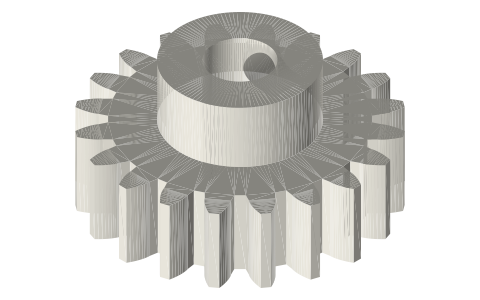
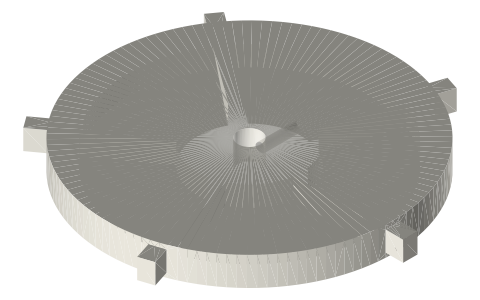
| ratchet-12t-d40 | ratchet wheel Ø40 × 6, 12 teeth 3 mm deep, Ø5 bore | STEP · STL |
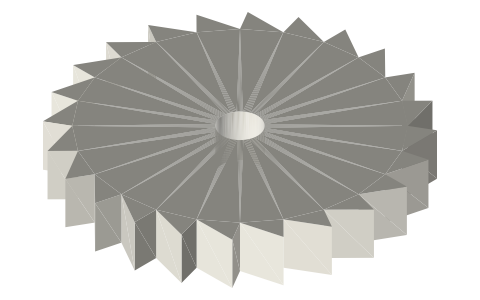
| ratchet-24t-d40 | ratchet wheel Ø40 × 6, 24 teeth 3 mm deep, Ø5 bore | STEP · STL |
| ratchet-36t-d40 | ratchet wheel Ø40 × 6, 36 teeth 3 mm deep, Ø5 bore | STEP · STL |
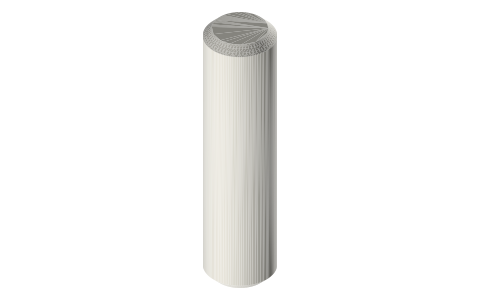
| pawl-24 | pawl 24 mm, Ø3.2 pivot, for the Ø40 wheels; spring not modeled | STEP · STL |
Plain text: sheet.txt · JSON: /api/geometry?object=ratchet-and-pawl
Fits with
Questions
How many teeth should a ratchet have?
Fewer teeth are stronger: 12 teeth (30° steps) for a hand-wound starter, 24–36 for fine positioning. Tooth depth 3 mm prints cleanly.
Which way does the pawl point?
Its contact point trails the pivot in the locking direction so load drives it into the tooth; the back of the tooth lifts it on the free stroke.
Can a printed ratchet hold an engine flywheel?
Yes at model scale: a 12-tooth PETG wheel with a 6 mm face holds several N·m; keep the pawl thick (6 mm) and pivot it on a 3 mm steel pin.