 Xem Studiomeasured geometry
Library › Mechanisms › Gears ·
Rectangular (oblong) gears for a varying speed
How do rectangular gears work? · Hardware · basis: Xem Studio design following Brown No. 30 (1868)
Also called: rectangular gears, non-circular gears, oblong gears, variable speed gears, engranajes rectangulares, Rechteckzahnräder
Exact dimensions. True size, with no printing tolerance added.
- sizes
- 4 in table
Notes
- Resize: multiply every length by one factor k and the motion stays identical: angles, ratios, timing and the formulas below do not change, because a mechanism's motion depends only on the ratios of its lengths. Here, scales with k: centre distance; stays the same: gears, ratio range, turns.
- Resize: Gears scale by the module m (pitch Ø = m·z, centre distance = m·(z₁ + z₂)/2): keep the tooth counts so the ratio stays, and choose a standard module (0.5, 0.8, 1, 1.25, 1.5, 2, 2.5, 3).
- Resize: fit clearances stay in mm (a slide fit is the same gap at any size); keep every printed wall and pin at least two nozzle widths; mass grows with k³ but part strength only with k², so at k = 2 parts are about 8× heavier and 4× stronger: check pins and thin links when scaling up.
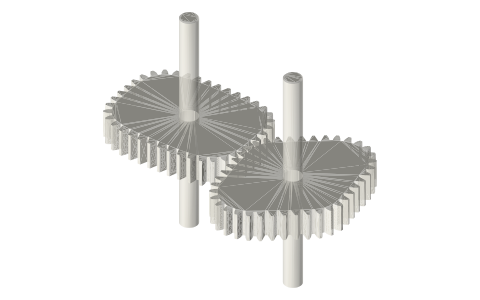
- An oblong gear turning about its centre drives a mate whose pitch curve is its exact rolling partner: at every angle the two contact radii add to the centre distance and the arcs rolled are equal, so the speed ratio swings twice per turn while both make one turn each.
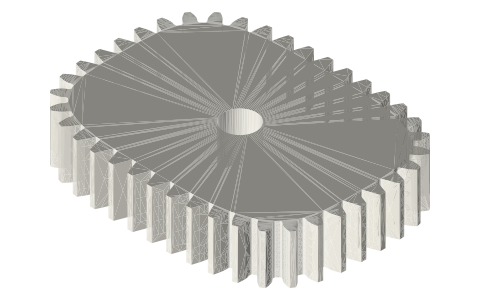
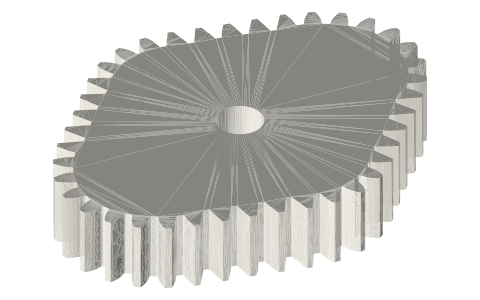
- Here the driver's pitch curve is a rounded rectangle (superellipse, 1.35 : 1); its mate, computed point by point, sits 58.37 mm away. Ratio range 0.66 – 1.29. Module 1.5, 40 teeth each, generated by the same basic rack so they mesh; checked at 72 angles through a turn (largest 2D overlap 0.0000 mm²) and in 3D at seven poses.
- Brown's No. 30: rectangular gears, for light work where a varying speed is wanted (he cites a printing press with the type on a rectangular roller).
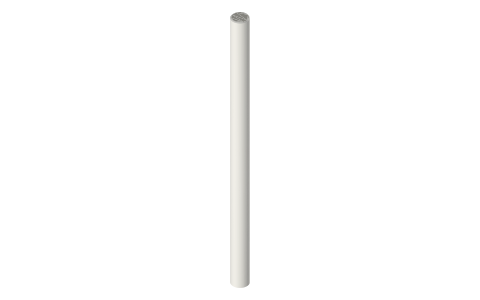
- Parts (each has its own page): rectangular-gear-m1-5-40t-driver, rectangular-gear-m1-5-40t-follower, linear-shafts-h6.
- Brown's movement No. 30 (1868) shows it; this model is a Xem Studio design following his figure, every part at true size.
Rectangular (oblong) gears for a varying speed size chart
| parameter | value |
|---|---|
| gears | 2 × module 1.5, 40 T |
| centre distance | 58.37 mm |
| ratio range | 0.66 – 1.29 |
| turns | 1 : 1 per revolution |
Where the files are
Other publishers' files are linked, not hosted. "verify" = check the license at the link before commercial use.
| Henry T. Brown (1868, public domain) | Five Hundred and Seven Mechanical Movements — scan on archive.org | web | Publisher's page; dimensions are facts |
| 507movements.com | Brown's movement No. 30: figure, his text and an animation | web | Publisher's page; dimensions are facts |
Free files
★ Free files 1 parts. Xem Studio design: free to use, print and sell things from; not to be republished as files. Xem Studio Design License. index.json
| rectangular-gears-oblong-mechanism-assembly | Assembled mechanism, all parts placed at one pose (STEP keeps each part separate) | STEP · STL |
https://xemstudio.com/mcp to Claude, ChatGPT, Cursor or any MCP client (free, no account, one minute) and it can look up exact sizes, mating fits and free STEP/STL from every chat.Plain text: sheet.txt · JSON: /api/geometry?object=rectangular-gears-oblong-mechanism
Fits with
Questions
How do rectangular gears work?
An oblong gear turning about its centre drives a mate whose pitch curve is its exact rolling partner: at every angle the two contact radii add to the centre distance and the arcs rolled are equal, so the speed ratio swings twice per turn while both make one turn each.