 Xem Studiomeasured geometry
Library › Stirling engines › Heat & regenerator ·
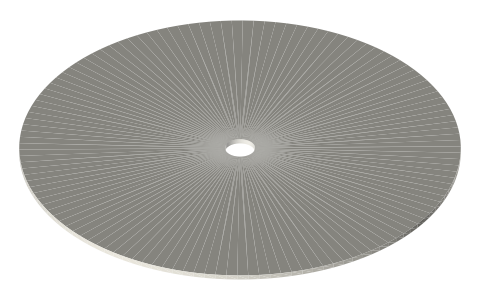
Regenerator matrix disc Ø44 / Ø32 × 0.5 mm (mesh counts #40–#200)
What mesh size is used for a Stirling engine regenerator? · Hardware · basis: ASTM E11 wire-mesh geometry (mesh count, wire diameter, opening); discs drawn at the regenerator cage bores, Ø44 and Ø32 × 0.5, Ø3 centre hole
Long Earth Society build part. The regenerator packing and burner insulation on every LES engine. The engines
Exact dimensions. Every file is drawn at true size with no printing tolerance. The holes and pins that meet another part are listed below under Mating features, with the fit each joint needs; open those by your printer's or process's clearance before making the part. Mating features
- sizes
- 6 in table
Notes
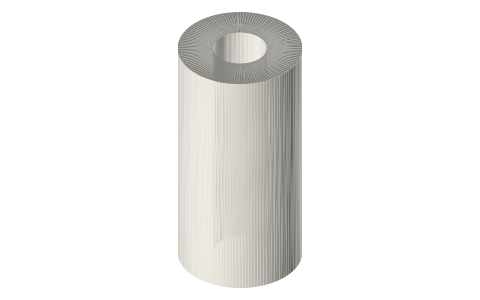
- The file is one regenerator matrix disc at its exact size: the bore of its cage (Ø44 or Ø32) × 0.5 mm, with a Ø3 centre hole the displacer rod passes through, drawn as a solid disc (the mesh weave is not modelled).
- Mesh count → wire Ø / opening (ASTM E11): #40 0.25 / 0.42 mm, #60 0.19 / 0.25, #80 0.14 / 0.18, #100 0.10 / 0.15, #150 0.066 / 0.104, #200 0.053 / 0.074.
- Regenerators use #100–#200 discs stacked loosely to 60–70 % porosity; #40–#60 suits low-temperature demonstrators where flow loss matters more than heat capacity.
- On my engines the regenerator is a split cage filled with a stack of #100 matrix discs.
Sizes
| mesh | wire_mm | opening_mm | use |
|---|---|---|---|
| #40 | 0.25 | 0.42 | low-temperature demonstrator |
| #60 | 0.19 | 0.25 | low-temperature demonstrator |
| #80 | 0.14 | 0.18 | regenerator |
| #100 | 0.1 | 0.15 | regenerator |
| #150 | 0.066 | 0.104 | regenerator |
| #200 | 0.053 | 0.074 | high-temperature regenerator |
Mating features
Drawn at the exact size. Open press, slide, run and socket features by your process's clearance; leave designed gaps and clamp fits as drawn.
| feature | exact | mates with | fit | files |
|---|---|---|---|---|
| mesh disc OD | Ø44 / Ø32 | regenerator cage bore Ø44 / Ø32 | socket | mesh-disc-* |
| mesh disc centre hole | Ø3 | Ø3 displacer rod (passes through) | run | mesh-disc-* |
Where the files are
Other publishers' files are linked, not hosted. "verify" = check the license at the link before commercial use.
| Wikipedia | Mesh (scale) | web | CC BY-SA 4.0 (text) |
| Wikipedia | Regenerative heat exchanger | web | CC BY-SA 4.0 (text) |
| Wikipedia | Steel wool | web | CC BY-SA 4.0 (text) |
| McMaster-Carr | Wire cloth (free STEP per part, for your own design use; no redistribution) | STEP, PDF | McMaster-Carr site terms verify |
| Long Earth Society | Engine and rig builds | web, video | LES site |
Free files
★ Free files 2 parts. Generated by Xem Studio from the standard; threads are plain cylinders at major diameter. CC BY 4.0. index.json
| mesh-disc-44mm | regenerator mesh disc Ø44 × 0.5 with a Ø3 centre hole for the displacer rod: the bore of regenerator-cage-47-5x40 (Ø44), one disc of the stack that fills it | STEP · STL |
| mesh-disc-32mm | regenerator mesh disc Ø32 × 0.5 with a Ø3 centre hole for the displacer rod: the bore of regenerator-cage-34-8x30 (Ø32), one disc of the stack that fills it | STEP · STL |
Plain text: sheet.txt · JSON: /api/geometry?object=regenerator-mesh-disc
How it fits
Goes in or on
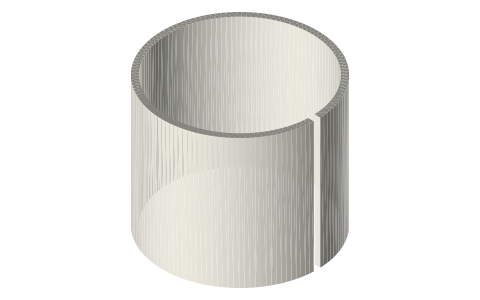 Regenerator cage for 2 in and 1.5 in tri-clamp…discs stacked inside the cage bore
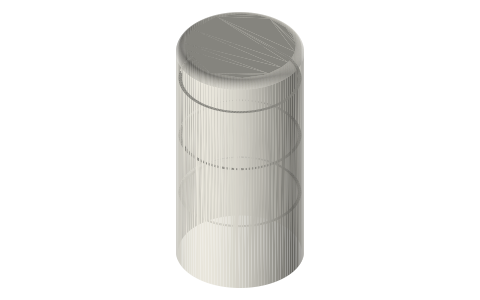 Tri-clamp displacermatrix in the regenerative displacer's slots
Also needed
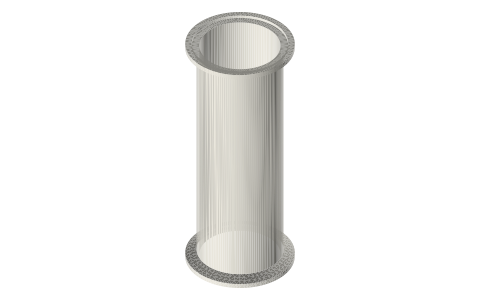 Tri-clamp spool, 1.5 and 2 inchthe spool that holds the regenerator
In these build lists
Tri-clamp elbow diaphragm alpha, 2 inA torch-heated alpha in 2 in tri-clamp: a square of fittings with a diaphragm he…You might also need
Questions
What mesh size for a Stirling regenerator?
#100 to #200 (0.10–0.053 mm wire) stacked loosely to 60–70 % porosity; #40–#60 for low-temperature demonstrators.
What is the wire diameter of #100 mesh?
0.10 mm with a 0.15 mm opening (ASTM E11); #200 is 0.053 mm wire, 0.074 opening.
What diameter is the regenerator disc?
Ø44 × 0.5 mm for the 2 in regenerator cage (its Ø44 bore) and Ø32 × 0.5 for the 1.5 in cage, each with a Ø3 centre hole for the displacer rod.