 Xem Studiomeasured geometry
Library › Stirling engines › Drives & mechanisms ·
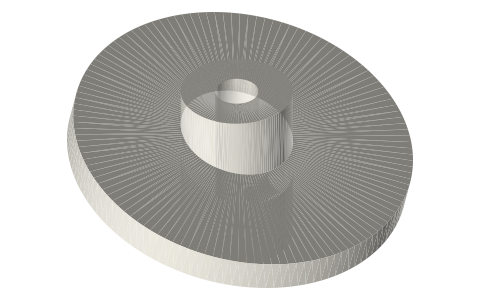
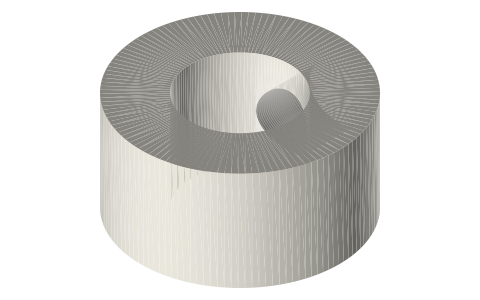
Swash (wobble) plate: Ø40 plates at 10, 15 and 20° with a ball-end follower
How do I make a swash plate (wobble plate) drive with 3D printed parts? · Hardware · basis: Swash plate geometry: a follower at radius r on a plate tilted θ moves r·sin θ each side (stroke 2r·sin θ); Ø5 shaft
Long Earth Society build part. Multi-cylinder drive from one shaft, used on the LES rigs. The engines
Exact dimensions. Every file is drawn at true size with no printing tolerance. The holes and pins that meet another part are listed below under Mating features, with the fit each joint needs; open those by your printer's or process's clearance before making the part. Mating features
- sizes
- 3 in table
Notes
- A disc fixed at an angle on a shaft; a follower pressed against it reciprocates once per turn.
- Stroke = 2 × r × sin θ for a follower at radius r. At the Ø40 rim: 6.9 mm at 10°, 10.4 mm at 15°, 13.7 mm at 20°.
- Several followers spaced around one plate drive several cylinders from one shaft.
- The follower is an 8 mm square pushrod with a Ø8 ball end and a Ø3 hole in its tail.
Sizes
| plate | tilt | stroke at rim (r 20) | stroke at r 18 |
|---|---|---|---|
| Ø40 | 10° | 6.9 mm | 6.3 mm |
| Ø40 | 15° | 10.4 mm | 9.3 mm |
| Ø40 | 20° | 13.7 mm | 12.3 mm |
Mating features
Drawn at the exact size. Open press, slide, run and socket features by your process's clearance; leave designed gaps and clamp fits as drawn.
| feature | exact | mates with | fit | files |
|---|---|---|---|---|
| hub bore | Ø5 | Ø5 shaft | slide | swash-plate-* |
| set-screw hole | Ø2.5 | M3 tap drill | designed | swash-plate-* |
| follower tail hole | Ø3 | Ø3 pin | run | swash-follower-* |
Where the files are
Other publishers' files are linked, not hosted. "verify" = check the license at the link before commercial use.
| Wikipedia | Swashplate | web | CC BY-SA 4.0 (text) |
| Long Earth Society | Engine and rig builds on extrusion frames | web, video | LES site |
Free files
★ Free files 4 parts. Generated by Xem Studio from the standard; threads are plain cylinders at major diameter. CC BY 4.0. index.json
| swash-plate-40-10deg | swash (wobble) plate Ø40, 10° tilt, 6.9 mm stroke at the rim, Ø5 shaft, Ø2.5 set-screw hole | STEP · STL |
| swash-plate-40-15deg | swash (wobble) plate Ø40, 15° tilt, 10.4 mm stroke at the rim, Ø5 shaft, Ø2.5 set-screw hole | STEP · STL |
| swash-plate-40-20deg | swash (wobble) plate Ø40, 20° tilt, 13.7 mm stroke at the rim, Ø5 shaft, Ø2.5 set-screw hole | STEP · STL |
| swash-follower-8x30 | swash follower: 8 mm square pushrod with a Ø8 ball end, Ø3 tail hole | STEP · STL |
Plain text: sheet.txt · JSON: /api/geometry?object=swash-plate
How it fits
Goes in or on
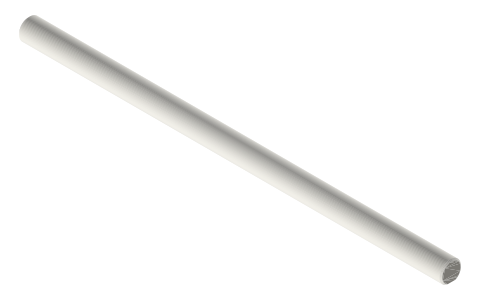 Stirling shafts and rodsØ5 shaft through the hub
Alternatives
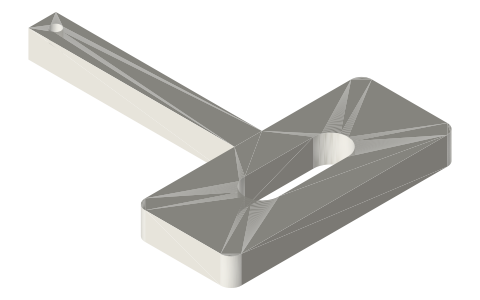 Scotch yokesingle-cylinder sine motion
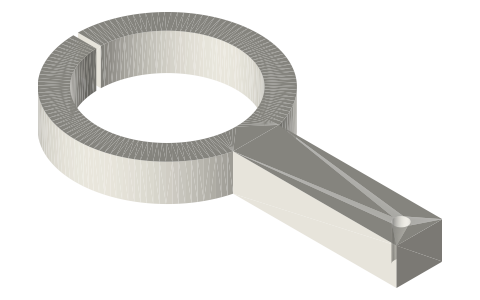 Eccentric and strapsingle strap drive
Also needed
 Shafts, D-flats, set-screw collars, E-clips and…locate the plate on the shaft
You might also need
Questions
How much stroke does a swash plate give?
Stroke = 2 × r × sin θ for a follower at radius r on a plate tilted θ: Ø40 plate, follower at r = 18, 15° gives 9.3 mm.
Can one plate drive more than one cylinder?
Yes. Space followers around the plate; each one reaches top of stroke at a different shaft angle, set by its position around the plate.