 Xem Studiomeasured geometry
Library › Stirling engines › Thermoacoustic & fluidyne ·
Thermoacoustic heat exchangers, hot and cold, parallel plate, for 1.5, 2 and 3 in tri-clamp spools
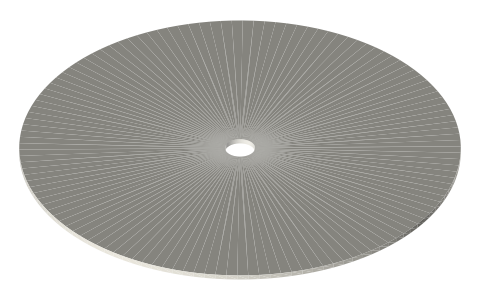
What heat exchanger goes on each face of a thermoacoustic stack in a tri-clamp spool? · Hardware · basis: Parallel-plate heat exchangers on both stack faces (Swift), plate gap and thickness equal to the spiral stack's channel; disc drawn at the 16 ga tri-clamp spool bore (1.5 in = 34.8 mm, 2 in = 47.5, 3 in = 72.9)
Long Earth Society build part. The hot and cold exchangers I drew for the stacks on this shelf. The engines
Exact dimensions. Every file is drawn at true size with no printing tolerance. The holes and pins that meet another part are listed below under Mating features, with the fit each joint needs; open those by your printer's or process's clearance before making the part. Mating features
- sizes
- 3 in table
Notes
- A thermoacoustic stack only holds the temperature gradient; the heat exchangers on its two faces move heat into and out of the gas. The hot exchanger sits against the stack's hot face (the closed-end side of a λ/4 resonator), the cold one against the cold face, both inside the same spool bore.
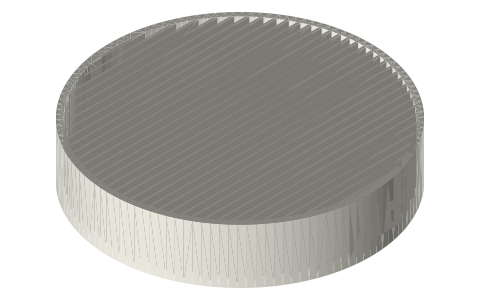
- Each exchanger is a disc Ø34.8 / Ø47.5 / Ø72.9 (the 1.5 / 2 / 3 in spool bore, exact) × 10 mm long: a 1.0 mm outer ring holding parallel plates 0.4 mm thick at 1.4 mm pitch, one plate on the axis, 1.0 mm gas gaps between them. That is the spiral stack's 1.0 mm gap and 0.4 mm wall (stack-spiral-*-g1.0), so the gas channel keeps its width from stack to exchanger.
- The hot and cold files of a size are the same geometry; there are two so each stack face has its own. What they are made of, and how heat reaches the ring and plates, is the maker's choice: the file is the geometry.
- Exact dimensions: the disc OD is the spool bore with no allowance, listed under Mating features with its fit. Plate thickness, gap and ring width are design dimensions and stay as drawn.
- LES: I drew these for the stacks on this shelf: same spools, same 1.0 mm channel.
Sizes
| spool | bore_mm (= exchanger OD) | length_mm | ring_mm | plate_mm | gap_mm | pitch_mm | plates | open_area_pct |
|---|---|---|---|---|---|---|---|---|
| 1.5 | 34.8 | 10.0 | 1.0 | 0.4 | 1.0 | 1.4 | 23 | 63.5 |
| 2 | 47.5 | 10.0 | 1.0 | 0.4 | 1.0 | 1.4 | 33 | 65.5 |
| 3 | 72.9 | 10.0 | 1.0 | 0.4 | 1.0 | 1.4 | 51 | 67.5 |
Mating features
Drawn at the exact size. Open press, slide, run and socket features by your process's clearance; leave designed gaps and clamp fits as drawn.
| feature | exact | mates with | fit | files |
|---|---|---|---|---|
| exchanger OD | spool bore (34.8 / 47.5 / 72.9) | tri-clamp spool bore | socket | heat-exchanger-* |
| plates / gas gaps | 0.4 plates, 1.0 gaps, 1.4 pitch | stack channel (stack-spiral-*-g1.0) | designed | heat-exchanger-* |
| outer ring | 1.0 wall | holds the plates | designed | heat-exchanger-* |
Where the files are
Other publishers' files are linked, not hosted. "verify" = check the license at the link before commercial use.
| Wikipedia | Thermoacoustic heat engine | web | CC BY-SA 4.0 (text) |
| G. W. Swift (LANL) | Thermoacoustics: A Unifying Perspective for Some Engines and Refrigerators (textbook; DeltaEC software free) | web, software | LANL verify |
| Long Earth Society | Engine builds | web, video | LES site |
Free files
★ Free files 6 parts. Generated by Xem Studio from the standard; threads are plain cylinders at major diameter. CC BY 4.0. index.json
| heat-exchanger-hot-1.5in | hot heat exchanger for the 1.5 in spool: Ø34.8 × 10 disc (the spool bore, exact), 1 mm outer ring, 0.4 mm plates at 1.4 mm pitch with 1 mm gas gaps (the spiral stack's channel); goes on the hot face of the stack | STEP · STL |
| heat-exchanger-cold-1.5in | cold heat exchanger for the 1.5 in spool: Ø34.8 × 10 disc (the spool bore, exact), 1 mm outer ring, 0.4 mm plates at 1.4 mm pitch with 1 mm gas gaps (the spiral stack's channel); goes on the cold face of the stack | STEP · STL |
| heat-exchanger-hot-2in | hot heat exchanger for the 2 in spool: Ø47.5 × 10 disc (the spool bore, exact), 1 mm outer ring, 0.4 mm plates at 1.4 mm pitch with 1 mm gas gaps (the spiral stack's channel); goes on the hot face of the stack | STEP · STL |
| heat-exchanger-cold-2in | cold heat exchanger for the 2 in spool: Ø47.5 × 10 disc (the spool bore, exact), 1 mm outer ring, 0.4 mm plates at 1.4 mm pitch with 1 mm gas gaps (the spiral stack's channel); goes on the cold face of the stack | STEP · STL |
| heat-exchanger-hot-3in | hot heat exchanger for the 3 in spool: Ø72.9 × 10 disc (the spool bore, exact), 1 mm outer ring, 0.4 mm plates at 1.4 mm pitch with 1 mm gas gaps (the spiral stack's channel); goes on the hot face of the stack | STEP · STL |
| heat-exchanger-cold-3in | cold heat exchanger for the 3 in spool: Ø72.9 × 10 disc (the spool bore, exact), 1 mm outer ring, 0.4 mm plates at 1.4 mm pitch with 1 mm gas gaps (the spiral stack's channel); goes on the cold face of the stack | STEP · STL |
Plain text: sheet.txt · JSON: /api/geometry?object=thermoacoustic-heat-exchanger
How it fits
In these build lists
Thermoacoustic standing-wave engine, 2 in spoolsNo moving parts: a heated stack between two heat exchangers in a closed-open 2 i…You might also need
Questions
What does a heat exchanger do in a thermoacoustic engine?
It moves heat into the gas at the stack's hot face and out of it at the cold face; the stack between them only holds the temperature gradient.
What plate spacing should a thermoacoustic heat exchanger have?
The same channel as the stack: here 1.0 mm gaps between 0.4 mm plates (1.4 mm pitch), matching the spiral stack's 1.0 mm gap and 0.4 mm sheet.
What size heat exchanger fits a 2 inch tri-clamp spool?
Ø47.5 × 10 mm, the 2 in spool bore exactly, with a 1.0 mm outer ring and 0.4 mm plates at 1.4 mm pitch. The 1.5 in is Ø34.8 and the 3 in Ø72.9, same plates and length.
Are the hot and cold heat exchangers different?
Not in shape: both files of a size are the same geometry, one for each face of the stack.