 Xem Studiomeasured geometry
Library › Hardware › Stirling & thermoacoustic ·
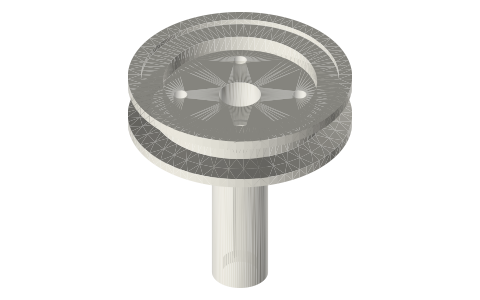
Clamp-in bearing plate: 2 in, two ISO 2852 faces, spigot with two 623 seats
How do I carry a crankshaft inside a sealed tri-clamp vessel without a shaft seal? · Hardware · basis: ISO 2852 face and 20° back (as the ferrule and the flat end cap) on both sides, ASME BPE tube OD for the neck; 16 mm face to face so two standard 2 in clamps (15.97 wide each) sit side by side over 1.7 mm gaskets; 623 bearing 3 × 10 × 4 (ISO 15)
Long Earth Society build part. The plates that carry my sealed generator's crankshaft without letting it out. The engines
Exact dimensions. Every file is drawn at true size with no printing tolerance. The holes and pins that meet another part are listed below under Mating features, with the fit each joint needs; open those by your printer's or process's clearance before making the part. Mating features
- sizes
- 8 in table
Notes
- A plate clamped between two faces like a thick gasket: each side is an ISO 2852 face (land Ø56.5–Ø64, 2.85 rim, 1.6 recess inside Ø56.5) with the 20° back down to the tube OD, the two joined by a Ø50.8 neck. Each side takes its own Type B gasket and clamp; the two clamps sit 1.74 mm apart.
- Inside: a Ø16 spigot runs 52.1 mm inward from the inner face with a 623 seat at its end; a second 623 seat sits 3.1–7.1 mm inside the inner face; a Ø4 bore joins them, clear of the Ø3 shaft. The shaft never leaves the vessel: the plate's outer face holds a Ø44 pocket for a Ø42 pocket flywheel on the shaft end, and a flat end cap clamps over it.
- Four Ø4 vents join the pocket to the crankcase, so the pocket is crankcase gas too. The sealed generator uses two, one in each branch of the cross.
- Fits: the faces are clamp faces; the seats press on the 623 outer rings; the Ø4 and Ø12 bores are clearance (designed).
Sizes
| feature | value |
|---|---|
| faces | ISO 2852 both sides, 2 in |
| face to face | 16.0 |
| neck | Ø50.8 |
| spigot | Ø16 × 52.1 from the inner face |
| bearing seats | 2 × Ø10 × 4 (623) |
| shaft bore | Ø4 (no contact) |
| flywheel pocket | Ø44 × 6.2, Ø12 hub bore |
| vents | 4 × Ø4 on Ø34 |
Mating features
Drawn at the exact size. Open press, slide, run and socket features by your process's clearance; leave designed gaps and clamp fits as drawn.
| feature | exact | mates with | fit | files |
|---|---|---|---|---|
| faces | ISO 2852 both sides (land Ø56.5–Ø64, rim 2.85, 1.6 recess, 20° back to Ø50.8) | standard clamps + Type B gaskets | clamp | all |
| bearing seats | 2 × Ø10 × 4 (spigot end; 3.1–7.1 inside the inner face) | 623 outer ring | press | all |
| shaft bore | Ø4 | Ø3 crankshaft (no contact) | designed | all |
| hub bore and flywheel pocket | Ø12; Ø44 × 6.2 | pocket-flywheel hub Ø10 and disc Ø42 (1 mm radial, 1 mm behind) | designed | all |
| spigot | Ø16 | inside the 2 in branch bore (no contact) | designed | all |
Where the files are
Other publishers' files are linked, not hosted. "verify" = check the license at the link before commercial use.
| ISO (via iTeh sample) | ISO 2852 clamp liners: face profile and flange / groove diameters | standard excerpt; dimensions are facts | |
| ASME | BPE Bioprocessing Equipment (clamp fitting dimensions, tube OD and wall) | standard | ASME; dimensions are facts verify |
| Long Earth Society | Engine builds | web, video | LES site |
Free files
★ Free files 1 parts. Generated by Xem Studio from the standard; threads are plain cylinders at major diameter. CC BY 4.0. index.json
| bearing-plate-2in-623 | clamp-in bearing plate: ISO 2852 face (land Ø56.5–Ø64, rim 2.85, recess 1.6) and 20° back on both sides, Ø50.8 neck, 16 face to face; Ø16 spigot 52.1 inward with a 623 seat at its end, 623 seat 3.1–7.1 inside the inner face, Ø4 bore between; Ø12 bore and Ø44 × 6.2 flywheel pocket in the outer face; 4 × Ø4 vents | STEP · STL |
Plain text: sheet.txt · JSON: /api/geometry?object=tri-clamp-clamp-in-bearing-plate
How it fits
In these build lists
Tri-clamp sealed diaphragm generator, 2 inA sealed, pressurised gamma Stirling generator in 2 in tri-clamp: a finned one-p…You might also need
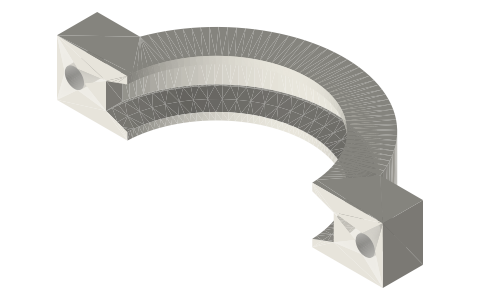
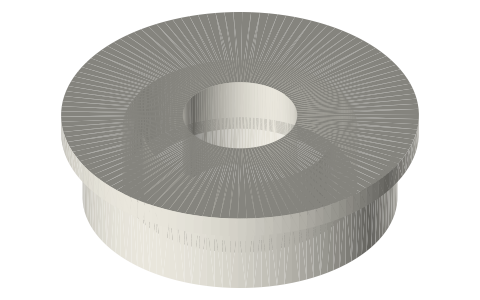
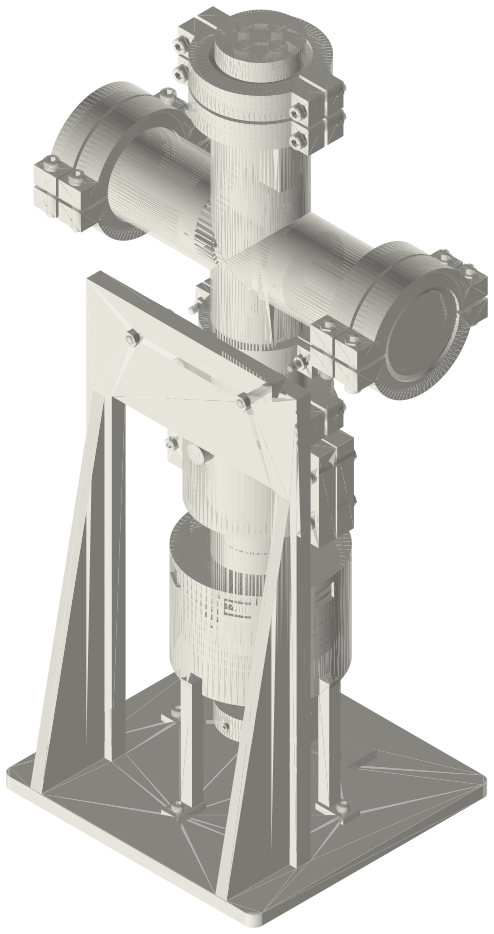
Questions
Will two clamps fit on one plate?
Yes: each 2 in clamp reaches 7.98 mm from its joint plane, the joint planes are 17.7 mm apart (16 + 1.7), so 1.74 mm is left between the clamps.
Where are the bearings?
One 623 at the spigot end, 52.1 mm in from the inner face, one 3.1 mm inside the inner face; the crank sits between the two plates' spigots.