 Xem Studiomeasured geometry
Library › Stirling engines › Can & LTD engines ·
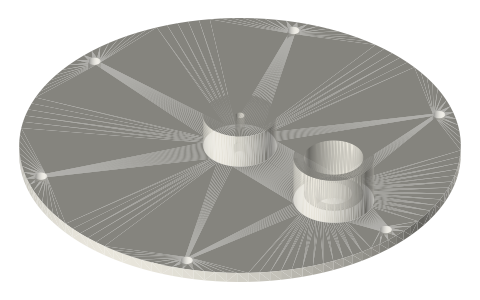
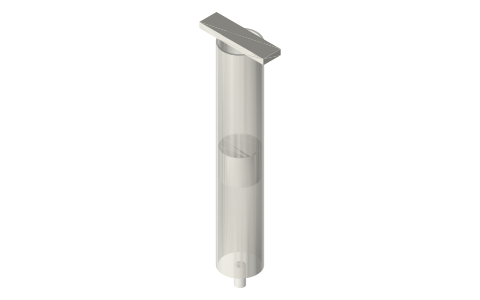
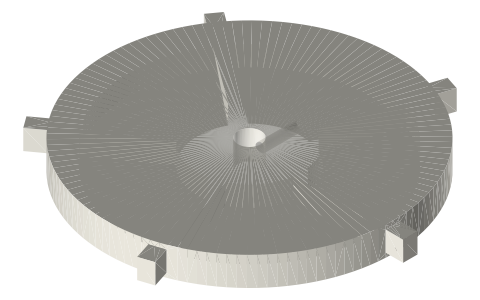
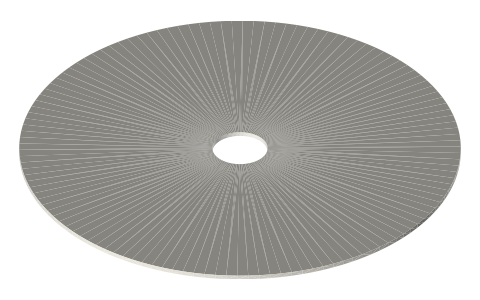
LTD (low-temperature differential, coffee-cup) Stirling kit: plates, chamber ring, displacer, top plate with syringe cylinder
How do I build a coffee cup Stirling engine and what are the plate and displacer dimensions? · Hardware · basis: Senft / Kolin LTD gamma proportions: displacer diameter ≫ stroke (D/stroke ≈ 15–25), displacer swept volume 10–20× the power piston swept volume, thin chamber (height ≈ 1.5 × displacer thickness)
Long Earth Society build part. The warm-hand demonstrator. The engines
- sizes
- 6 in table
Notes
- An LTD runs on a cup of coffee or a warm hand: a wide thin chamber between two conductive plates (aluminium, 1–3 mm), a foam displacer filling it with a 2 mm gap, a tiny power piston (syringe) and a crank with the displacer 90° ahead. Everything is about low friction and large area: Ø100 chamber, 16 mm tall, Ø96 × 8 foam displacer, 6 mm displacer stroke, 10 mL syringe at 4–6 mm stroke.
- Plates: the printed bottom plate is a drilling template; the real plate must be metal (aluminium 2 mm) for heat to get in. The top plate can be printed (it is the cold side: PETG, with the syringe socket and rod guide) or metal with the printed boss glued on. Chamber ring: printed, 10 mm wall, sealed to the plates with silicone or a 1.5 mm O-ring (Ø100 ID groove).
- Numbers: 10 mL syringe (Ø14.5) at 5 mm stroke = 0.83 mL; displacer Ø96 × 6 mm stroke = 43 mL → ratio 52 (high, fine for ΔT 20 K). Flywheel Ø100 CD or the crank kit. Runs at 1–3 Hz on 15–20 °C ΔT.
- LES: the warm-hand demonstrator that opens the thermodynamics video.
Sizes
| part | Ø100 kit | Ø150 kit |
|---|---|---|
| chamber bore × height | 100 × 16 | 150 × 16 |
| displacer | Ø96 × 8 foam, 6 stroke | Ø146 × 8, 6 stroke |
| plates | Ø120 × 2 Al | Ø170 × 2 Al |
| power piston | 10 mL syringe, 5 stroke | 20 mL syringe, 5 stroke |
| displacer : piston volume | ~50 | ~60 |
| ΔT to run | 15–20 K | 10–15 K |
Where the files are
Other publishers' files are linked, not hosted. "verify" = check the license at the link before commercial use.
| Wikipedia | Stirling engine | web | CC BY-SA 4.0 (text) |
| James R. Senft | An Introduction to Low Temperature Differential Stirling Engines | book | Moriya Press verify |
| Long Earth Society | Engine builds | web, video | LES site |
Free files
★ Free files 9 parts. Generated by Xem Studio from the standard; threads are plain cylinders at major diameter. CC BY 4.0. index.json
| ltd-100-bottom-plate-template | bottom plate template Ø120 × 3 (cut aluminium to this; the printed one is for layout), 6 × M3 | STEP · STL |
| ltd-100-chamber-ring-h16 | chamber ring Ø100 bore × 16 tall, 10 mm wall, 6 × M3; the displacer runs inside | STEP · STL |
| ltd-100-displacer-foam-template | displacer template Ø96 × 8 (cut from foam; 2 mm radial gap) | STEP · STL |
| ltd-100-top-plate-syringe | top plate Ø120 with 3/32 in rod guide boss on centre and a 10 mL syringe socket as the power cylinder | STEP · STL |
| ltd-150-bottom-plate-template | bottom plate template Ø170 × 3 (cut aluminium to this; the printed one is for layout), 6 × M3 | STEP · STL |
| ltd-150-chamber-ring-h16 | chamber ring Ø150 bore × 16 tall, 10 mm wall, 6 × M3; the displacer runs inside | STEP · STL |
| ltd-150-displacer-foam-template | displacer template Ø146 × 8 (cut from foam; 2 mm radial gap) | STEP · STL |
| ltd-150-top-plate-syringe | top plate Ø170 with 3/32 in rod guide boss on centre and a 10 mL syringe socket as the power cylinder | STEP · STL |
| ltd-crank-stand-pair | crank stand 45 mm tall with a 623 pocket (print two) | STEP · STL |
Plain text: sheet.txt · JSON: /api/geometry?object=ltd-coffee-cup-engine-kit
Fits with
Questions
What size displacer for a coffee cup Stirling engine?
Ø96 × 8 mm foam in a Ø100 × 16 chamber with a 6 mm stroke; the displacer swept volume should be 20–60× the power piston's.
Why does an LTD have such a big displacer?
With only 15–20 K of temperature difference the gas changes pressure very little, so you need a lot of gas shuttled per cycle and almost no friction: big area, small stroke, tiny piston.
Can the plates be 3D printed?
The cold (top) plate yes; the hot plate must be metal (2 mm aluminium) or the heat never gets into the gas. Use the printed bottom plate as the drilling template.