 Xem Studiomeasured geometry
Library › Stirling engines › Drives & mechanisms ·
Rod clevises for a Ø2 or Ø3 rod or a Ø5 tube, 5 mm gap
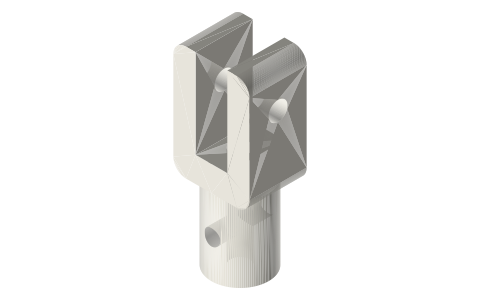
How does a plain 3 mm displacer rod connect to a connecting rod? · Hardware · basis: Clevis with a socket at the rod Ø, M3 grub, 5 mm gap for a 5 mm con-rod and a Ø3 cross pin 8 mm above the slot floor (a con-rod eye, R7, clears the floor by 1 mm)
Long Earth Society build part. The connectors between rods, cranks and drives on the LES engines. The engines
Exact dimensions. Every file is drawn at true size with no printing tolerance. The holes and pins that meet another part are listed below under Mating features, with the fit each joint needs; open those by your printer's or process's clearance before making the part. Mating features
- sizes
- 3 in table
Notes
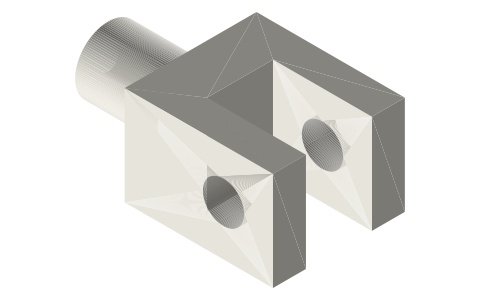
- A fork 12 × 9 × 18 with a 5 mm gap (the con-rod thickness) between two 3.5 mm cheeks and a Ø3 cross hole 12 mm up; the slot floor is 4 mm up, 8 below the pin, so the con-rod's R7 eye swings 1 mm clear of it. A round socket below; overall 30 tall.
- Rod-clevis-2mm: Ø8 socket boss with a Ø2 bore for the can and LTD engines' displacer rod. rod-clevis-3mm: Ø9 socket boss with a Ø3 bore 16 deep for the displacer rod. rod-clevis-5mm-tube: Ø11 boss with a Ø5 bore for the tube piston rod. Socket wall 3 mm, so an M3 × 3 grub sits flush.
- A radial Ø2.5 hole (M3 tap drill) 6 mm below the fork locks the rod with a grub.
- The con-rod's 623 end sits in the gap on a Ø3 × 12 pin, the full width of the fork.
Sizes
| file | socket | boss | gap | pin hole | overall |
|---|---|---|---|---|---|
| rod-clevis-2mm | Ø2 × 16 | Ø7 | 5 | Ø3 | 11 × 9 × 26 |
| rod-clevis-3mm | Ø3 × 16 | Ø9 | 5 | Ø3 at 12, floor at 4 | 12 × 9 × 30 |
| rod-clevis-5mm-tube | Ø5 × 16 | Ø11 | 5 | Ø3 at 12, floor at 4 | 12 × 11 × 30 |
Mating features
Drawn at the exact size. Open press, slide, run and socket features by your process's clearance; leave designed gaps and clamp fits as drawn.
| feature | exact | mates with | fit | files |
|---|---|---|---|---|
| rod-clevis socket | Ø2 / Ø3 / Ø5 | Ø2 rod / Ø3 rod / 5 mm tube (M3 grub) | slide | rod-clevis-* |
| rod-clevis pin hole | Ø3 | Ø3 pin; the con-rod turns on it | press | rod-clevis-* |
| rod-clevis gap | 5.0 | 5 mm con-rod, 623 end (turns in it) | run | rod-clevis-* |
| rod-clevis grub hole | Ø2.5 | M3 tap drill | designed | rod-clevis-* |
| rod-clevis slot floor | 8 below the pin | con-rod eye R7 (1 mm clear) | designed | rod-clevis-* |
Where the files are
Other publishers' files are linked, not hosted. "verify" = check the license at the link before commercial use.
| Long Earth Society | Tri-clamp Stirling engine builds | web, video | LES site |
Free files
★ Free files 3 parts. Generated by Xem Studio from the standard; threads are plain cylinders at major diameter. CC BY 4.0. index.json
| rod-clevis-3mm | clevis for a Ø3 displacer or piston rod: Ø9 × 12 socket with a Ø3 bore and a tapped M3 grub (Ø2.5) 6 from its top, two 3.5 mm cheeks 5 apart (a 5 mm con-rod), Ø3 cross pin 12 above the socket, slot floor 8 below the pin; 12 × 9 × 18 above the socket: takes a con-rod's 623 end on a Ø3 × 12 pin | STEP · STL |
| rod-clevis-2mm | clevis for the Ø2 displacer rod of the can and LTD engines: Ø8 × 12 socket with a Ø2 bore and a tapped M3 grub (Ø2.5), cheeks and Ø3 pin as the 3 mm clevis | STEP · STL |
| rod-clevis-5mm-tube | clevis for the 5 mm tube piston rod: Ø11 × 12 socket with a Ø5 bore and a tapped M3 grub (Ø2.5), cheeks and Ø3 pin as the 3 mm clevis | STEP · STL |
Plain text: sheet.txt · JSON: /api/geometry?object=rod-clevises
How it fits
Parts that fit it
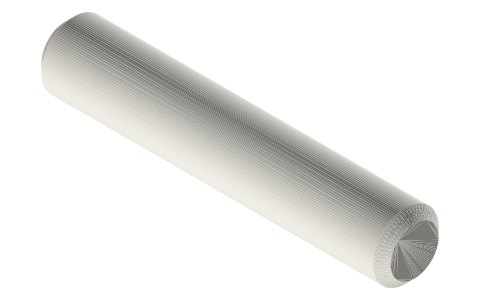 Crank and wrist pins Ø3 × 12, 16, 19, 20 and 23Ø3 hole across the 5 mm gap
Goes in or on
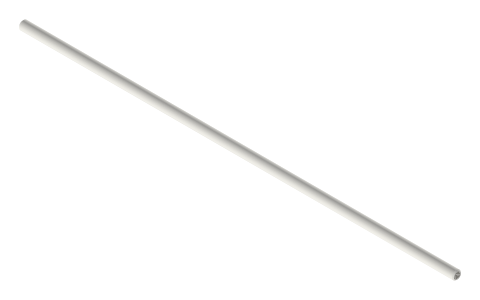 Displacer rods Ø2 × 60, 78, 100 and 180, Ø3 ×…Ø3 rod in the socket, M3 grub
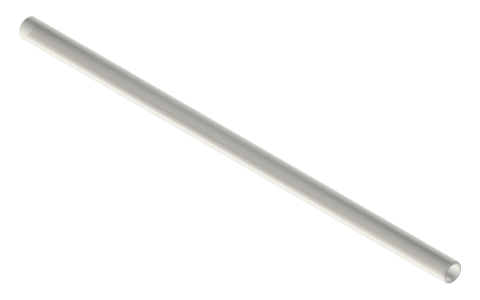 Tube piston rods Ø5 × Ø3.4Ø5 tube in the 5mm-tube socket
Connects to
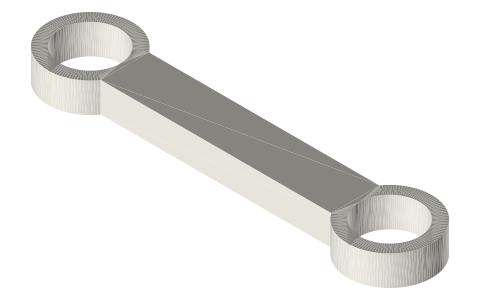 Connecting rods 30 to 80 mm centres with 623 pockets5 mm con-rod in the 5 mm gap
Also needed
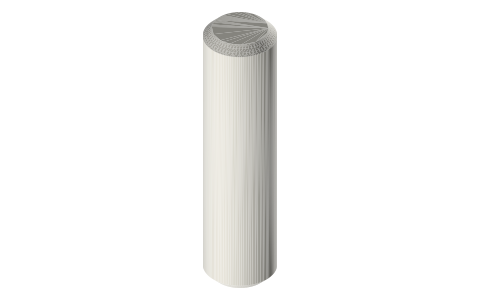 Dowel pins, 2–6 mmØ3 × 12 pin across the fork
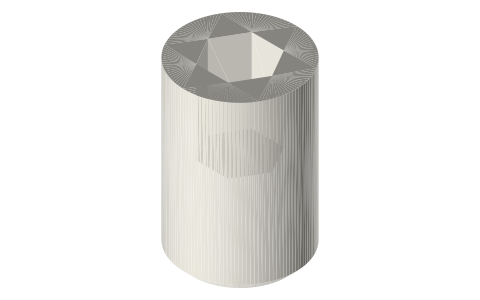 Set screws, M3–M8M3 × 3 grub
In these build lists
Gamma Stirling, 2 in tri-clampHot spool with a shell displacer, a crank head that carries the crankshaft, the …Soda-can gammaA 12 oz can as the displacer cylinder over a tea light, a 10 mL syringe barrel a…LTD coffee-cup engineRuns on a cup of coffee: wide thin displacer, small piston.Tri-clamp tee diaphragm gamma, 2 inA tea-light gamma in 2 in tri-clamp: displacer in a 3 in spool, a short-outlet t…Tri-clamp elbow diaphragm alpha, 2 inA torch-heated alpha in 2 in tri-clamp: a square of fittings with a diaphragm he…You might also need
Questions
How do I connect a 3 mm displacer rod to a connecting rod?
Rod-clevis-3mm: the rod goes in the Ø3 socket under an M3 × 3 grub; the con-rod's 5 mm thick 623 end sits in the 5 mm gap on a Ø3 × 12 pin.
What is the clevis for the tube piston rod?
Rod-clevis-5mm-tube: same 5 mm gap and Ø3 pin, Ø5 socket for the tube.