 Xem Studiomeasured geometry
Library › Stirling engines › Drives & mechanisms ·
Ross yoke kit (alpha Stirling with parallel cylinders)
What is a Ross yoke and how do I make an alpha Stirling engine with parallel cylinders? · Hardware · basis: Andy Ross's yoke (1970s): a triangular rocker on a single crank gives two parallel pistons ~90° apart with near-straight-line motion; proportions a = 30, h = 20 for 16 mm strokes
Long Earth Society build part. The parallel-cylinder alpha demonstrator. The engines
- sizes
- 5 in table
Notes
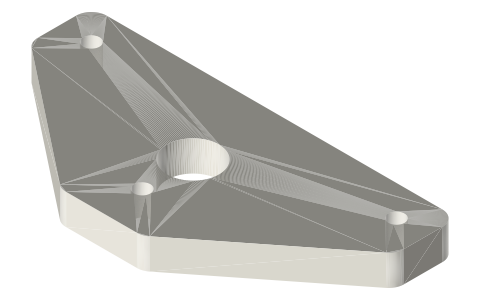
- Alpha engines need two pistons 90° out of phase; the usual V-twin crank puts the cylinders at 90°. The Ross yoke lets both cylinders sit side by side and parallel: a triangular rocker pivots on a short rocking link, its bottom corner rides the crank pin, and its two top corners drive the pistons through short con-rods. The geometry makes each piston's motion almost straight (low side load) and roughly 90° apart.
- Proportions: top pivots at ±a, crank pivot at −h below, rocking pivot near the centroid; a/h ≈ 1.5, crank throw ≈ h/2.5. With a 30 / h 20 / e 8 the strokes are ~16 mm and phase ~90°. Cylinder spacing = 2a = 60 mm... here the syringe block uses 34 mm spacing with the a = 30 yoke angled; use a = 17 for a dead-parallel block, or the 2× syringe block as the compact version.
- Parts: yoke, rocking link (frame to yoke centroid, 623 bearing), two con-rods, crank disc, cylinder block for two 10 mL syringes (the simplest alpha: one hot, one cold, a tube between), flywheel from the crank kit.
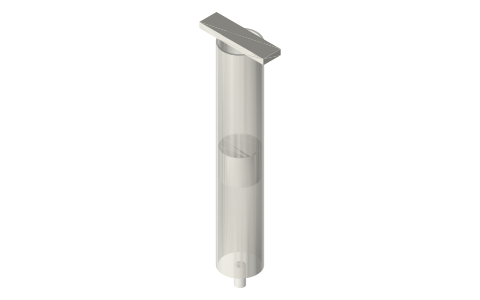
- LES: the alpha demonstrator with two syringes; the hot syringe sits in a tri-clamp hot end via the power head.
Sizes
| part | size | note |
|---|---|---|
| yoke | a 30, h 20 (or 40/25) | 623 at centroid |
| rocking link | 30 | frame pivot |
| con-rods | 45 × 2 | Ø3 pins |
| crank | e 8 (stroke 16) | Ø5 shaft |
| cylinder block | 2 × 10 mL syringes @ 34 | alpha |
Where the files are
Other publishers' files are linked, not hosted. "verify" = check the license at the link before commercial use.
| Wikipedia | Stirling engine | web | CC BY-SA 4.0 (text) |
| Andy Ross | Making Stirling Engines (Ross yoke) | book | reference verify |
| Long Earth Society | Engine builds | web, video | LES site |
Free files
★ Free files 6 parts. Generated by Xem Studio from the standard; threads are plain cylinders at major diameter. CC BY 4.0. index.json
| ross-yoke-a30-h20 | Ross yoke rocker: piston pivots ±30 mm, crank pivot 20 mm below, 623 pocket at the rocking pivot | STEP · STL |
| ross-yoke-a40-h25 | larger rocker ±40 / 25 | STEP · STL |
| rocking-link-30 | rocking link 30 mm (yoke centroid to frame pivot) | STEP · STL |
| conrod-45 | piston con-rod 45 mm, Ø3.2 ends (2 needed) | STEP · STL |
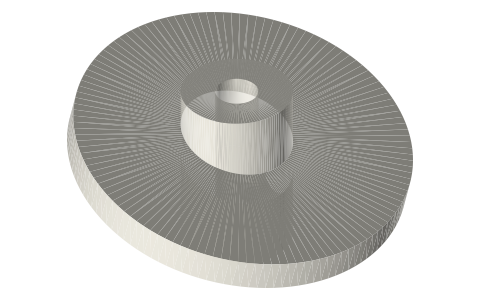
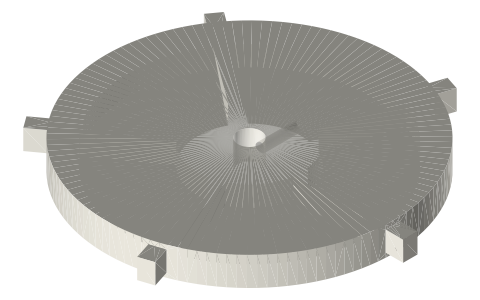
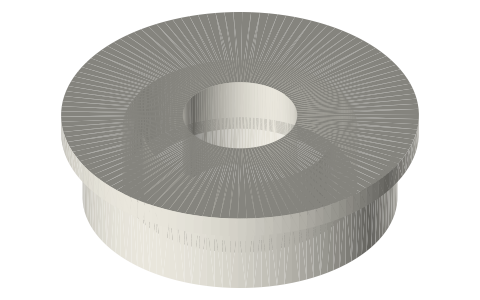
| crank-disc-stroke16 | crank disc, pin at 8 mm | STEP · STL |
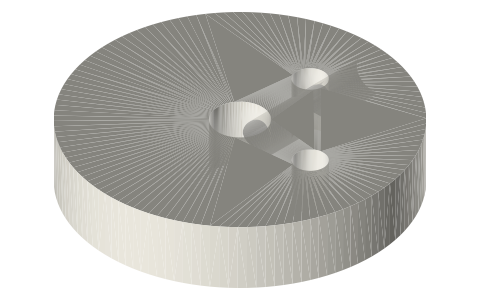
| cylinder-block-2x-syringe-10ml | alpha cylinder block: two parallel 10 mL syringe barrel sockets (Ø16.05) 34 mm apart, pinch slot | STEP · STL |
Plain text: sheet.txt · JSON: /api/geometry?object=ross-yoke-kit
Fits with
Questions
What is a Ross yoke?
A triangular rocker on one crank that drives two parallel pistons about 90° apart with nearly straight-line motion: the way to build an alpha Stirling with side-by-side cylinders instead of a V.
What phase angle does a Ross yoke give?
About 90° with a/h ≈ 1.5; it varies a few degrees through the cycle, which is harmless.
Can I make an alpha Stirling from two syringes?
Yes: the cylinder block takes two 10 mL barrels; heat one, cool the other, connect them with a short tube and a regenerator plug, drive the plungers with the Ross yoke.