 Xem Studiomeasured geometry
Motion mechanisms: Scotch yoke, swash (wobble) plate, eccentric + strap, Geneva, four-bar links, bell crank, rack
How do I convert rotary motion to linear motion with 3D printed parts? · Hardware · basis: Textbook mechanism geometry (Scotch yoke, swash plate stroke = D·sin θ, eccentric stroke = 2e, Geneva with c = R / cos(π/n)); parts sized for Ø5 shafts, Ø3 pins and 623 bearings to match the rest of the shelf
Long Earth Society build part. Displacer drives (yoke, swash plate, eccentric) and the linkages used on the LES rigs. The engines · all LES parts
- sizes
- 7 in table
Notes
- Scotch yoke: pure sinusoidal motion, no con-rod; the crank pin (623 bearing on a Ø3 pin) rides in the yoke slot; stroke = 2 × pin offset. Runs the displacer on a beta Stirling without a wrist pin.
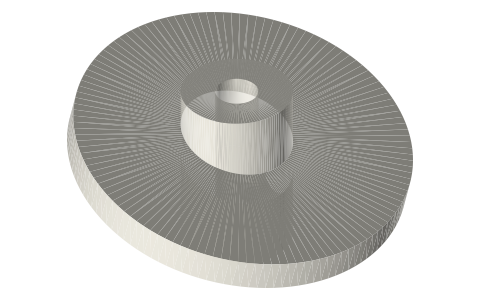
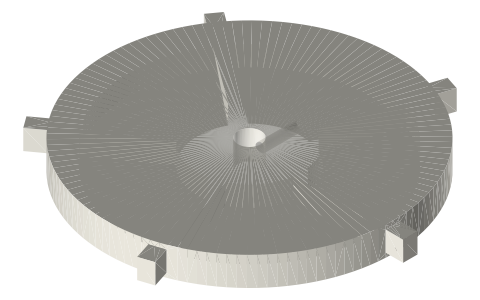
- Swash / wobble plate: a disc tilted θ on the shaft; a follower touching it at radius r reciprocates r·sin θ each side (Ø40 plate at 15° → 10.4 mm stroke at the rim). Several followers around one plate = multi-cylinder from one shaft; the follower here is an 8 mm square pushrod with a ball end.
- Eccentric + strap: a disc offset e on the shaft inside a split ring; stroke 2e, carries load on the whole ring, the quiet way to drive a pump or displacer. Geneva: intermittent motion, n stops per turn; drive-disc radius locks the wheel between indexes.
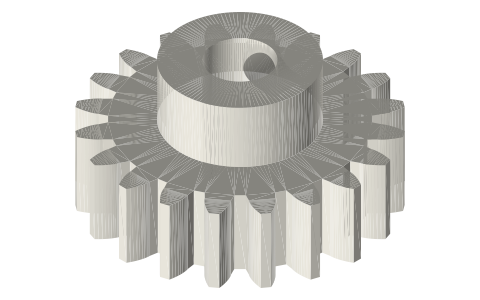
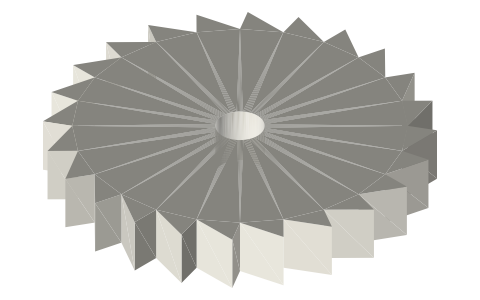
- Four-bar links (20–100 mm centres, Ø3.2) and the bell crank build crank-rockers, parallel motions and the Ross yoke; rack m1 meshes the module 1 gears for linear drives. All pivots are Ø3 dowel pins, Ø3.2 printed holes, or 623 bearings in Ø10.2 pockets.
Sizes
| mechanism | parts | input → output | key dimension |
|---|---|---|---|
| Scotch yoke | yoke + crank | rotary → sinusoidal linear | stroke 20 / 30 mm |
| swash plate | plate + follower | rotary → linear, multi-follower | Ø40 at 10 / 15 / 20° |
| eccentric | disc + split strap | rotary → linear, high load | e 3 / 5 / 8 mm (stroke 6 / 10 / 16) |
| Geneva | wheel + drive | continuous → intermittent | 4 / 6 stations, R30 |
| four-bar links | 7 lengths | rockers, parallel motion, Ross yoke | 20–100 mm centres |
| bell crank | 30×30, 20×40 | redirect / lever 90° | Ø3.2 pins |
| rack | m1 100, m2 150 | rotary ↔ linear with the gears | module 1 / 2 |
Where the files are
Other publishers' files are linked, not hosted. "verify" = check the license at the link before commercial use.
| Wikipedia | Scotch yoke | web | CC BY-SA 4.0 (text) |
| Wikipedia | Swashplate | web | CC BY-SA 4.0 (text) |
| Wikipedia | Geneva drive | web | CC BY-SA 4.0 (text) |
| Wikipedia | Four-bar linkage | web | CC BY-SA 4.0 (text) |
| Wikipedia | Eccentric (mechanism) | web | CC BY-SA 4.0 (text) |
| Long Earth Society | Engine and rig builds on extrusion frames | web, video | LES site |
Free files
★ Free files 27 parts. Generated by Xem Studio from the standard; threads are plain cylinders at major diameter. CC BY 4.0. index.json
| scotch-yoke-20-yoke | Scotch yoke slider, 20 mm stroke, 10.4 mm slot for a 623 bearing on the crank pin, 8 mm rod with M3 end | STEP · STL |
| scotch-yoke-20-crank | Scotch yoke crank disc, pin at 10 mm (20 stroke), Ø5 bore | STEP · STL |
| scotch-yoke-30-yoke | Scotch yoke slider, 30 mm stroke | STEP · STL |
| scotch-yoke-30-crank | Scotch yoke crank disc, pin at 15 mm | STEP · STL |
| swash-plate-40-10deg | swash (wobble) plate Ø40, 10° tilt → 6.9 mm stroke at the rim, Ø5 shaft, M3 set screw | STEP · STL |
| swash-plate-40-15deg | swash (wobble) plate Ø40, 15° tilt → 10.4 mm stroke at the rim, Ø5 shaft, M3 set screw | STEP · STL |
| swash-plate-40-20deg | swash (wobble) plate Ø40, 20° tilt → 13.7 mm stroke at the rim, Ø5 shaft, M3 set screw | STEP · STL |
| swash-follower-8x30 | swash follower: 8 mm square pushrod with a Ø8 ball end, M3 tapped tail | STEP · STL |
| eccentric-d30-e3 | eccentric Ø30, 3 mm offset (6 mm stroke), Ø5 shaft, set screw | STEP · STL |
| eccentric-d30-e5 | eccentric Ø30, 5 mm offset (10 mm stroke), Ø5 shaft, set screw | STEP · STL |
| eccentric-d30-e8 | eccentric Ø30, 8 mm offset (16 mm stroke), Ø5 shaft, set screw | STEP · STL |
| eccentric-strap-d30 | eccentric strap for the Ø30 eccentrics, split ring, 40 mm rod with M3 eye | STEP · STL |
| geneva-4-wheel-r30 | Geneva wheel, 4 stations, R30, 5.6 mm slots, Ø5 bore | STEP · STL |
| geneva-4-drive-r30 | Geneva drive disc + arm + Ø5 pin for the 4-station wheel (centre distance 42.4 mm) | STEP · STL |
| geneva-6-wheel-r30 | Geneva wheel, 6 stations, R30, 5.6 mm slots, Ø5 bore | STEP · STL |
| geneva-6-drive-r30 | Geneva drive disc + arm + Ø5 pin for the 6-station wheel (centre distance 34.6 mm) | STEP · STL |
| link-20 | four-bar / rocker link, 20 mm centres, Ø3.2 holes, 10 wide × 5 | STEP · STL |
| link-30 | four-bar / rocker link, 30 mm centres, Ø3.2 holes, 10 wide × 5 | STEP · STL |
| link-40 | four-bar / rocker link, 40 mm centres, Ø3.2 holes, 10 wide × 5 | STEP · STL |
| link-50 | four-bar / rocker link, 50 mm centres, Ø3.2 holes, 10 wide × 5 | STEP · STL |
| link-60 | four-bar / rocker link, 60 mm centres, Ø3.2 holes, 10 wide × 5 | STEP · STL |
| link-80 | four-bar / rocker link, 80 mm centres, Ø3.2 holes, 10 wide × 5 | STEP · STL |
| link-100 | four-bar / rocker link, 100 mm centres, Ø3.2 holes, 10 wide × 5 | STEP · STL |
| bell-crank-30x30-90 | bell crank 30 × 30 mm arms at 90°, Ø10.2 pocket for a 623 bearing pivot, Ø3.2 arm holes | STEP · STL |
| bell-crank-20x40-90 | bell crank 20 × 40 (2:1), 90° | STEP · STL |
| rack-m1-100 | rack, module 1, 100 mm, 8 high × 8 wide, three M3 mounting holes; meshes with the module 1 gears | STEP · STL |
| rack-m2-150 | rack, module 2, 150 mm | STEP · STL |
Plain text: sheet.txt · JSON: /api/geometry?object=motion-mechanisms
Fits with
Questions
What is a Scotch yoke and when is it better than a con-rod?
A pin in a slot: the slider moves as a pure sine of crank angle with no connecting rod, so it is shorter and has no angularity; the pin bearing takes side load, so put a 623 on it. Good for displacers and pumps.
How much stroke does a swash plate give?
Stroke = 2 × r × sin θ for a follower at radius r on a plate tilted θ: Ø40 plate, follower at r = 18, 15° → 9.3 mm. Several followers around the plate run from one shaft.
What is the stroke of an eccentric?
Twice the offset: a 5 mm eccentric gives a 10 mm stroke. The split strap goes over the disc and the rod takes the motion.
What centre distance does a Geneva mechanism need?
c = R / cos(π/n): for a 6-station wheel of R30, 34.6 mm; the drive pin sits at R·tan(π/n) = 17.3 mm from the drive centre.