 Xem Studiomeasured geometry
Library › Aircraft design › Tail configurations ·
Tail volume coefficient (horizontal and vertical tail sizing)
What is the tail volume coefficient and how do you size an RC plane's tail with it? · Standard part · basis: Design rules and figures from the cited sources; example geometry by Xem Studio
Also called: tail volume coefficient, horizontal tail volume coefficient, vertical tail volume coefficient, how big should the tail be rc plane, tail sizing formula, Vh Vv tail volume, raymer tail volume table, stabilizer size calculator, rc plane tail area percentage, tail moment arm formula, horizontal stabilizer sizing
Exact dimensions. True size, with no printing tolerance added.
- sizes
- 19 in table
Notes
- The tail volume coefficient multiplies tail area by tail arm and divides by wing area times a reference length (MAC for the stabiliser, span for the fin), so one number captures how much pitch or yaw 'leverage' the tail has (EAA Chapter 62, Kitplanes).
- Designers pick a coefficient from aircraft of the same class and solve for tail area or arm; published class values run from 0.50/0.02 for sailplanes to 1.00/0.09 for jet transports (HAW Hamburg Table 2.1, matching Raymer's Table 6.4 values quoted by OpenConcept).
- A longer arm needs less area for the same coefficient, and the ratio of tail arm to MAC sets how much tail lift is needed to trim the wing (Kitplanes, Wainfan). Light aircraft with little c.g. travel, like the J-3 Cub, sit at the low end (Vh 0.34) while four-seaters with more c.g. travel, like the Navion, sit high (Vh 0.69) (EAA62/Pazmany).
- Used on: Piper J-3 Cub, Luscombe Silvaire, Ryan Navion.
- The file is a reference example built by Xem Studio from the numbers above. Sizes the sources do not fix are illustrative; scale the example to your own vehicle.
Tail volume coefficient size chart
| parameter | value or range | source |
|---|---|---|
| Horizontal tail volume Vh = (Sh x Lh)/(Sw x MAC) | definition | EAA62 / Kitplanes |
| Vertical tail volume Vv = (Sv x Lv)/(Sw x b) | definition | EAA62 |
| Sailplane Vh / Vv | 0.50 / 0.02 | HAW Hamburg Table 2.1 (Raymer-type table) |
| Homebuilt Vh / Vv | 0.50 / 0.04 | HAW Hamburg Table 2.1 |
| General aviation single engine Vh / Vv | 0.70 / 0.04 | HAW Hamburg Table 2.1 |
| General aviation twin engine Vh / Vv | 0.80 / 0.07 | HAW Hamburg Table 2.1 |
| Agricultural Vh / Vv | 0.50 / 0.04 | HAW Hamburg Table 2.1 |
| Twin turboprop Vh / Vv | 0.90 / 0.08 | HAW Hamburg Table 2.1; OpenConcept (Raymer 1992 Table 6.4) |
| Flying boat Vh / Vv | 0.70 / 0.06 | HAW Hamburg Table 2.1 |
| Jet trainer Vh / Vv | 0.70 / 0.06 | HAW Hamburg Table 2.1 |
| Jet fighter Vh / Vv | 0.40 / 0.07 | HAW Hamburg Table 2.1 |
| Military cargo/bomber Vh / Vv | 1.00 / 0.08 | HAW Hamburg Table 2.1 |
| Jet transport Vh / Vv | 1.00 / 0.09 | HAW Hamburg Table 2.1; OpenConcept (Raymer 1992 Table 6.4) |
| Typical ranges (statistics) | Vh 0.5-1.0; Vv 0.03-0.08 | Scholz 2021 |
| Piper J-3 Cub Vh / Vv | 0.340 / 0.022 | EAA62 (Pazmany) |
| Luscombe Silvaire Vh / Vv | 0.442 / 0.026 | EAA62 (Pazmany) |
| Ryan Navion Vh / Vv | 0.692 / 0.040 | EAA62 (Pazmany) |
| T-tail allowance | tail volume coefficients may be reduced by 4% | Scholz 2021 |
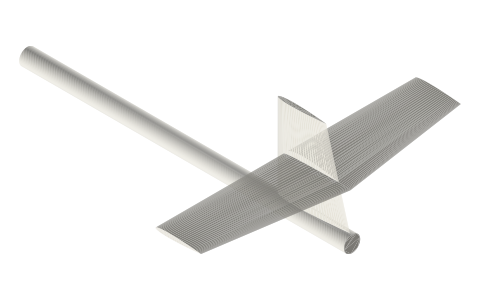
| Reference build (computed) | wing 1000 x 200 mm, Lh 500 mm, Vh 0.50 -> Sh 40,000 mm^2; Vv 0.04 -> Sv 16,000 mm^2 | computed from table above |
Where the files are
Other publishers' files are linked, not hosted. "verify" = check the license at the link before commercial use.
| EAA Chapter 62 (Stan Hall, from Pazmany 'Light Airplane Design') | How Big The Tail | web | Publisher's page; dimensions are facts |
| HAW Hamburg (Aircraft Design and Systems Group) | Empennage sizing: tail lever arm as % of fuselage length (thesis; Table 2.1 typical tail volume coefficients) | web | Publisher's page; dimensions are facts |
| MDO Lab, University of Michigan (OpenConcept docs) | Tail volume coefficient sizing (Raymer 1992 Table 6.4 defaults) | web | Publisher's page; dimensions are facts |
| INCAS Bulletin / HAW Hamburg (D. Scholz) | Empennage sizing with the tail volume complemented with a method for dorsal fin layout (2021) | web | Publisher's page; dimensions are facts |
| Kitplanes (B. Wainfan) | Design Process: Horizontal Tail (2022) | web | Publisher's page; dimensions are facts |
Free files
★ Free files 1 parts. Xem Studio design: free to use, print and sell things from; not to be republished as files. Xem Studio Design License. index.json
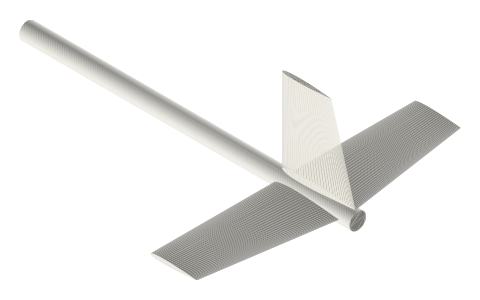
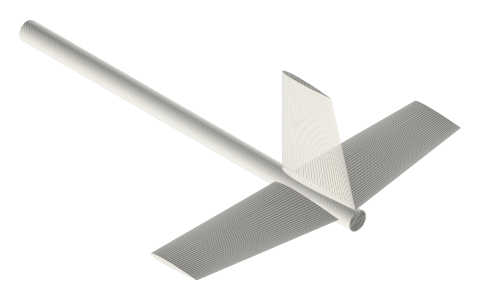
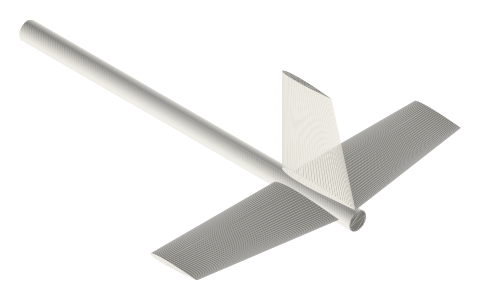
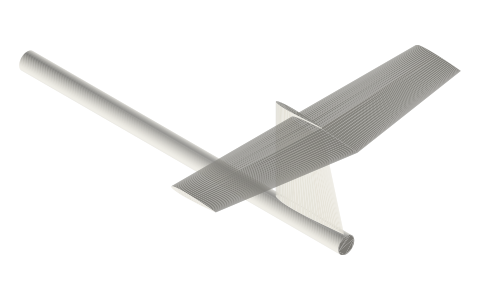
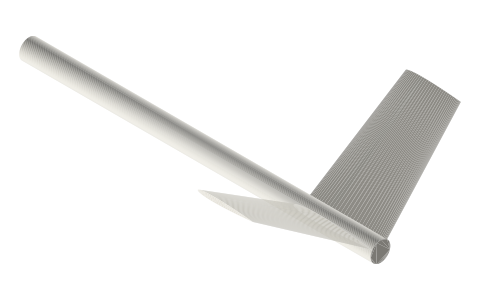
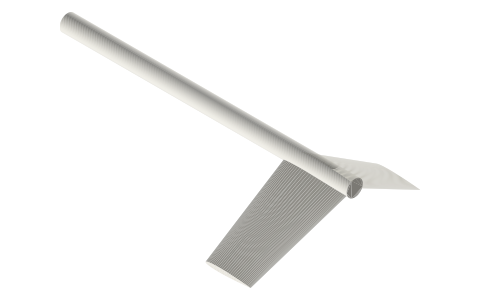
| tail-volume-coefficient-tail | conventional layout: horizontal span 400 × chord 100, vertical 140 × 114 mm on a 500 mm boom, NACA 0009 surfaces | STEP · STL |
https://xemstudio.com/mcp to Claude, ChatGPT, Cursor or any MCP client (free, no account, one minute) and it can look up exact sizes, mating fits and free STEP/STL from every chat.Plain text: sheet.txt · JSON: /api/geometry?object=tail-volume-coefficient
Fits with
Questions
What tail volume should an RC trainer use?
The homebuilt/sailplane class values of Vh 0.50 and Vv 0.02-0.04 (HAW Hamburg Table 2.1) are the closest published classes; full-size GA singles use 0.70/0.04.
Does a longer tail arm let me shrink the tail?
Yes. Area and arm trade one-for-one in the coefficient: Sh = Vh x Sw x MAC / Lh (EAA62).