 Xem Studiomeasured geometry
Library › Aircraft design › Tail configurations ·
V-tail (butterfly tail with ruddervators)
What is a V-tail and how do you size the ruddervators? · Standard part · basis: Design rules and figures from the cited sources; example geometry by Xem Studio
Also called: v-tail, v tail rc plane, ruddervator, butterfly tail, v-tail angle calculator, v tail sizing, v-tail dihedral angle, v-tail vs conventional tail, vee tail, v tail mixing, ruddervator size, v tail glider
Exact dimensions. True size, with no printing tolerance added.
- sizes
- 8 in table
Notes
- A V-tail replaces the stabiliser and fin with two slanted surfaces; their ruddervators move together for pitch and differentially for yaw (FAA PHAK ch.6). FAA notes it is more complex, more prone to Dutch roll, and the 'total reduction in drag is minimal'.
- Sizing rule (McCombs, Model Aviation): effective horizontal area = 2S cos^2(a) and effective vertical area = 2S sin^2(a), where S is one panel and a the dihedral. Because cos^2 + sin^2 = 1, total V-tail area equals the sum of the conventional horizontal and vertical areas it replaces, which is also Wainfan's conclusion (Kitplanes: no net area saving).
- Yaw input creates a roll opposite to the commanded yaw (Kitplanes), though on RC sailplanes Stackhouse calls it 'truly negligible'; ruddervators can flutter, so balance them (Kitplanes). NACA TR-823 (Purser & Campbell) is the classic test-verified V-tail theory.
- Used on: Beechcraft Bonanza V35, Fouga CM 170 Magister, Antonov A-15.
- The file is a reference example built by Xem Studio from the numbers above. Sizes the sources do not fix are illustrative; scale the example to your own vehicle.
V-tail size chart
| parameter | value or range | source |
|---|---|---|
| Typical dihedral per panel (models) | about 40 deg | McCombs, Model Aviation 1994 |
| Typical dihedral (full-size) | usually about 45 deg | Kitplanes V-Tails |
| Effective horizontal area | 2S cos^2(a) | McCombs 1994 |
| Effective vertical area | 2S sin^2(a) | McCombs 1994 |
| Angle from required areas | tan^2(a) = Sv_req / Sh_req | derived from McCombs formulas |
| Worked example (McCombs) | 40 deg -> 31 deg cut effective fin area from 12.4 to ~7.96 in^2 | McCombs 1994 |
| Reference build (computed) | Sh_req 40,000 + Sv_req 16,000 mm^2 -> a = 32.3 deg, each panel 28,000 mm^2 (250 x 112 mm) | computed |
| Pitch coupling fix | small differential: more travel on the down-going ruddervator | Stackhouse, CRRC |
Where the files are
Other publishers' files are linked, not hosted. "verify" = check the license at the link before commercial use.
| FAA | Pilot's Handbook of Aeronautical Knowledge (FAA-H-8083-25), Ch. 6 Flight Controls | web | Publisher's page; dimensions are facts |
| Model Aviation (AMA), W.F. McCombs | Wing and Tail Dihedral for Models (Dec 1994) | web | Publisher's page; dimensions are facts |
| Kitplanes (B. Wainfan) | Design Process: V-Tails (2022) | web | Publisher's page; dimensions are facts |
| Charles River Radio Controllers (D. Stackhouse) | V-Tail Adverse Yaw (1999) | web | Publisher's page; dimensions are facts |
| NACA (Purser & Campbell) | Experimental Verification of a Simplified Vee-Tail Theory, NACA TR-823 (1945) | web | Publisher's page; dimensions are facts |
| engrXiv (Bhattacharya et al., ICMMM 2023) | Design and Computational Analysis of Y-tail Configuration for Maritime UAV | web | Publisher's page; dimensions are facts |
Free files
★ Free files 1 parts. Xem Studio design: free to use, print and sell things from; not to be republished as files. Xem Studio Design License. index.json
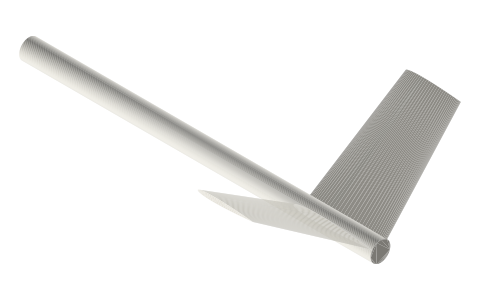
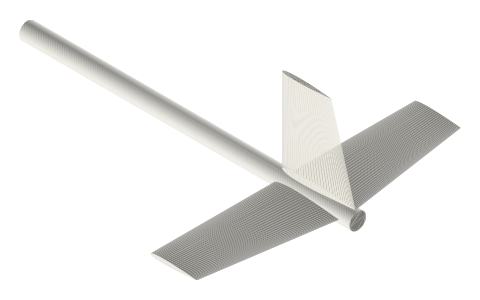
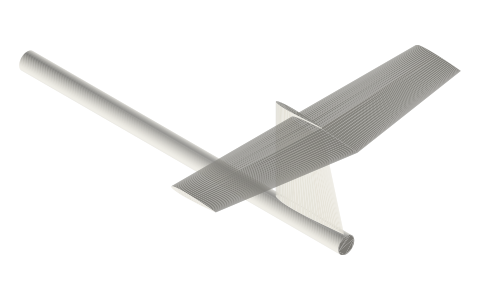
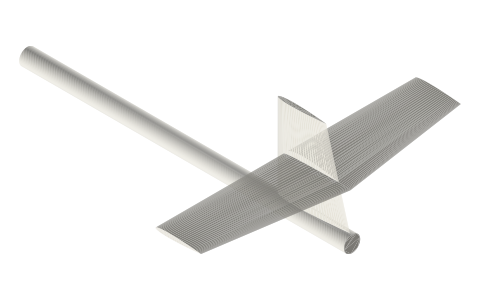
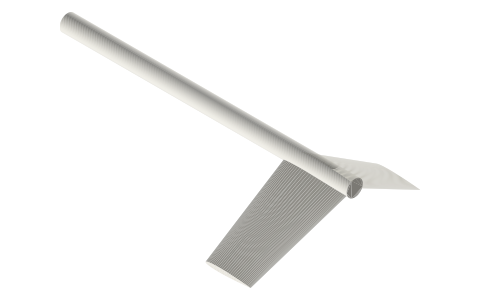
| v-tail-tail | v tail layout: horizontal span 250 × chord 112, vertical 0 × 0 mm on a 500 mm boom, NACA 0009 surfaces | STEP · STL |
https://xemstudio.com/mcp to Claude, ChatGPT, Cursor or any MCP client (free, no account, one minute) and it can look up exact sizes, mating fits and free STEP/STL from every chat.Plain text: sheet.txt · JSON: /api/geometry?object=v-tail
Fits with
Questions
What angle should a V-tail be?
Pick it from the areas you need: tan^2(a) = vertical area / horizontal area (McCombs). Models typically land near 40 deg (McCombs), full-size near 45 deg (Kitplanes).
Does a V-tail have less drag?
Not much: there is no wetted-area saving and FAA calls the total drag reduction minimal (Kitplanes; PHAK ch.6).