 Xem Studiomeasured geometry
Library › Aircraft design › Wing planforms ·
Tapered wing (taper ratio for minimum induced drag)
What taper ratio gives the lowest induced drag? · Standard part · basis: Design rules and figures from the cited sources; example geometry by Xem Studio
Also called: tapered wing, taper ratio, best taper ratio, taper ratio induced drag, tapered wing rc, tapered vs rectangular wing, trapezoidal wing, wing taper calculator, optimal taper ratio 0.45, tip chord root chord ratio
Exact dimensions. True size, with no printing tolerance added.
- sizes
- 6 in table
Notes
- Taper ratio is tip chord divided by root chord (Leishman, ERAU). Tapering moves the span loading toward elliptical, raising span efficiency and lowering induced drag (Kitplanes, Wainfan).
- Torenbeek's guidance, quoted in a UAV design paper, picks a taper ratio of 0.45 'because it gives fairly elliptic lift distribution and good stall characteristics' (arXiv 1801.02938). Leishman notes linear taper is a good compromise between weight and structural efficiency.
- Strong taper loads the tips more, so tapered wings need washout to keep the stall inboard (Boldmethod; R/C Soaring Digest).
- The file is a reference example built by Xem Studio from the numbers above. Sizes the sources do not fix are illustrative; scale the example to your own vehicle.
Tapered wing size chart
| parameter | value or range | source |
|---|---|---|
| Taper ratio definition | lambda = c_tip / c_root | ERAU (Leishman) |
| Recommended taper (unswept) | 0.45 | arXiv 1801.02938 citing Torenbeek (1976) |
| 2:1 taper example | lambda = 0.5 | ERAU; Kitplanes |
| Span loading example plotted | lambda = 0.4 closer to elliptical than constant chord | Kitplanes (Wainfan) |
| Model dihedral correction for taper | EVD factor F = 0.8 + 0.2 (Ct/Cr) | McCombs, Model Aviation 1994 |
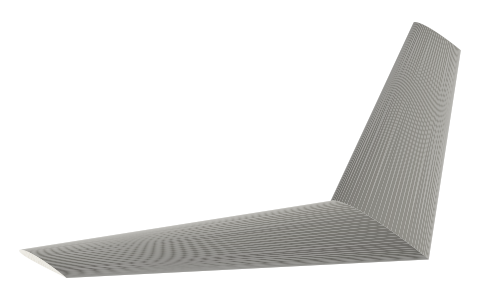
| Reference build | span 1000, root 220, tip 99 (lambda 0.45) | computed |
Where the files are
Other publishers' files are linked, not hosted. "verify" = check the license at the link before commercial use.
| Embry-Riddle (Leishman), Introduction to Aerospace Flight Vehicles | Wing Shapes and Nomenclature | web | Publisher's page; dimensions are facts |
| arXiv 1801.02938 (citing Torenbeek, Synthesis of Subsonic Airplane Design, 1976) | Systematic design methodology for a variable pitch quadrotor biplane VTOL UAV | web | Publisher's page; dimensions are facts |
| Kitplanes (B. Wainfan) | Design Process: Planform Effects on Span Loading and Drag (2020) | web | Publisher's page; dimensions are facts |
| Model Aviation (AMA), W.F. McCombs | Wing and Tail Dihedral for Models (Dec 1994) | web | Publisher's page; dimensions are facts |
| Boldmethod (pilot training) | How Stall Strips Keep Your Plane Under Control | web | Publisher's page; dimensions are facts |
| R/C Soaring Digest | Twist Distributions for Swept Wings, Part 2 (June 2002) | web | Publisher's page; dimensions are facts |
Free files
★ Free files 1 parts. Xem Studio design: free to use, print and sell things from; not to be republished as files. Xem Studio Design License. index.json
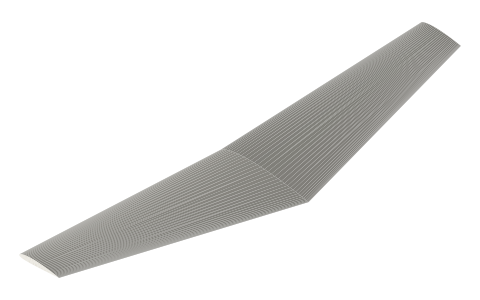
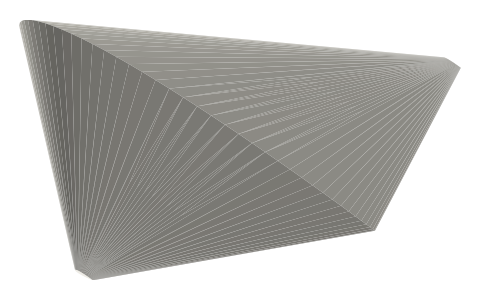
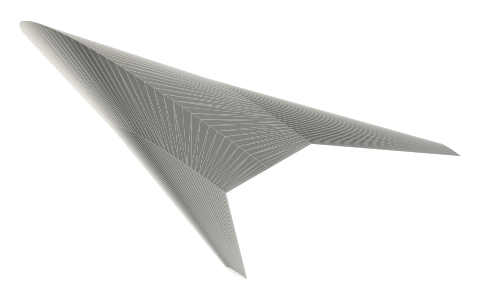
| tapered-wing-wing | tapered planform: span 1000, root 220, tip 99 mm, LE sweep 0°, dihedral 3°, NACA 2412 | STEP · STL |
https://xemstudio.com/mcp to Claude, ChatGPT, Cursor or any MCP client (free, no account, one minute) and it can look up exact sizes, mating fits and free STEP/STL from every chat.Plain text: sheet.txt · JSON: /api/geometry?object=tapered-wing
Fits with
Questions
What taper ratio should I use?
Torenbeek's 0.45 is a well-cited choice for unswept wings (via arXiv 1801.02938).