 Xem Studiomeasured geometry
Library › Stirling engines › Thermoacoustic & fluidyne ·
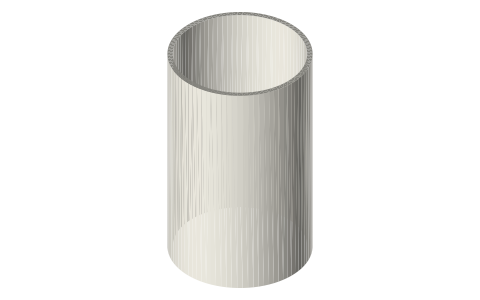
Thermoacoustic hot-cavity liners: Ø47.5 / Ø44 tubes that set a 40 mm hot exchanger flush with a closed hot end's face
How do I hold a hot heat exchanger at the top of a closed tri-clamp hot end? · Hardware · basis: Design values: lengths = the hot section's inside depth (length − 3 mm closed end) − four 10 mm hot exchanger discs
Long Earth Society build part. The hot cavity of my modular thermoacoustic engine. The engines
Exact dimensions. Every file is drawn at true size with no printing tolerance. The holes and pins that meet another part are listed below under Mating features, with the fit each joint needs; open those by your printer's or process's clearance before making the part. Mating features
- sizes
- 4 in table
Notes
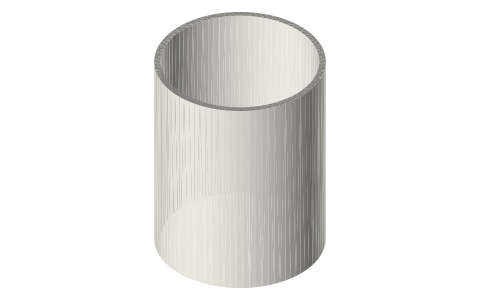
- A plain tube that stands on the inside of a closed 2 in hot end and holds the hot heat exchanger at its top, so the exchanger's top face is flush with the hot end's clamp face. The stack in the next section then stands on the exchanger, across the hot joint.
- Bore Ø44: the gas inside the liner is the engine's hot cavity, the gas spring at the hot end that sets how much the gas moves through the stack. Outside Ø47.5: the spool bore, a slide fit.
- It runs at the hot end's temperature: it has to take that temperature. The file is the geometry; what it is made of is the builder's choice.
Sizes
| part | hot section | section length_mm | inside depth_mm | liner_mm | hot exchanger above_mm |
|---|---|---|---|---|---|
| ta-hot-liner-2in-17 | cup-2in-60 | 60.0 | 57.0 | 17.0 | 40.0 |
| ta-hot-liner-2in-47 | cup-2in-90 | 90.0 | 87.0 | 47.0 | 40.0 |
| ta-hot-liner-2in-77 | cup-2in-120 | 120.0 | 117.0 | 77.0 | 40.0 |
| ta-hot-liner-2in-109.4 | closed-spool-2in-152.4 | 152.4 | 149.4 | 109.4 | 40.0 |
Mating features
Drawn at the exact size. Open press, slide, run and socket features by your process's clearance; leave designed gaps and clamp fits as drawn.
| feature | exact | mates with | fit | files |
|---|---|---|---|---|
| outside | Ø47.5 | closed hot cup / closed-end spool bore Ø47.5 | slide | all |
| inside | Ø44 | hot cavity gas (no contact) | designed | all |
| lower end | flat ring Ø44–Ø47.5 | the cup's closed end (inside floor) | designed | all |
| upper end | flat ring Ø44–Ø47.5 | the lowest hot exchanger disc's outer ring | designed | all |
| length | 17 / 47 / 77 / 109.4 | sets the top hot disc flush with the hot section face | designed | all |
Where the files are
Other publishers' files are linked, not hosted. "verify" = check the license at the link before commercial use.
| Xem Studio | tools/gen_ta_modular.py: the section geometry, the network model and every number on these pages | code | CC BY 4.0 |
| Long Earth Society | Engine builds | web, video | LES site |
Free files
★ Free files 4 parts. Generated by Xem Studio from the standard; threads are plain cylinders at major diameter. CC BY 4.0. index.json
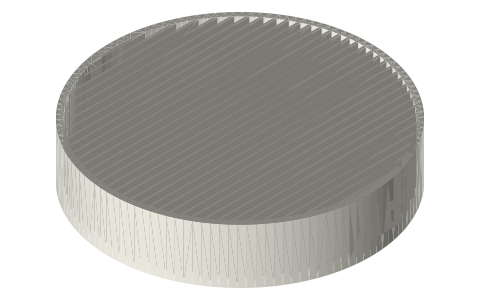
| ta-hot-liner-2in-17 | hot-cavity liner Ø47.5 / Ø44 × 17: stands on the closed end of cup-2in-60 and carries the four hot exchanger discs, whose top is then flush with the face | STEP · STL |
| ta-hot-liner-2in-47 | hot-cavity liner Ø47.5 / Ø44 × 47: stands on the closed end of cup-2in-90 and carries the four hot exchanger discs, whose top is then flush with the face | STEP · STL |
| ta-hot-liner-2in-77 | hot-cavity liner Ø47.5 / Ø44 × 77: stands on the closed end of cup-2in-120 and carries the four hot exchanger discs, whose top is then flush with the face | STEP · STL |
| ta-hot-liner-2in-109.4 | hot-cavity liner Ø47.5 / Ø44 × 109.4: stands on the closed end of closed-spool-2in-152.4 and carries the four hot exchanger discs, whose top is then flush with the face | STEP · STL |
Plain text: sheet.txt · JSON: /api/geometry?object=thermoacoustic-hot-cavity-liner
How it fits
In these build lists
Modular free-piston thermoacoustic engine, 2 in…A standing-wave thermoacoustic engine built from 2 in sanitary sections like Leg…You might also need
Questions
Why a liner and not a ledge?
A closed-end spool is plain tube inside; a liner standing on the closed end puts the exchanger exactly at the top without any welding or machining of the spool.
Which liner for which hot section?
Match the hot section: the table lists the liner for each closed hot end that takes the modular engine's column.