 Xem Studiomeasured geometry
Library › Hardware › Stirling & thermoacoustic ·
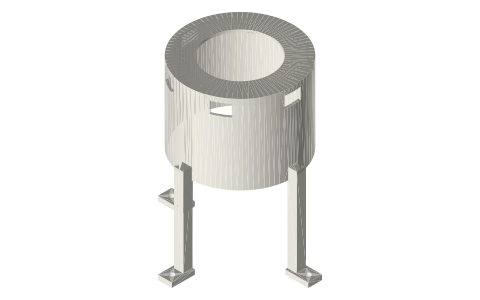
Finned tri-clamp hot head: 2 in tube closed at the end in one piece, with ring fins
How do I make a hot end for a pressurised tri-clamp Stirling engine with no gasket in the flame? · Hardware · basis: ISO 2852 ferrule face and 20° back cone as the ferrule on this site (gen_hardware.tc_ferrule); ASME BPE 2 in tube Ø50.8 × 1.65; length from the displacer stroke and clearances of the sealed generator; fin size and pitch are design values
Long Earth Society build part. The hot end of my sealed generator: closed in one piece so that no seal sits in the flame. The engines
Exact dimensions. Every file is drawn at true size with no printing tolerance. The holes and pins that meet another part are listed below under Mating features, with the fit each joint needs; open those by your printer's or process's clearance before making the part. Mating features
- sizes
- 7 in table
Notes
- One piece: a 2 in ferrule face, the 16 ga tube and a 3 mm closed end with a 1.5 mm outer round. The only joint is at the top, above the water jacket, where the power membrane is clamped; nothing that seals is near the flame.
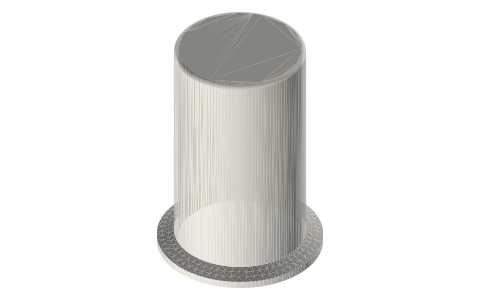
- 149.74 mm from the face to the outer bottom. The Ø46 × 120 displacer runs inside with the 0.75 mm designed radial gap (the gap is heater, regenerator and cooler in one) and comes to 2.0 mm above the floor at the bottom of its stroke.
- Nine ring fins Ø76 × 1.5 at 5 mm pitch cover the bottom 43.5 mm, inside the burner shroud. From the top fin to the jacket there are 40.1 mm of plain tube; the jacket takes the next 56 mm, up to 3 mm under the clamp.
- Fits: the face is a clamp face (the membrane goes in place of the gasket); the bore is the displacer's running bore with its designed gap; the tube OD carries the jacket halves (clamp fit).
Sizes
| feature | value |
|---|---|
| face | ISO 2852, 2 in (Ø64 flange, Ø56.5 groove) |
| tube | Ø50.8 × 1.65, bore Ø47.5 |
| face to outer bottom | 149.74 |
| closed end | 3 thick, 1.5 outer round |
| fins | 9 × Ø76 × 1.5, 5 pitch |
| finned length | 43.5 |
| plain tube, fins to jacket | 40.1 |
Mating features
Drawn at the exact size. Open press, slide, run and socket features by your process's clearance; leave designed gaps and clamp fits as drawn.
| feature | exact | mates with | fit | files |
|---|---|---|---|---|
| ferrule face | ISO 2852 (land Ø56.5–Ø64, rim 2.85, 1.6 recess, 20° back to the tube OD) | standard clamp + membrane bead (cross bottom face) | clamp | all |
| bore | Ø47.5 | Ø46 displacer: 0.75 radial gap (heater, regenerator, cooler) | designed | all |
| tube OD | Ø50.8 | jacket halves (jacket-half-2in-56) | clamp | all |
| fins | 9 × Ø76 × 1.5 at 5 pitch | burner shroud Ø88 bore: 6 mm gas annulus | designed | all |
| floor | 2.0 under the displacer at the bottom of its stroke | displacer closed end | designed | all |
Where the files are
Other publishers' files are linked, not hosted. "verify" = check the license at the link before commercial use.
| ISO (via iTeh sample) | ISO 2852 clamp liners: face profile and flange / groove diameters | standard excerpt; dimensions are facts | |
| ASME | BPE Bioprocessing Equipment (clamp fitting dimensions, tube OD and wall) | standard | ASME; dimensions are facts verify |
| Long Earth Society | Engine builds | web, video | LES site |
Free files
★ Free files 1 parts. Generated by Xem Studio from the standard; threads are plain cylinders at major diameter. CC BY 4.0. index.json
| hot-head-2in-149.74 | 2 in finned hot head, one piece: ISO 2852 ferrule face (land Ø56.5–Ø64, rim 2.85, recess 1.6 inside Ø56.5, 20° back to the tube OD), Ø50.8 × 1.65 tube, 149.74 from the face to the outer bottom, 3 mm closed end with a 1.5 outer round, 9 ring fins Ø76 × 1.5 at 5 pitch from 2 above the bottom | STEP · STL |
Plain text: sheet.txt · JSON: /api/geometry?object=tri-clamp-finned-hot-head

How it fits
In these build lists
Tri-clamp sealed diaphragm generator, 2 inA sealed, pressurised gamma Stirling generator in 2 in tri-clamp: a finned one-p…You might also need
Questions
Why not a cap and a gasket at the hot end?
A gasket in the flame is the first thing to fail on a pressurised engine. Closing the tube in one piece moves the only joint up to the cold end, above the jacket.
What runs inside it?
The Ø46 × 120 displacer with 0.75 mm all round, 2.0 mm off the floor at the bottom of its stroke.