 Xem Studiomeasured geometry
Library › Mechanisms › Cams ·
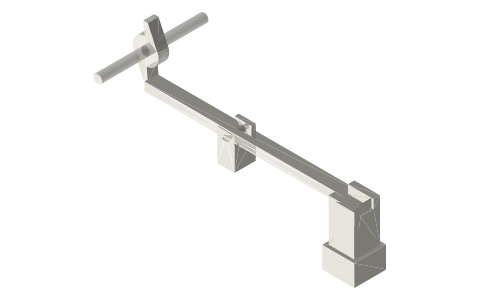
Trip hammer: wiper cam pressing the tail of a first-order helve
How does a trip hammer work? · Hardware · basis: Xem Studio design following Brown No. 353 (1868)
Also called: trip hammer, tilt hammer, helve hammer, cam hammer, martinete de cola, Schwanzhammer
Exact dimensions. True size, with no printing tolerance added.
- sizes
- 4 in table
Notes
- A shaft carrying wiper cams turns above the tail of the hammer helve: each lobe presses the tail down, the head at the other end of the lever rises, and when the lobe slips off the tail the head falls on the anvil. Two lobes give two blows per turn.
- First-order lever (fulcrum between cam and head): tail 80 mm, head 120 mm, so the head rises 1.5 × the cam's lift. Drawn with the helve at rest on the anvil and a lobe tip just touching the tail (contact only), ready to press.
- Brown's No. 353 (tilt hammer with the helve as a first-order lever, modified from No. 72, where it is a third-order lever).
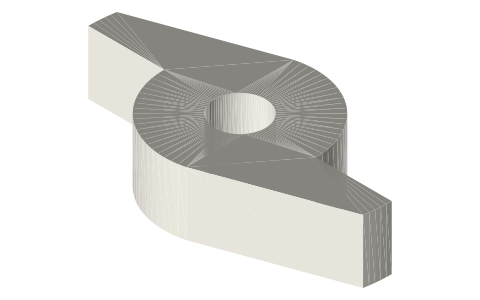
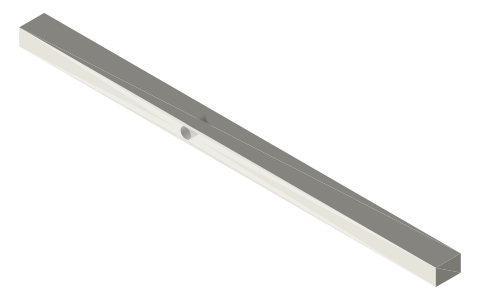
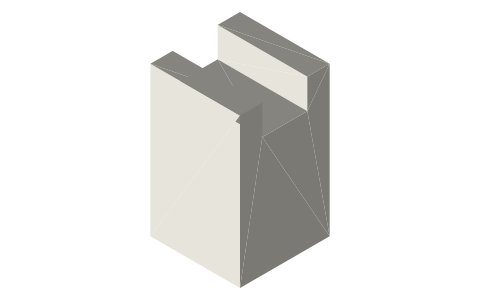
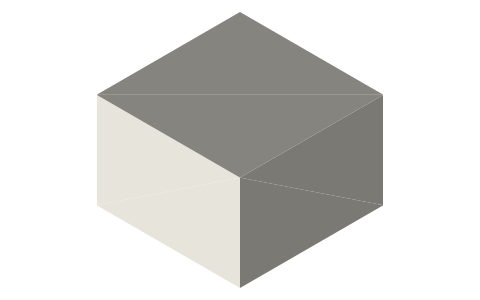
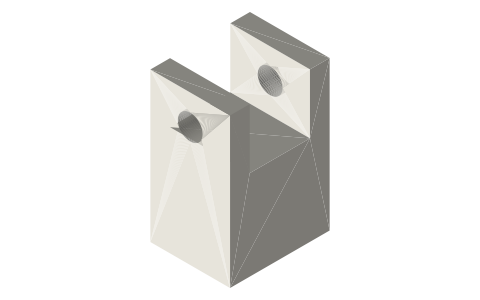
- Parts (each has its own page): wiper-cam-2-lobe-r12-r24-b8, trip-hammer-helve-200x12, hammer-head-24x24x40, anvil-block-30x30x20, pivot-post-16x20x30-fork, linear-shafts-h6, dowel-pins-metric.
- Brown's movement No. 353 (1868) shows it; this model is a Xem Studio design following his figure, every part at true size.
Trip hammer: wiper cam pressing the tail of a first-order helve size chart
| parameter | value |
|---|---|
| helve | 200 mm, pivot at 80 from the tail |
| cam | 2 lobes, lift 12 mm |
| head lift | 18 mm per blow |
| blows per turn | 2 |
Where the files are
Other publishers' files are linked, not hosted. "verify" = check the license at the link before commercial use.
| Henry T. Brown (1868, public domain) | Five Hundred and Seven Mechanical Movements — scan on archive.org | web | Publisher's page; dimensions are facts |
| 507movements.com | Brown's movement No. 353: figure, his text and an animation | web | Publisher's page; dimensions are facts |
Free files
★ Free files 1 parts. Xem Studio design: free to use, print and sell things from; not to be republished as files. Xem Studio Design License. index.json
| trip-hammer-mechanism-assembly | Assembled mechanism, all parts placed at one pose (STEP keeps each part separate) | STEP · STL |
https://xemstudio.com/mcp to Claude, ChatGPT, Cursor or any MCP client (free, no account, one minute) and it can look up exact sizes, mating fits and free STEP/STL from every chat.Plain text: sheet.txt · JSON: /api/geometry?object=trip-hammer-mechanism
Fits with
Questions
How does a trip hammer work?
A shaft carrying wiper cams turns above the tail of the hammer helve: each lobe presses the tail down, the head at the other end of the lever rises, and when the lobe slips off the tail the head falls on the anvil. Two lobes give two blows per turn.