 Xem Studiomeasured geometry
Library › Aircraft design › Tail configurations ·
Canard (foreplane ahead of the wing)
What is a canard and why do some aircraft put the tail in front? · Standard part · basis: Design rules and figures from the cited sources; example geometry by Xem Studio
Also called: canard, canard aircraft, canard wing, canard rc plane, foreplane, canard vs conventional tail, canard stall, tail first airplane, canard design rules, canard configuration
Exact dimensions. True size, with no printing tolerance added.
- sizes
- 5 in table
Notes
- A canard is a horizontal surface ahead of the wing that lifts upward to hold the nose up, instead of pushing down like an aft tail; FAA notes it is theoretically more efficient because it helps carry the weight (PHAK ch.6).
- If the canard stalls before the wing, longitudinal stability and stall resistance increase (NASA TP-2623); in NASA's tunnel test, full elevator at mid c.g. could only trim to about 15 deg, below wing stall. At aft c.g. the same model showed a potential deep-stall trim near 53 deg, so c.g. limits matter.
- NASA's model needed an outboard leading-edge droop to stop premature wing-tip stall and wing rock (TP-2623).
- Used on: Wright Flyer, Piaggio P180, Beech Starship, X-29.
- The file is a reference example built by Xem Studio from the numbers above. Sizes the sources do not fix are illustrative; scale the example to your own vehicle.
Canard size chart
| parameter | value or range | source |
|---|---|---|
| Canard aspect ratio (NASA test model) | 11.90 (wing 9.18) | NASA TP-2623 |
| Trim limit, mid c.g., full elevator | about 15 deg AoA (below wing stall) | NASA TP-2623 |
| Potential deep-stall trim, aft c.g. | about 53 deg AoA | NASA TP-2623 |
| Outboard LE droop added | ~6% chord extension, ~3% camber on outer 25% span | NASA TP-2623 |
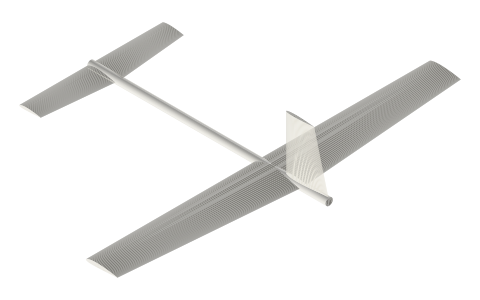
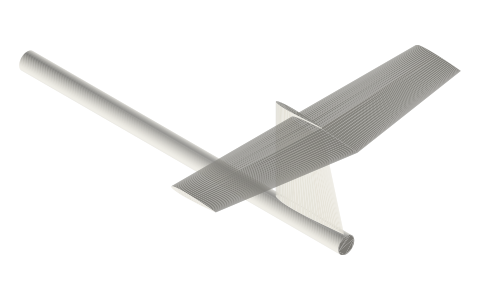
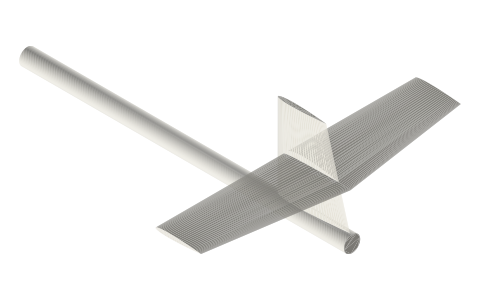
| Reference build | canard 300 x 60 mm, arm 500 mm ahead of wing | illustrative |
Where the files are
Other publishers' files are linked, not hosted. "verify" = check the license at the link before commercial use.
| FAA | Pilot's Handbook of Aeronautical Knowledge (FAA-H-8083-25), Ch. 6 Flight Controls | web | Publisher's page; dimensions are facts |
| NASA Langley (D. Satran) | Wind-Tunnel Investigation of the Flight Characteristics of a Canard General-Aviation Airplane Configuration, NASA TP-2623 (1986) | web | Publisher's page; dimensions are facts |
| Kitplanes (B. Wainfan) | Wind Tunnel: More Flying Fleas (2017) | web | Publisher's page; dimensions are facts |
| Kitplanes (B. Wainfan) | Wind Tunnel: Vortex Generators and STOL Performance (2012) | web | Publisher's page; dimensions are facts |
| NASA Armstrong | X-29 Fact Sheet FS-008 | web | Publisher's page; dimensions are facts |
Free files
★ Free files 1 parts. Xem Studio design: free to use, print and sell things from; not to be republished as files. Xem Studio Design License. index.json
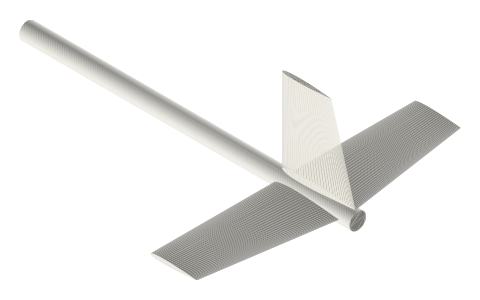
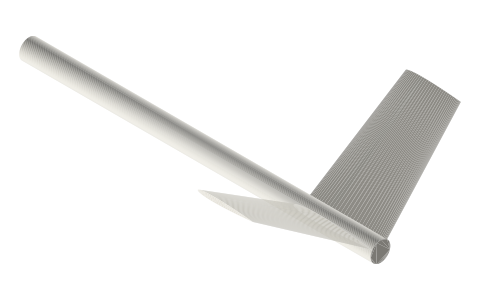
| canard-tail | canard layout: horizontal span 300 × chord 60, vertical 120 × 90 mm on a 500 mm boom, NACA 0009 surfaces | STEP · STL |
https://xemstudio.com/mcp to Claude, ChatGPT, Cursor or any MCP client (free, no account, one minute) and it can look up exact sizes, mating fits and free STEP/STL from every chat.Plain text: sheet.txt · JSON: /api/geometry?object=canard
Fits with
Questions
Why is a canard stall-resistant?
The canard is set to stall first; when it does the nose drops before the wing stalls (NASA TP-2623).
Is a canard more efficient?
Theoretically, because it lifts rather than pushing down (FAA PHAK ch.6).