 Xem Studiomeasured geometry
Library › Tools & garage › Bench & craft machines ·
Cyclone separator proportions: Stairmand high-efficiency and Lapple conventional
What are the standard cyclone separator dimensions (Stairmand, Lapple) as ratios of the barrel diameter? · Standard part · basis: Published ratios: Stairmand 1951, Lapple 1951, as tabulated in Utikar et al. 2010, Grave et al. 2021 and Dartmouth ENGS 37 notes
Also called: cyclone separator dimensions, stairmand cyclone, lapple cyclone, cyclone design ratios, dust separator stl, cyclone dust collector design, shop vac cyclone, cyclone inlet size, vortex finder diameter, cyclone cone angle
Exact dimensions. True size, with no printing tolerance added.
- sizes
- 8 in table
Notes
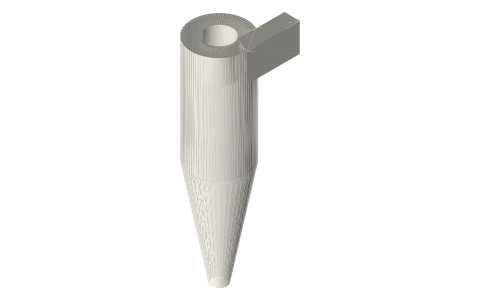
- Reference geometry from published ratios; no efficiency claim. A reverse-flow cyclone is sized by its barrel diameter D: every other dimension is a fixed ratio of D for a given family. Gas enters tangentially through a rectangular inlet, spirals down the barrel and cone, and leaves upward through the vortex finder; the separated dust leaves through the bottom outlet.
- Stairmand (1951) high-efficiency and Lapple (1951) conventional ratios as tabulated by Utikar et al. (2010, after Leith & Licht 1972), Grave et al. (2021, Stairmand only) and Cushman-Roisin (Dartmouth, after Cooper & Alley). Utikar et al. print the Lapple cylinder height as 1 D; the other tabulation prints 2 D with a 2 D cone and H = 4 D, which is what is used here.
- Files: D = 100 and 150 mm for both families. D, a, b, De, S, h, H and B are gas-side (inside) sizes; the wall is added outside them. The wall (2 mm, normal to the cone too) and the inlet duct run (1 D from the barrel centre plane, open end) are example parameters, not part of the published ratios. The vortex finder is a plain tube De inside, flush with the top of the roof; the inlet's outer wall is tangent to the barrel and its top is level with the roof.
- Material-neutral: the files are shapes. Wall thickness, joints and outlet connections are yours to choose.
Cyclone separator proportions: Stairmand high-efficiency and Lapple… size chart
| dimension | Stairmand HE | Lapple | Stairmand at D = 100 / 150 | Lapple at D = 100 / 150 |
|---|---|---|---|---|
| a: inlet height | 0.5 D | 0.5 D | 50 / 75 mm | 50 / 75 mm |
| b: inlet width | 0.2 D | 0.25 D | 20 / 30 mm | 25 / 37.5 mm |
| De: vortex finder (gas outlet) diameter | 0.5 D | 0.5 D | 50 / 75 mm | 50 / 75 mm |
| S: vortex finder length below the roof | 0.5 D | 0.625 D | 50 / 75 mm | 62.5 / 93.75 mm |
| h: cylinder (barrel) height | 1.5 D | 2 D | 150 / 225 mm | 200 / 300 mm |
| H: overall height, roof to dust outlet | 4 D | 4 D | 400 / 600 mm | 400 / 600 mm |
| B: dust outlet diameter | 0.375 D | 0.25 D | 37.5 / 56.25 mm | 25 / 37.5 mm |
| cone height (H − h) | 2.5 D | 2 D | 250 / 375 mm | 200 / 300 mm |
Where the files are
Other publishers' files are linked, not hosted. "verify" = check the license at the link before commercial use.
| InTech (open access) | Utikar et al., Hydrodynamic Simulation of Cyclone Separators, in Computational Fluid Dynamics (2010), Table 1 | web | Open access chapter; ratios are facts |
| EPJ Web of Conferences (open access) | Grave, Paulo, Petit, Irassar, Optimal design of cyclones in series ..., EPJ Web Conf. 249, 12003 (2021), Table 1 | web | CC BY 4.0; ratios are facts |
| Dartmouth College (ENGS 37 course notes) | B. Cushman-Roisin, Cyclones: standard cyclone dimensions (Stairmand 1951, Lapple 1951, Swift 1969) | web | Publisher's page; dimensions are facts |
Free files
★ Free files 4 parts. Generated by Xem Studio from the standard; threads are plain cylinders at major diameter. CC BY 4.0. index.json
| cyclone-stairmand-d100 | Stairmand high-efficiency proportions at D = 100 mm (inside): tangential rectangular inlet, vortex finder, cone to the dust outlet; example wall 2 mm, inlet duct run 1 D; reference geometry, no efficiency claim | STEP · STL |
| cyclone-stairmand-d150 | Stairmand high-efficiency proportions at D = 150 mm (inside): tangential rectangular inlet, vortex finder, cone to the dust outlet; example wall 2 mm, inlet duct run 1 D; reference geometry, no efficiency claim | STEP · STL |
| cyclone-lapple-d100 | Lapple conventional proportions at D = 100 mm (inside): tangential rectangular inlet, vortex finder, cone to the dust outlet; example wall 2 mm, inlet duct run 1 D; reference geometry, no efficiency claim | STEP · STL |
| cyclone-lapple-d150 | Lapple conventional proportions at D = 150 mm (inside): tangential rectangular inlet, vortex finder, cone to the dust outlet; example wall 2 mm, inlet duct run 1 D; reference geometry, no efficiency claim | STEP · STL |
https://xemstudio.com/mcp to Claude, ChatGPT, Cursor or any MCP client (free, no account, one minute) and it can look up exact sizes, mating fits and free STEP/STL from every chat.Plain text: sheet.txt · JSON: /api/geometry?object=cyclone-separator-proportions
Fits with

Questions
What are the Stairmand high-efficiency cyclone proportions?
Inlet 0.5 D high × 0.2 D wide, vortex finder 0.5 D diameter and 0.5 D long, barrel 1.5 D, overall 4 D, dust outlet 0.375 D.
How does the Lapple cyclone differ?
Wider inlet (0.25 D), longer vortex finder (0.625 D), taller barrel (2 D), smaller dust outlet (0.25 D); same 0.5 D inlet height, outlet and 4 D overall.