 Xem Studiomeasured geometry
Library › Electronics › Generators & alternators ·
Linear alternator module mover: Ø48 piston cup, 40-magnet carrier and tube rod, sprung on two leaves
What moves inside the clamp-in linear alternator module? · Hardware · basis: Design values; moving mass from the CAD volumes at 7.9 g/cm³ (metal parts, assumed) and 7.5 g/cm³ (magnets, published), each leaf adding its hub and a third of its arms
Long Earth Society build part. The moving part of my clamp-in linear alternator module. The engines
Exact dimensions. Every file is drawn at true size with no printing tolerance. The holes and pins that meet another part are listed below under Mating features, with the fit each joint needs; open those by your printer's or process's clearance before making the part. Mating features
- sizes
- 6 in table
Notes
- Three parts and the magnets: a piston cup whose Ø48.00 × 24 land is the clearance seal in the 42 mm bored spool; a Ø18 tube rod pressed into the cup's socket; a Ø47 × 56 magnet carrier pressed on the tube in the 3 in bored spool, with the 40 Ø12 × 3 disc magnets of the free-piston generator in four rows (S, N, N, S from face A), faces out.
- The tube rod carries the hubs of leaf 1 (between the two bored spools) and leaf 2 (between the 3 in spool and the 25.4 mm spool) on four Ø28 collars: the magnets sit between the two leaves, so the stator's side pull acts between its supports and the cup's land runs on the axis without touching.
- The carrier's body is the magnetic return between the magnet rows, so it must be magnetically soft; the cup and tube only have to be stiff. Moving mass of the standard build: 865 g (piston cup 184, magnet carrier 428, tube rod 86, magnets (40) 102, collars (4) 56, grub screws (4) 1, leaves 1, 2 (share) 7 g).
- The cup is open toward face B: its inside is part of the bounce space. Its crown has three M3 tapped holes for the add-on mass discs (tuning page). At mid-stroke the crown face is 9.00 mm inside face A: a depth gauge on the crown is the module's centring check.
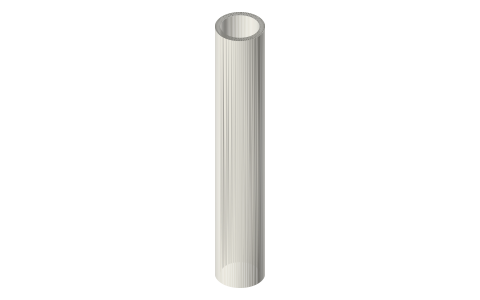
- The same mover serves both versions of the module. Only the tube rod differs: 108.15 long in the closed module (leaves 77.9 apart in the spool joints), 151.70 in the open frame (leaves 93.0 apart on the frame's seats).
Sizes
| part | size |
|---|---|
| la-piston-cup-48x24 | Ø48.00 × 24 land, crown 5 |
| la-magnet-carrier-47x56 | Ø47 × 56, 40 pockets Ø12 × 3 |
| la-tube-rod-18x14x108.15 | Ø18 / Ø14 × 108.15 (closed) |
| la-tube-rod-18x14x151.70 | Ø18 / Ø14 × 151.70 (open frame) |
| magnets | 40 × Ø12 × 3, rows S N N S at 14 pitch |
| moving mass | 865 g closed, 899 g open frame (standard build) |
Mating features
Drawn at the exact size. Open press, slide, run and socket features by your process's clearance; leave designed gaps and clamp fits as drawn.
| feature | exact | mates with | fit | files |
|---|---|---|---|---|
| land | Ø48.00 × 24 | 42 mm spool bore Ø48.00 (clearance seal) | run | la-piston-cup* |
| socket | Ø18 × 15 | tube rod end | press | la-piston-cup* |
| hub boss | Ø26 | mass disc bores | slide | la-piston-cup* |
| skirt bore | Ø42 | mass discs Ø41 (0.5 radial gap, no contact) | designed | la-piston-cup* |
| tapped holes | 3 × Ø2.5 × 4 on r 17 | M3 mass-disc screws (M3 tap drill) | designed | la-piston-cup* |
| OD | Ø47.0 | 3 in bored spool Ø48.00 (0.5 radial gap, no contact) | designed | la-magnet-carrier* |
| bore | Ø18 × 56 | tube rod | press | la-magnet-carrier* |
| magnet pockets | 40 × Ø12 × 3 radial | Ø12 × 3 disc magnets | press | la-magnet-carrier* |
| vents | 8 × Ø2.5 | gas passage (no contact) | designed | la-magnet-carrier* |
| OD | Ø18 | piston cup socket and carrier bore | press | la-tube-rod* |
| OD | Ø18 | leaf hubs and the four collars (M3 grubs) | slide | la-tube-rod* |
| bore | Ø14 | bounce gas (no contact) | designed | la-tube-rod* |
Where the files are
Other publishers' files are linked, not hosted. "verify" = check the license at the link before commercial use.
| K&J Magnetics | Neodymium magnet specifications: N42 Br 1.30–1.32 T, density 7.4–7.5 g/cm³ | web | maker page; values are facts verify |
| Xem Studio | tools/gen_la_module.py: the module's geometry, masses, bounce volume, natural frequencies and every number on these pages | code | CC BY 4.0 |
| Long Earth Society | Engine builds | web, video | LES site |
Free files
★ Free files 4 parts. Generated by Xem Studio from the standard; threads are plain cylinders at major diameter. CC BY 4.0. index.json
| la-piston-cup-48x24 | piston cup: land Ø48.00 × 24 (the clearance seal), crown 5 thick, skirt bore Ø42, hub boss Ø26 with the Ø18 tube-rod socket from 9 to the top, 3 × M3 tapped (Ø2.5 × 4) on r 17 for the mass discs | STEP · STL |
| la-magnet-carrier-47x56 | magnet carrier Ø47 × 56, Ø18 bore (pressed on the tube rod), 4 rows × 10 radial pockets Ø12 × 3 at z 7, 21, 35, 49 (pocket floor plane 19.7 from the axis), cavity r 12–15 vented by 4 × Ø3 through each end web | STEP · STL |
| la-tube-rod-18x14x108.15 | tube rod Ø18 / Ø14 × 108.15 (closed module): piston cup socket to the top of leaf 2's upper collar | STEP · STL |
| la-tube-rod-18x14x151.70 | tube rod Ø18 / Ø14 × 151.70 (open-frame module): piston cup socket to the top of leaf 2's upper collar | STEP · STL |
Plain text: sheet.txt · JSON: /api/geometry?object=linear-alternator-module-mover-2in
How it fits
In these build lists
Linear alternator module, 2 in, closed (sealed…One standard linear alternator that clamps in line on any 2 in sanitary device: …Linear alternator module, 2 in, open frame…The same linear alternator on an open frame: it clamps on the end of an unpressu…You might also need
Questions
Why a cup and a separate carrier?
The seal wants a short, light, true land right at the working face; the magnets want to sit under the stator between the two leaves. A tube rod joins them through leaf 1's hub.
Is it the same alternator as the free-piston generator's?
Yes: the same stator, coil, magnets and magnet spacing, so the same force constant; only the piston is new, with a leaf at each end of the magnets.