 Xem Studiomeasured geometry
Library › Stirling engines › Free-piston ·
Moving-magnet linear alternator kit (free-piston Stirling power take-off)
How does the linear alternator in a free-piston Stirling engine work and what parts does it need? · Hardware · basis: Moving-magnet linear alternator as in Sunpower / NASA convertors: magnet ring on the power piston oscillates through a stationary coil inside a back-iron; sizes here suit the Ø40 and Ø30 free-piston cores and the library's Ø10 × 3 magnets
Long Earth Society build part. Power take-off on the LES free-piston test bed. The engines · all LES parts
- sizes
- 6 in table
Notes
- Layout: the power piston carries a ring of magnets (poles alternating around the ring, all facing radially out); a stationary annular coil sits in a 1–1.5 mm gap outside it; a soft-iron ring (back iron) outside the coil closes the flux. Piston stroke S moves the magnet ring through the coil, inducing V ≈ N·B·l·v: turns × flux density × wire length in the field × piston velocity (v_peak = π·f·S).
- Numbers for the Ø40 kit: 12 × Ø10 × 3 N42 magnets, B ≈ 0.3 T in a 1.5 mm gap, 300 turns of 0.4 mm wire (≈ 4 Ω), stroke 10 mm at 15 Hz → v_peak 0.47 m/s → roughly 5–8 V peak open circuit and a watt or two into a matched load. Real convertors use laminated iron, Halbach-style magnet arrays and 50–100 Hz; this kit shows the principle and lights LEDs.
- The alternator is also the engine's load control: a free-piston engine without a load over-strokes and hits the stops, so the coil must always see a load (or a tuning capacitor + resistor). Phase the load for resonance: C = 1 / ((2πf)² L_coil) brings the current in phase with velocity.
- Parts: magnet carrier (print, PETG), coil bobbin (print, wind by hand), back-iron ring (mild-steel tube or a stack of washers; printed envelope here is for fit), Ø5 piston rod with E-clip grooves for the flexure hubs.
Sizes
| part | size_mm | note |
|---|---|---|
| magnet carrier Ø40 | ID 38, OD 47, 20 long | 12 × Ø10×3 radial |
| magnet carrier Ø30 | ID 28, OD 37 | 8 magnets |
| coil annulus | ID 50 / OD 70 / 12 | 300 t × 0.4 mm |
| coil annulus small | ID 40 / OD 58 / 12 | for Ø30 |
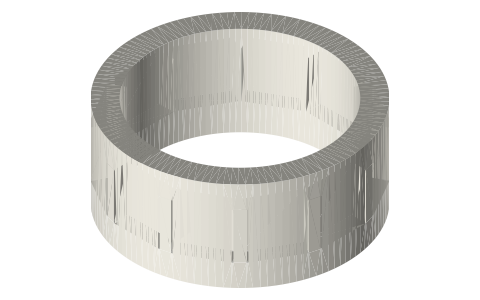
| back iron | ID 72 / OD 84 / 30 | steel ring |
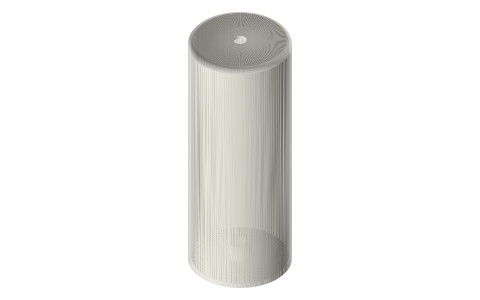
| piston rod | Ø5 × 120 | E-clip grooves |
Where the files are
Other publishers' files are linked, not hosted. "verify" = check the license at the link before commercial use.
| NASA (NTRS, public domain) | Linear alternator design for free-piston Stirling convertors (2005) | US Government work, public domain | |
| NASA (NTRS, public domain) | Sunpower/NASA 80 We free-piston Stirling convertor (2002) | US Government work, public domain | |
| Wikipedia | Linear alternator | web | CC BY-SA 4.0 (text) |
| Wikipedia | Free-piston engine | web | CC BY-SA 4.0 (text) |
| Long Earth Society | Engine builds | web, video | LES site |
Free files
★ Free files 7 parts. Generated by Xem Studio from the standard; threads are plain cylinders at major diameter. CC BY 4.0. index.json
| magnet-carrier-40-12x10x3 | moving-magnet carrier: Ø40 bore sleeve, 12 radially-magnetized Ø10 × 3 discs in pockets around the OD (alternate poles), 20 long | STEP · STL |
| magnet-carrier-30-8x10x3 | moving-magnet carrier Ø30 with 8 magnets | STEP · STL |
| coil-annulus-50-70-12 | stationary coil bobbin: ID 50, OD 70, 12 wide; ~300 turns 0.4 mm wire | STEP · STL |
| coil-annulus-40-58-12 | coil bobbin ID 40, OD 58, for the Ø30 carrier | STEP · STL |
| back-iron-ring-72-84 | back-iron envelope (laminated or mild-steel ring) ID 72, OD 84, 30 long | STEP · STL |
| back-iron-ring-60-72 | back-iron envelope ID 60, OD 72 | STEP · STL |
| piston-rod-5x120-grooved | Ø5 × 120 piston rod with two E-clip grooves for the flexure hubs | STEP · STL |
Plain text: sheet.txt · JSON: /api/geometry?object=linear-alternator-kit
Fits with
Questions
How does a free-piston Stirling generate electricity?
The power piston carries magnets that oscillate through a stationary coil: V = N·B·l·v. No crank, no rotation; the engine's resonance sets the frequency and the alternator's load sets the stroke.
What happens if a free-piston engine has no load?
The stroke grows until the piston hits the stops. Always connect the coil to a load or a tuned capacitor-resistor; the alternator is the throttle.
How much power from a small linear alternator?
The Ø40 kit at 10 mm stroke and 15 Hz with 12 N42 magnets gives roughly 1–2 W; power scales with stroke², frequency², flux and turns. NASA's 80 W convertors run at 80–100 Hz with laminated iron.