 Xem Studiomeasured geometry
Library › 3D printing › Print-in-place mechanisms ·
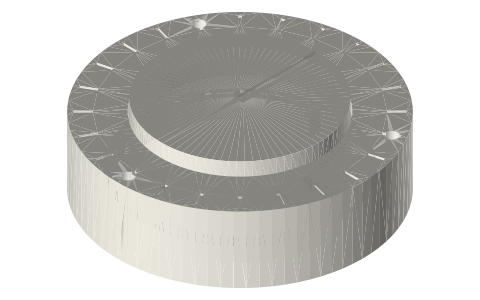
Print-in-place: rotary dial with 24 detents (compliant arms)
How do you 3D print a clicking rotary dial (detent knob) in one piece? · Hardware · basis: Xem Studio design: V-notch detents, compliant arms, 45° V-groove bearing; one designed running gap of 0.40 mm
Also called: print in place dial, detent knob 3d print, clicky rotary dial stl, print in place knob with clicks, compliant detent
Exact dimensions. True size, with no printing tolerance added.
- length
- 80.0 mm
- width
- 80.0 mm
- height
- 25.7 mm
Notes
- 3D print in place — prints already assembled, moving, in one job. Drawn at true size with no printer tolerance added; the 0.40 mm running gaps are part of the design.
- Running gap 0.40 mm per side, 0.80 mm on diameter — part of the design, drawn as is. On the 45° faces the same 0.40 mm is measured square to the face (0.57 mm along the axis).
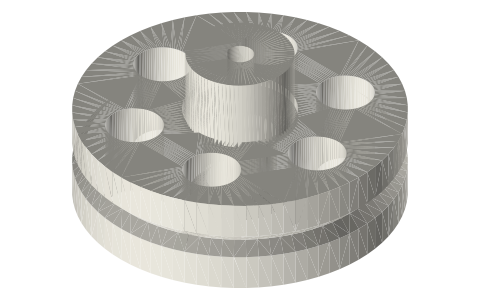
- Bed: flat. Frame ring and dial both on the bed; in the bottom 6 mm layer the frame bore has 24 V-notches and the dial two thin arms with 45° bumps sitting in opposite notches, 0.40 mm clear.
- Support while printing: over the arms the frame closes as a 45° cone (0.40 mm square to the bumps' top corners), then holds the dial's boss with a 45° V-ridge in a V-groove. Nothing overhangs more than 45°.
- Captured: the V-ridge in the boss's V-groove holds the dial up and down and centres it.
- Freeing it: hold the frame and turn the knob through a full turn each way.
- Motion: continuous rotation both ways with 24 detent positions (15° apart) marked on the frame top; between positions each arm bends 1.5 mm inward as its bump climbs out of a notch. At a detent the dial is free for ±1.05° (computed).
Print-in-place: rotary dial with 24 detents size chart
| key | value | what |
|---|---|---|
| gap_mm | 0.4 | running gap per side on every moving interface (radial, axial, under captured parts) — part of the design, not a tolerance |
| frame_od_mm | 80.0 | |
| detents | 24 | positions per turn, every 15° |
| notch_depth_mm | 1.5 | 45° V notches in the frame bore Ø60 |
| arms | 2 | flexible detent arms on the dial, 180° apart |
| arm_mm | 1.6 wide × 80° of arc | |
| arm_flex_mm | 1.5 | bump travel inward between positions |
| free_play_deg | 1.05 | rotation before a bump meets a notch flank, each way |
| knob_d_mm | 51.2 | dial boss / knob, pointer slot on top |
| axial_play_mm | 0.57 | |
| height_mm | 25.67 | as printed |
| index_marks | 24 | on the frame top |
| mount_holes | 3 × Ø3.4 | frame |
Where the files are
Other publishers' files are linked, not hosted. "verify" = check the license at the link before commercial use.
| Xem Studio | Print-in-place mechanism design (geometry computed in the generator) | web | Xem Studio design |
Free files
★ Free files 3 parts. Xem Studio design: free to use, print and sell things from; not to be republished as files. Xem Studio Design License. index.json
| print-in-place-detent-dial-assembly | The whole print as laid on the bed (2 bodies, already assembled); STEP keeps each moving body a separate solid | STEP · STL |
| print-in-place-detent-dial-frame | Frame ring Ø80 with 24 detent notches, index marks, 45° cone and V-ridge bearing, 3 × Ø3.4 | STEP · STL |
| print-in-place-detent-dial-dial | Dial with two flexible detent arms, boss with 45° V-groove, knob with pointer slot | STEP · STL |
https://xemstudio.com/mcp to Claude, ChatGPT, Cursor or any MCP client (free, no account, one minute) and it can look up exact sizes, mating fits and free STEP/STL from every chat.Plain text: sheet.txt · JSON: /api/geometry?object=print-in-place-detent-dial
Fits with
Questions
How does a print-in-place dial click?
Two thin arms on the dial carry 45° bumps that sit in 45° notches of the frame; turning it bends the arms inward until the bumps drop into the next notches.
How many positions?
24, every 15°; both arms engage at once (notches 180° apart).