 Xem Studiomeasured geometry
Library › 3D printing › Print-in-place mechanisms ·
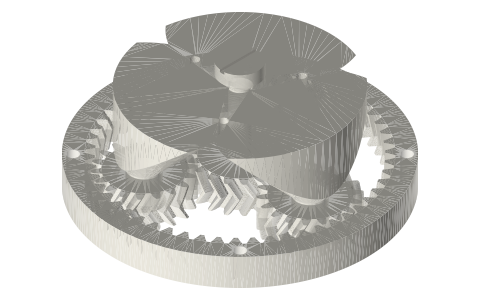
Print-in-place: planetary gearbox, herringbone, 4 : 1
How do you 3D print a planetary gearbox already assembled? · Hardware · basis: Xem Studio design; involute gearing per ISO 53 (20° basic rack), double helical 30°, normal module 1.5; one designed running gap of 0.40 mm
Also called: print in place planetary gearbox, print in place gears, herringbone planetary gear stl, 3d printed planetary gearbox, gear bearing print in place
Exact dimensions. True size, with no printing tolerance added.
- length
- 112.0 mm
- width
- 112.0 mm
- height
- 48.0 mm
Notes
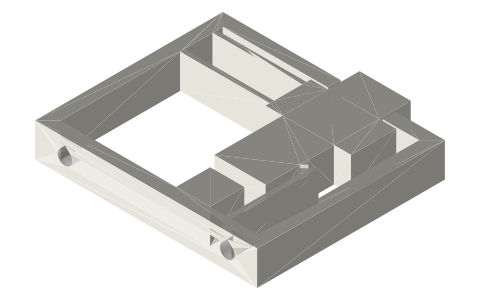
- 3D print in place — prints already assembled, moving, in one job. Drawn at true size with no printer tolerance added; the 0.40 mm running gaps are part of the design.
- Running gap 0.40 mm per side, 0.80 mm on diameter — part of the design, drawn as is. On the 45° faces the same 0.40 mm is measured square to the face (0.57 mm along the axis).
- Bed: sun, three planets, ring and carrier all stand on the bed: the gears on their bottom faces, the carrier on its three pins (each a 45° cone in a planet's counterbore). The carrier grows up from the pins as three 45° cones that merge into one three-lobed dome above the gears.
- Support while printing: herringbone flanks lean 28° (base helix) and the carrier's underside is all 45° cone, 0.40 mm clear of the planet tops and bores; the sun's knob flares out at 45° above the carrier. Nothing is flat over air.
- Captured: the herringbone (two opposed 30° helices) locks each planet axially between sun and ring; each planet's 45° counterbore holds the carrier's pin base below it; the carrier's cones close over the planets above. Nothing can come out.
- Freeing it: hold the ring and turn the sun knob slowly in both directions until it runs smoothly (a screwdriver fits the slot); the carrier follows at a quarter of the speed.
- Motion: continuous; ratio 4 : 1 (sun : carrier, ring fixed); planets spin 1× the sun-relative-to-carrier speed. Checked in the transverse section through a quarter turn of the sun: min gap 0.454 mm in the section (≥ 0.40 square to the flanks).
- Involute teeth: 20° normal pressure angle, addendum 1.0 m, dedendum 1.25 m (ring: tips at 0.88 m inside the pitch circle, the catalog ring's rule); every tooth thinned so the running gap is 0.40 mm square to the flanks at the exact centre distance.
Print-in-place: planetary gearbox, herringbone, 4 : 1 size chart
| key | value | what |
|---|---|---|
| gap_mm | 0.4 | running gap per side on every moving interface (radial, axial, under captured parts) — part of the design, not a tolerance |
| module_n_mm | 1.5 | normal module |
| helix_deg | 30.0 | herringbone (double helical), 20° normal pressure angle, ISO 53 basic rack |
| teeth_sun | 18 | |
| teeth_planet | 18 | three planets |
| teeth_ring | 54 | |
| face_w_mm | 12.0 | all gears |
| ratio | 4 : 1 | sun in, carrier out, ring fixed |
| center_distance_mm | 31.18 | sun to planet |
| flank_gap_mm | 0.4 | square to the tooth flanks: sun and planet teeth thinned 0.20 mm per flank (0.226 in the transverse section), ring spaces opened 0.238 (measured in the model: 0.401 sun–planet, 0.402 ring–planet) |
| pin_d_mm | 11.0 | carrier pins, 45° base cone Ø14 on the bed |
| bore_d_mm | 11.8 | planet bores, 45° counterbore below |
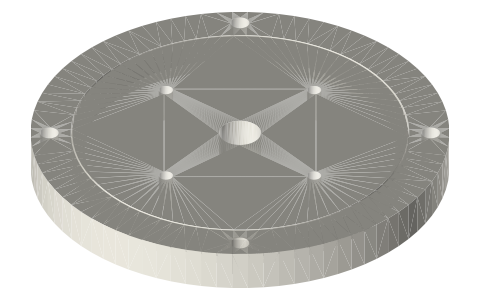
| ring_od_mm | 112 | 4 × Ø4.5 on Ø105 |
| height_mm | 48.0 | to the top of the sun knob |
| planet_axial_play_mm | 0.86 | herringbone end play (computed) |
| carrier_holes | 3 × Ø3.4 on Ø40 | output |
| sun_shaft_d_mm | 7.6 | runs in the carrier's Ø8.4 centre bore |
Where the files are
Other publishers' files are linked, not hosted. "verify" = check the license at the link before commercial use.
| Xem Studio | Print-in-place mechanism design (geometry computed in the generator) | web | Xem Studio design |
Free files
★ Free files 7 parts. Xem Studio design: free to use, print and sell things from; not to be republished as files. Xem Studio Design License. index.json
| print-in-place-planetary-gearbox-assembly | The whole print as laid on the bed (6 bodies, already assembled); STEP keeps each moving body a separate solid | STEP · STL |
| print-in-place-planetary-gearbox-ring | Ring gear 54 teeth, herringbone, Ø112 × 12, 4 × Ø4.5 | STEP · STL |
| print-in-place-planetary-gearbox-sun | Sun 18 teeth with shaft Ø7.6 and slotted knob | STEP · STL |
| print-in-place-planetary-gearbox-planet-1 | Planet 18 teeth, Ø11.8 bore with 45° counterbore | STEP · STL |
| print-in-place-planetary-gearbox-planet-2 | Planet 18 teeth, Ø11.8 bore with 45° counterbore | STEP · STL |
| print-in-place-planetary-gearbox-planet-3 | Planet 18 teeth, Ø11.8 bore with 45° counterbore | STEP · STL |
| print-in-place-planetary-gearbox-carrier | Carrier: three Ø11 pins on 45° bases, 45° cone dome, Ø8.4 centre bore, 3 × Ø3.4 | STEP · STL |
https://xemstudio.com/mcp to Claude, ChatGPT, Cursor or any MCP client (free, no account, one minute) and it can look up exact sizes, mating fits and free STEP/STL from every chat.Plain text: sheet.txt · JSON: /api/geometry?object=print-in-place-planetary-gearbox
Fits with
Questions
How are the gears kept from falling out?
Herringbone teeth: the two opposed helices of each planet interlock with the sun and the ring, so no gear can slide axially; the carrier hangs on the planets by its 45° pin bases.
What is the gear ratio?
4 : 1 — sun 18 teeth, ring 54: carrier turns once for every 4 turns of the sun.