 Xem Studiomeasured geometry
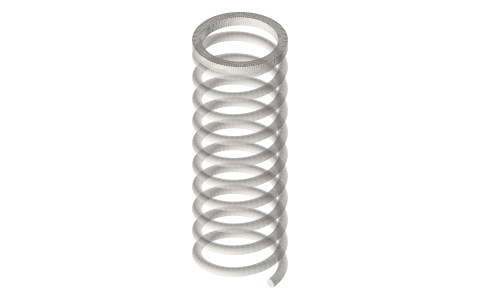
Compression, extension and torsion springs: sizes, rate formula, printed envelopes
How do I calculate the rate of a compression spring? · Hardware · basis: Music-wire (ASTM A228) spring design: k = G·d⁴ / (8·D³·n) with G = 79.3 GPa, D = mean diameter, n = active coils; envelopes in common hobby sizes
Long Earth Society build part. Pawl returns, diaphragm bias and belt tensioners on the LES rigs. The engines · all LES parts
- sizes
- 8 in table
Notes
- Rate k (N/mm) = G d⁴ / (8 D³ n): wire 1.0 mm, OD 10 (D = 9), 10 active coils → 79300 × 1 / (8 × 729 × 10) = 1.36 N/mm. Halve the coils, double the rate. Spring index D/d between 4 and 12 is makeable; 6–9 is comfortable.
- Compression: free length L, solid height ≈ (n + 2) × d, max deflection about 0.8 × (L − solid). Extension: same k, plus initial tension; hooks need D/2 of extra length each end. Torsion: rate in N·mm/deg = E d⁴ / (3667 D n) with E = 207 GPa.
- Printed TPU springs work for small forces (ratchet pawls, detents); PLA/PETG helices break. The files here are envelopes for fit and to check pocket clearance (pocket ID = OD + 0.5; guide rod = ID − 0.5).
- Where they go on the LES rigs: pawl return (torsion 0.8 × 8), diaphragm return and displacer-rod bias (compression 0.5 × 6 × 20), belt tensioner (extension 1.0 × 10 × 50).
Sizes
| type | wire_mm | od_mm | length_mm | coils | rate_n_per_mm | index_d_over_d |
|---|---|---|---|---|---|---|
| compression | 0.5 | 6 | 20 | 8 | 0.47 | 11.0 |
| compression | 0.8 | 8 | 25 | 10 | 1.09 | 9.0 |
| compression | 1.0 | 10 | 30 | 10 | 1.36 | 9.0 |
| compression | 1.2 | 12 | 40 | 12 | 1.36 | 9.0 |
| compression | 1.6 | 16 | 50 | 10 | 2.18 | 9.0 |
| extension | 0.6 | 6 | 30 | 20 | 0.41 | 9.0 |
| extension | 1.0 | 10 | 50 | 25 | 0.54 | 9.0 |
| torsion | 0.8 | 8 | 10 | 6 | — | 9.0 |
Where the files are
Other publishers' files are linked, not hosted. "verify" = check the license at the link before commercial use.
| Wikipedia | Spring (device) | web | CC BY-SA 4.0 (text) |
| McMaster-Carr | Compression springs (free STEP per part, for your own design use; no redistribution) | STEP, PDF | McMaster-Carr site terms verify |
| Lee Spring | Spring design formulas | web | Lee Spring site verify |
| Long Earth Society | Engine and rig builds | web, video | LES site |
Free files
★ Free files 8 parts. Generated by Xem Studio from the standard; threads are plain cylinders at major diameter. CC BY 4.0. index.json
| compression-d0.5-od6-l20 | compression spring envelope: wire 0.5, OD 6, 20 mm, 8 coils | STEP · STL |
| compression-d0.8-od8-l25 | compression spring envelope: wire 0.8, OD 8, 25 mm, 10 coils | STEP · STL |
| compression-d1-od10-l30 | compression spring envelope: wire 1.0, OD 10, 30 mm, 10 coils | STEP · STL |
| compression-d1.2-od12-l40 | compression spring envelope: wire 1.2, OD 12, 40 mm, 12 coils | STEP · STL |
| compression-d1.6-od16-l50 | compression spring envelope: wire 1.6, OD 16, 50 mm, 10 coils | STEP · STL |
| extension-d0.6-od6-l30 | extension spring envelope: wire 0.6, OD 6, 30 mm, 20 coils | STEP · STL |
| extension-d1-od10-l50 | extension spring envelope: wire 1.0, OD 10, 50 mm, 25 coils | STEP · STL |
| torsion-d0.8-od8-l10 | torsion spring envelope: wire 0.8, OD 8, 10 mm, 6 coils | STEP · STL |
Plain text: sheet.txt · JSON: /api/geometry?object=springs
Fits with
Questions
How do I calculate a compression spring rate?
k = G·d⁴ / (8·D³·n): shear modulus 79.3 GPa for music wire, d wire diameter, D mean coil diameter (OD − d), n active coils. 1 mm wire, 10 mm OD, 10 coils → 1.36 N/mm.
What is the solid height of a compression spring?
About (total coils) × wire diameter: a 10-coil, 1 mm wire spring with closed ends is 12 mm solid; usable travel is about 80% of free length minus solid height.
Can I 3D print springs?
Only in TPU for light duty (pawl returns, detents, compliant mechanisms); rigid filaments fatigue in a few cycles. Use the printed envelope to check the pocket, then buy the steel spring.