 Xem Studiomeasured geometry
Library › Hardware › Stirling & thermoacoustic ·
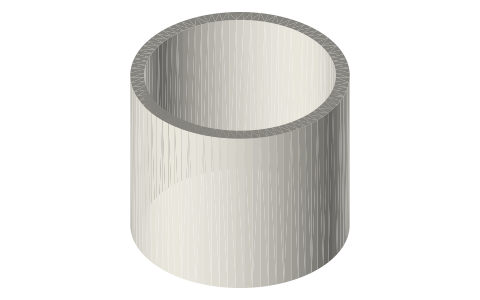
Annular regenerator screen stack, Ø48 / Ø42 × 40 (50 mesh × 0.22 mm wire)
How big should the regenerator screen stack be in a 2 in Stirling engine? · Hardware · basis: Porosity of stacked square-weave screens 1 − π m d / 4; friction and heat transfer from the Urieli & Berchowitz screen correlations
Long Earth Society build part. The regenerator of my performance engines. The engines
Exact dimensions. Every file is drawn at true size with no printing tolerance. The holes and pins that meet another part are listed below under Mating features, with the fit each joint needs; open those by your printer's or process's clearance before making the part. Mating features
- sizes
- 4 in table
Notes
- Annular screens punched Ø48.00 outside, Ø42.00 inside, stacked 40 mm deep on the liner's neck: about 91 screens of 50 mesh (per inch) × 0.22 mm wire, porosity 0.660, hydraulic diameter 0.43 mm.
- Gas volume in the stack 11.2 mL. In the cycle model its effectiveness is 0.966 on charged air at 600 rpm and 0.980 on helium at 1200 rpm.
- Finer screens raise the effectiveness and the pumping loss together; I swept 0.10 to 0.30 mm wire and 0.22 mm was the best shaft power on air and on helium.
Sizes
| item | value |
|---|---|
| envelope | Ø48.00 / Ø42.00 × 40 |
| screen | 50 mesh × 0.22 wire |
| count | ≈ 91 |
| porosity | 0.66 |
Mating features
Drawn at the exact size. Open press, slide, run and socket features by your process's clearance; leave designed gaps and clamp fits as drawn.
| feature | exact | mates with | fit | files |
|---|---|---|---|---|
| outside | Ø48.00 | hot-spool finished bore | slide | all |
| inside | Ø42.00 | liner neck | slide | all |
Where the files are
Other publishers' files are linked, not hosted. "verify" = check the license at the link before commercial use.
| Ohio University (I. Urieli) | Stirling cycle machine analysis (after Urieli & Berchowitz, Stirling Cycle Engine Analysis, 1984): Schmidt and simple analyses, wire-screen regenerator friction fr = 54 + 1.43 Re^0.78 and St = 0.46 Re^−0.4 / Pr | web | university course pages verify |
| NASA (W. R. Martini) | Stirling Engine Design Manual, 2nd edition, NASA CR-168088 (1983): decoupled second-order losses (shuttle, conduction, flow friction, regenerator) | US government report | |
| Cambridge University Press (J. R. Senft) | Mechanical Efficiency of Heat Engines (2007): shaft work = E·W − (1/E − E)·W_forced | book | book; formula cited verify |
| Long Earth Society | Engine builds | web, video | LES site |
Free files
★ Free files 1 parts. Generated by Xem Studio from the standard; threads are plain cylinders at major diameter. CC BY 4.0. index.json
| screen-stack-48x42x40-50mesh | regenerator screen stack envelope Ø48.00 / Ø42.00 × 40: about 91 annular screens, 50 mesh × 0.22 wire (porosity 0.66) | STEP · STL |
Plain text: sheet.txt · JSON: /api/geometry?object=stirling-annular-screen-stack
How it fits
In these build lists
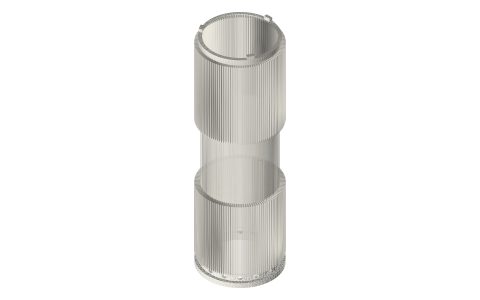
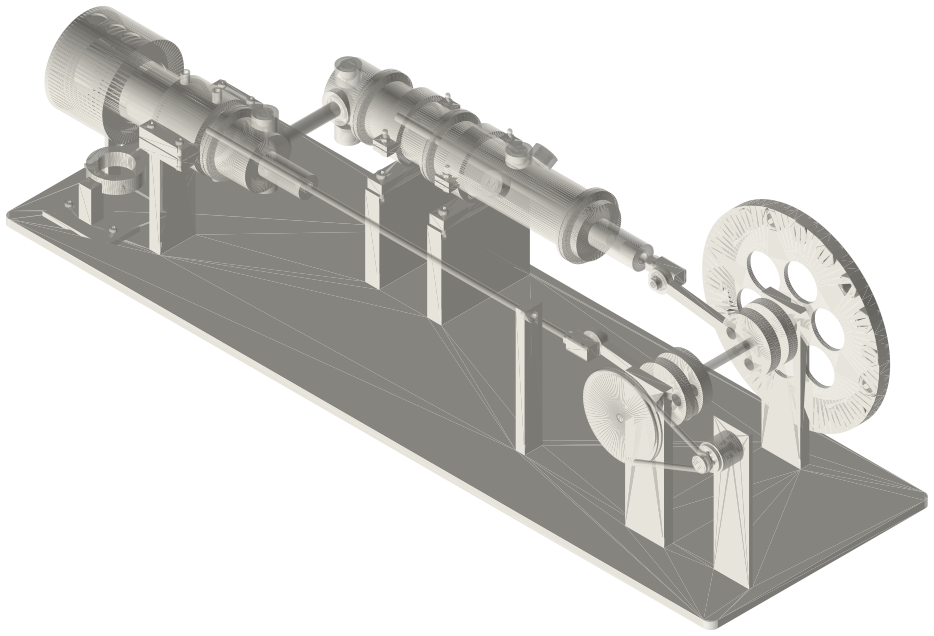
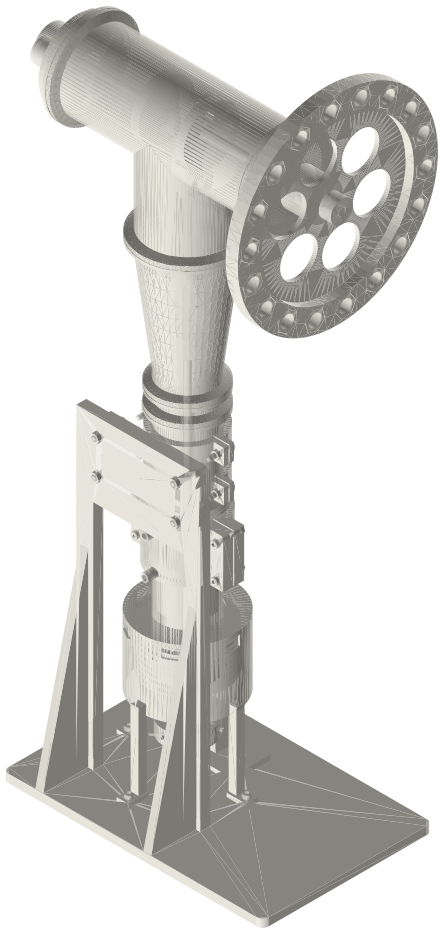
Tri-clamp horizontal gamma generator, 2 in,…The classic desk Stirling generator in tri-clamp, built for power: a horizontal …Tri-clamp walking-beam gamma generator, 2 in,…The classic desk walking-beam Stirling in tri-clamp: a standard 2 in tee with th…Tri-clamp charged beta, 2 inA standing beta that holds a charge: the same hot spool, liner, regenerator and …Tri-clamp twin walking-beam gamma generator, 2…Two walking-beam tee units side by side on one crank, a quarter turn apart: each…You might also need
Questions
Can I use a different screen?
Yes; keep the stack length and the porosity near 0.66 and re-run the numbers.