 Xem Studiomeasured geometry
Library › Stirling engines › Thermoacoustic & fluidyne ·
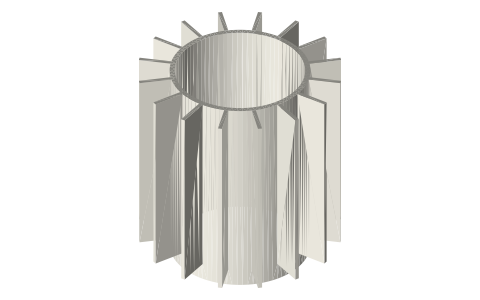
Thermoacoustic hot-end fin sleeve: radial fins that slide over a 2 in closed-end cup
How do I put fins on the hot end of a tri-clamp thermoacoustic engine? · Hardware · basis: ASME BPE 2 in tube OD Ø50.8 (the sleeve's bore); fin count, thickness and reach are design values; M4 set screws ISO 4026
Long Earth Society build part. The optional fins on my propane standing-wave engines' hot end. The engines
Exact dimensions. Every file is drawn at true size with no printing tolerance. The holes and pins that meet another part are listed below under Mating features, with the fit each joint needs; open those by your printer's or process's clearance before making the part. Mating features
- sizes
- 6 in table
Notes
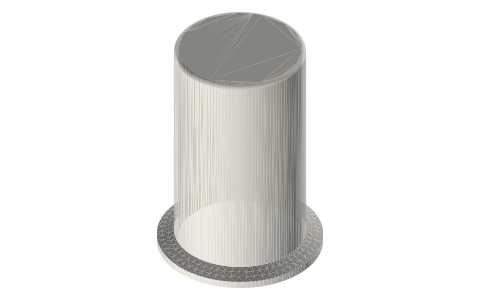
- A separate, optional heat exchanger for the closed hot end of the standing-wave engines: a sleeve whose bore is exactly the tube's Ø50.8 slides over the closed end of the plain cup-2in-133.35 (a standard closed-end 2 in spool, 133.35 mm), and 16 radial fins carry the torch's heat into the hot cavity and the hot exchanger. Three M4 set screws in a band above the fins hold it.
- It covers 49 to 131.85 mm from the cup's face, so it stays clear of the water jacket and the clamp; the fins reach Ø80, as far from the tube as the Ø76 fins the hot end used to carry built on.
- Without it the flame heats the bare cup: the engine is complete and still runs, but needs more heat to start. The cup stays a plain part a sanitary fabricator makes; the sleeve can be made any way you like.
- Fits: the bore slides on the tube OD (slide fit), the set screws clamp it.
Sizes
| feature | value |
|---|---|
| bore | Ø50.8 (tube OD) |
| length | 82.85 |
| wall | 2.0 |
| fins | 16 × 1.6 thick, to Ø80 |
| set screws | 3 × M4, 0 / 120 / 240° |
| fits | cup-2in-133.35 |
Mating features
Drawn at the exact size. Open press, slide, run and socket features by your process's clearance; leave designed gaps and clamp fits as drawn.
| feature | exact | mates with | fit | files |
|---|---|---|---|---|
| bore | Ø50.8 = the 2 in tube OD | cup-2in-133.35 tube OD (over its closed end) | slide | all |
| set-screw holes | 3 × Ø3.3 at 0 / 120 / 240° | M4 tap drill; M4 × 4 set screws onto the tube OD | clamp | all |
| fins | 16 × 1.6 to Ø80, 56–131.85 from the cup face | torch flame (no contact) | designed | all |
Where the files are
Other publishers' files are linked, not hosted. "verify" = check the license at the link before commercial use.
| G. W. Swift (LANL / Acoustical Society of America) | Thermoacoustics: A Unifying Perspective for Some Engines and Refrigerators (Rott's equations, screen relations, DeltaEC) | web, software | LANL verify |
| Long Earth Society | Engine builds | web, video | LES site |
Free files
★ Free files 1 parts. Generated by Xem Studio from the standard; threads are plain cylinders at major diameter. CC BY 4.0. index.json
| ta-fin-sleeve-2in-16x80 | radial-fin sleeve for the 2 in tube: bore Ø50.8 (the tube OD) × 82.85, 2 mm wall, 16 radial fins 1.6 thick to Ø80 over the last 75.85, 7 mm band with 3 × M4 tapped (Ø3.3) at 0 / 120 / 240°; drawn in the cup's frame (49 to 131.85 from its face) | STEP · STL |
Plain text: sheet.txt · JSON: /api/geometry?object=thermoacoustic-hot-fin-sleeve
How it fits
In these build lists
Thermoacoustic standing-wave engine,…A propane-fired standing-wave thermoacoustic engine in 2 in tri-clamp: a plain c…Thermoacoustic standing-wave engine, half-wave,…The propane standing-wave engine as a half-wave: closed at both ends, the top cl…You might also need
Questions
Do I need it?
No. It is an optional heat exchanger; without it the engine needs more heat at the cup to start.
Why not fins on the cup itself?
Sanitary fabricators make plain spools and closed-end cups; fins built onto one are not something they make. A separate sleeve keeps the cup standard.