 Xem Studiomeasured geometry
Library › Stirling engines › Thermoacoustic & fluidyne ·
Thermoacoustic slotted exchanger insert: 2 in bore, 14 and 12 mm
How do I make a heat exchanger inside a 2 inch tri-clamp tube? · Hardware · basis: Bore Ø47.5 (ASME BPE 2 in); slot width and depth from the thermal penetration depth in the network model (tools/gen_ta_power.py)
Used in Long Earth Society builds. Custom high-temperature thermoacoustic engine (final design)
Exact dimensions. Every file is drawn at true size with no printing tolerance. The holes and pins that meet another part are listed below under Mating features, with the fit each joint needs; open those by your printer's or process's clearance before making the part. Mating features
- sizes
- 2 in table
Notes
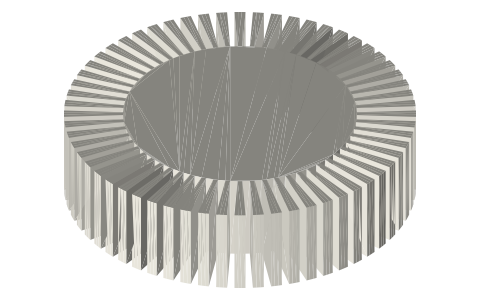
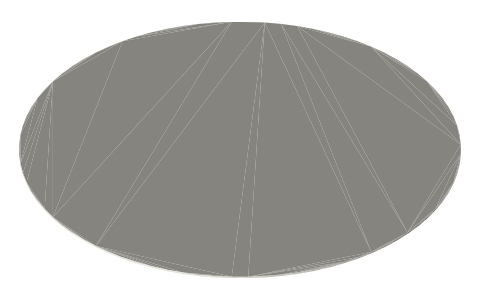
- A plug at the bore diameter with 60 radial slots 1 wide and 8 deep cut along its whole length. Gas passes through the slots; heat passes between the gas and the tube wall through the 60 fins left between them, each only 8 mm from the wall. The centre Ø31.5 is solid.
- Slot hydraulic radius 0.44 mm; open area 27 % of the bore. In 20 bar helium at the generators' 25 Hz the thermal penetration depth is about 0.34 mm at 27 °C and 0.81 mm at 550 °C, so the gas in a slot is in good thermal contact.
- 14 mm: the ambient exchangers, under the clamp-on water jacket (same length). 12 mm: the hot exchanger, under the fin sleeve and burner drum. The insert is pressed into the tube so the fins conduct into the wall (fit class press).
- The exchanger works on the tube wall's temperature: the jacket, fin sleeve and drum outside are optional parts that set that temperature.
Sizes
| file | length_mm | slots | slot_mm | depth_mm | open_area_pct |
|---|---|---|---|---|---|
| hx-insert-2in-14 | 14.0 | 60 | 1.0 | 8.0 | 27.1 |
| hx-insert-2in-12 | 12.0 | 60 | 1.0 | 8.0 | 27.1 |
Mating features
Drawn at the exact size. Open press, slide, run and socket features by your process's clearance; leave designed gaps and clamp fits as drawn.
| feature | exact | mates with | fit | files |
|---|---|---|---|---|
| outside | Ø47.5 | 2 in spool bore: the fins conduct into the wall | press | all |
| slots | 60 × 1.0 wide × 8 deep, full length | gas passage (no contact) | designed | all |
| end faces | flat Ø47.5 | 8.4 spacer, screen stack, buffer-tube liner | designed | all |
Where the files are
Other publishers' files are linked, not hosted. "verify" = check the license at the link before commercial use.
| G. W. Swift (Acoustical Society of America / LANL) | Thermoacoustics: A Unifying Perspective for Some Engines and Refrigerators (Rott's equations, the energy equation, screen relations; the method behind DeltaEC) | web, book | cited verify |
| Xem Studio | tools/gen_ta_power.py: the network model and every dimension on this page | code | CC BY 4.0 |
| Long Earth Society | Engine builds | web, video | LES site |
Free files
★ Free files 2 parts. Generated by Xem Studio from the standard; threads are plain cylinders at major diameter. CC BY 4.0. index.json
| hx-insert-2in-14 | Ø47.5 × 14 plug with 60 radial slots 1 wide, 8 deep from the surface (to Ø31.5), solid centre: ambient exchanger | STEP · STL |
| hx-insert-2in-12 | Ø47.5 × 12 plug with 60 radial slots 1 wide, 8 deep from the surface (to Ø31.5), solid centre: hot exchanger | STEP · STL |
Plain text: sheet.txt · JSON: /api/geometry?object=thermoacoustic-slotted-exchanger-insert
How it fits
In these build lists
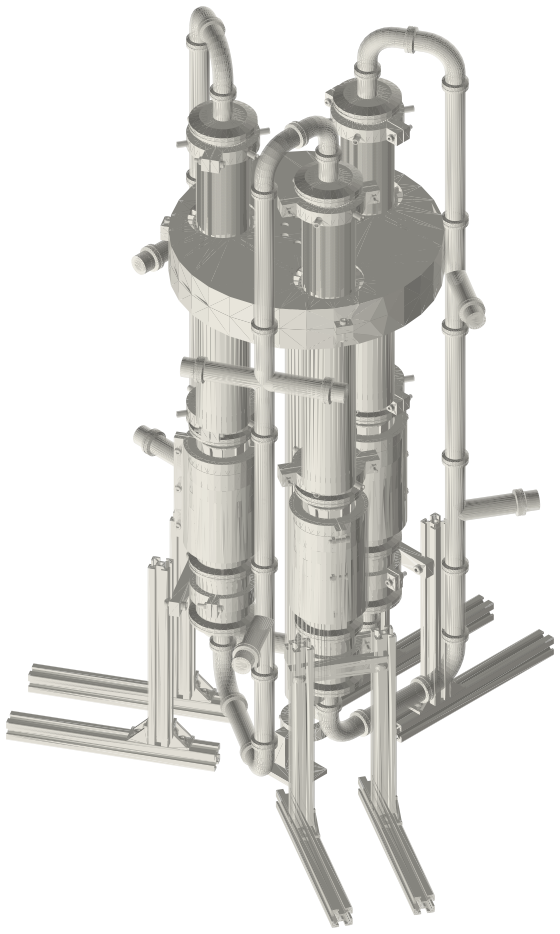
Thermoacoustic-Stirling ring generator, three 2…A double-acting thermoacoustic-Stirling generator in 2 in tri-clamp: three cores…Thermoacoustic-Stirling engine with twin…Backhaus & Swift's thermoacoustic-Stirling torus in 2 in tri-clamp with two oppo…You might also need
Questions
Why slots instead of plates?
Every fin is joined to the wall it takes heat from, and a slotting cutter or wire makes them all the same.
Why a solid centre?
The centre is farthest from the wall; gas there would not exchange heat in one pass.