 Xem Studiomeasured geometry
Library › Stirling engines › Tri-clamp engine parts ·
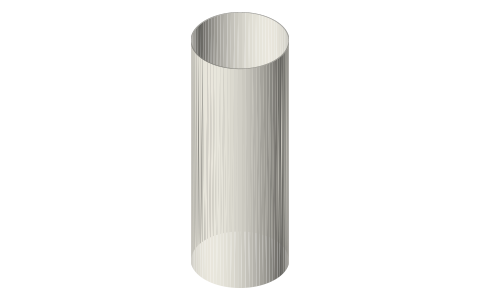
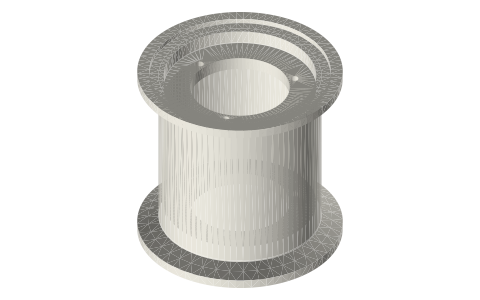
Free-piston mover for a 2 in honed spool: piston and alternator magnets in one, Ø48.00 × 130
How do I make a free piston that is also the alternator's moving magnet? · Hardware · basis: Ø48.00 to the honed spool; magnet rows and pitch from the alternator design in tools/gen_ta_power.py
Used in Long Earth Society builds. Thermoacoustic engine spool (aluminum)
Exact dimensions. Every file is drawn at true size with no printing tolerance. The holes and pins that meet another part are listed below under Mating features, with the fit each joint needs; open those by your printer's or process's clearance before making the part. Mating features
- sizes
- 6 in table
Notes
- The piston and the alternator's moving part are one: a 12-sided core carries 4 rows of 12 block magnets (30 × 10 × 4, magnetised through 4), rows alternately N and S outward at 32 mm pitch, and a sleeve Ø48.00 / Ø47 slides over them and runs in the honed bore. The core is the magnets' return path, so it has to carry magnetic flux; what it and the sleeve are made of is the builder's choice within that.
- The crown is closed; an M4 threaded rod screws into it from inside the Ø20 bore and carries the two flexure stacks below. Moving mass with the magnets, rod and hub parts: about 1.39 kg (core and sleeve counted at 7.8 g/cm³, magnets at 7.5).
- Design stroke ±8 mm: the 30 mm magnet rows stay fully over their 14 mm coils that far.
- Fits: sleeve OD is the clearance seal in the honed bore (run); the sleeve's bore slides over the core's flanges (press); the magnets sit on the flats (bonded, designed).
Sizes
| feature | value |
|---|---|
| length | 130 |
| sleeve | Ø48.00 / Ø47 |
| magnets | 4 × 12 blocks 30 × 10 × 4 |
| row pitch | 32 |
| moving mass | ≈ 1.39 kg |
| design stroke | ±8 |
Mating features
Drawn at the exact size. Open press, slide, run and socket features by your process's clearance; leave designed gaps and clamp fits as drawn.
| feature | exact | mates with | fit | files |
|---|---|---|---|---|
| sleeve outside | Ø48.00 × 130 | honed spool bore Ø48.00: clearance seal | run | mover-sleeve-* |
| sleeve bore | Ø47.00 | mover core end flanges Ø47.00 | press | all |
| flats | 12 × 10 wide on r 18.66, 4 rows of 30 at 32 pitch | block magnets 30 × 10 × 4 (bonded) | designed | mover-core-* |
| crown hole | Ø3.3 × 6 (M4 tap drill) from the Ø20 bore | M4 threaded rod | designed | mover-core-* |
| core bore | Ø20 from the bottom face to the crown | M4 rod (no contact) | designed | mover-core-* |
Where the files are
Other publishers' files are linked, not hosted. "verify" = check the license at the link before commercial use.
| Appl. Phys. Lett. (S. Backhaus, E. Tward, M. Petach) | Traveling-wave thermoacoustic electric generator, APL 85, 1085 (2004): a thermoacoustic-Stirling engine driving linear alternators, 18 % heat to electricity | web | journal article; cited verify |
| Applied Energy (Z. Wu, G. Yu, L. Zhang, W. Dai, E. Luo) | Development of a 3 kW double-acting thermoacoustic Stirling electric generator, 136, 866-872 (2014): three engines and three linear alternators in a loop, 5 MPa helium, 86 Hz, 1.57 kW electric, 16.8 % | web | journal article; cited verify |
| Xem Studio | tools/gen_ta_power.py: the network model and every dimension on this page | code | CC BY 4.0 |
| Long Earth Society | Engine builds | web, video | LES site |
Free files
★ Free files 2 parts. Generated by Xem Studio from the standard; threads are plain cylinders at major diameter. CC BY 4.0. index.json
| mover-core-2in-130 | mover core, 130 long: 12-sided body (flats r 18.66) between Ø47 × 2 end flanges, Ø20 bore from the bottom to an 8 mm crown, M4 tap drill Ø3.3 × 6 in the crown | STEP · STL |
| mover-sleeve-48x130 | mover sleeve Ø48.00 / Ø47 × 130: the running surface | STEP · STL |
Plain text: sheet.txt · JSON: /api/geometry?object=free-piston-mover-2in
How it fits
In these build lists
Thermoacoustic-Stirling ring generator, three 2…A double-acting thermoacoustic-Stirling generator in 2 in tri-clamp: three cores…Thermoacoustic-Stirling engine with twin…Backhaus & Swift's thermoacoustic-Stirling torus in 2 in tri-clamp with two oppo…You might also need
Questions
Where is the rod?
Inside: it screws into the crown from the bore and leaves through the bottom to the flexures. Nothing crosses the pressure wall.
Why a sleeve?
The magnets cannot be the running surface; the sleeve is, finished to the clearance-seal fit.